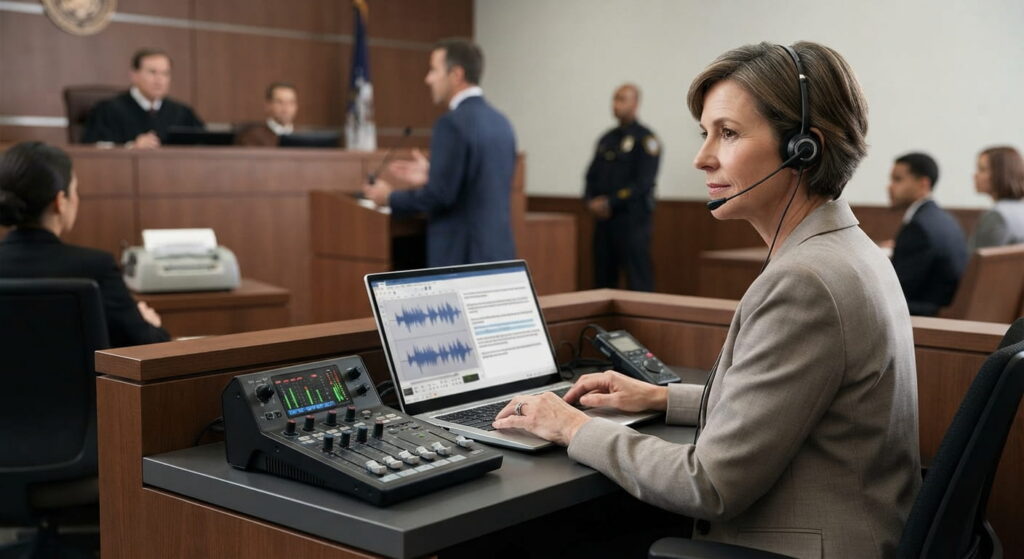


Court administrators, judicial officers, legal operations directors, and court reporting agency managers.
Table of contents
- Introduction
- Court Transcription Requires Institutional Awareness
- Technology Must Adapt to Local Court Realities
- The Importance of Multilingual Court Transcription
- Scalable Transcription Technology to Address Court Backlogs
- How Transcript Requirements Vary Across Jurisdictions
- How AI in Courts Complements, Not Replaces Professionals
- The Transcription Solutions that Digital Courts Require
- Key Takeaways on Court Transcription
- FAQs on Court Transcription
Key Takeaways
Judicial modernization requires transcription technology that respects local institutional frameworks, adapts to multilingual environments, and preserves human oversight. This resource highlights key lessons from global court authorities on integrating scalable artificial intelligence into existing legal systems.
AT A GLANCE
- Effective court technology must adapt to diverse language needs, dialects, and regional legal terminologies.
- Automated systems work best when they complement professional expertise rather than replace human reviewers.
- Modern infrastructure supports judicial independence while effectively reducing severe administrative backlogs.
WHO SHOULD READ THIS
Estimated Reading Time
7 min read
Introduction: What Courts Need from Transcription Technology
Although Verbit has supported law firms, court reporting agencies and legal service providers for years, attending the International Association for Court Administration – IACA – Conference in Dubai marked our first opportunity to engage directly with court administrators from around the world.
We arrived with deep experience in legal transcription. We left with a clearer understanding of judicial modernization – and a stronger appreciation for how courts evaluate transcription technology within the broader justice system.
Over three days, we spoke with chief administrators, judges, technologists and policy leaders representing courts across multiple continents. While their systems differ significantly, the operational pressures were strikingly similar: reducing court backlog, managing multilingual proceedings, scaling digital courts, improving access to justice and modernizing responsibly.
Again and again, one core question emerged: Can transcription technology adapt to courts — not the other way around?
Read below for key takeaways from Eliran Noy and Rachel Klagsbrun who attended this year’s IACA conference in Dubai.
1. Court Transcription in Judicial Systems Requires Institutional Awareness, Not Just Technical Accuracy
In the private legal sector, transcription often revolves around precision, formatting standards and certified outputs. Courts operate within a far broader institutional ecosystem.
Court administrators must consider:
- Governance and judicial independence
- Case backlog reduction
- Language access compliance
- Data security and privacy
- Staffing models and resource allocation
- Integration with existing courtroom technology
Transcription in courts is not a standalone service. It is one component of a complex judicial infrastructure.
Modernization is never “just a technology project.” Implementation affects workflow continuity, public trust and procedural fairness. Courts cannot afford disruption that compromises stability. Any effective court transcription technology must account for this institutional complexity.

2. Judicial Modernization Succeeds When Technology Adapts to Local Court Realities
Court systems are modernizing at different speeds and under different constraints. Some are fully digital courts. Others are transitioning from stenographers to digital recording and AI-assisted transcription. Many operate hybrid models.
Across jurisdictions, one lesson was clear: Technology must adapt to local judicial realities. Infrastructure varies. Funding levels differ. Language diversity is often significant. Reform is frequently incremental by necessity.
We heard about courts implementing:
- Remote hearing expansion
- Data-driven court administration
- Incremental digital transformation strategies
- Human-centered reform models
Judicial modernization works best when technology strengthens existing workflows while enabling gradual improvement – not sudden overhaul.
3. Multilingual Court Transcription Is Foundational to Language Access and Fairness
Language diversity is not a peripheral issue. It is central to court operations. Many judicial systems must capture proceedings across multiple official languages, regional dialects or code-switching environments. In these contexts, transcription must go beyond basic speech recognition.
Effective multilingual court transcription requires:
- Accurate legal terminology recognition
- Proper handling of names and jurisdiction-specific references
- Speaker differentiation
- Dialect and accent resilience
- Support for translation workflows
Language access is tied directly to fairness and due process. Courts increasingly require transcription technology that is resilient across languages while remaining scalable and practical.
4. Scalable Transcription Technology Can Help Courts Address Backlog and Volume Pressures
For many judicial systems, the primary challenge is scale. Some court systems operate hundreds of courtrooms generating hours of proceedings daily. Others are expanding remote hearings, increasing recording output dramatically. Transcription must scale without creating additional administrative burden.
Court leaders repeatedly asked:
- Can transcription handle our caseload?
- Can it integrate with existing courtroom recording systems?
- Can it reduce backlog rather than add review time?
- Can it function within current staffing constraints?
Many courts rely on built-in transcription within remote platforms such as Microsoft Teams or Webex. These tools offer convenience but often lack advanced legal vocabulary models, structured formatting capabilities and robust multilingual depth. Scalable court transcription technology must enhance efficiency while preserving operational stability.
5. In Court Environments, Practicality Often Matters as Much as Certified Transcript Precision
One of the most revealing insights from IACA was that transcript requirements vary widely across jurisdictions. Not all courts require certified transcripts for every proceeding. Some prioritize speed and searchability. Others require high-precision outputs only for specific case types.
Court transcription expectations are shaped by:
- Accuracy requirements
- Turnaround time pressures
- Budget constraints
- Staff availability
- Case type distinctions
Unlike rigid private-sector standards, courts frequently balance precision with practicality.
Judicial systems often seek technology that is:
- Fast
- Scalable
- Transparent
- Configurable
- Easy to implement
- Compatible with existing systems
Functionality and adaptability can be just as important as formatting perfection.
6. AI in Courts Works Best When It Rebalances Workflows, Not Replaces Professionals
Automation in the courtroom is not viewed as replacement. It is viewed as rebalancing. AI in courts must support human judgment, not override it.
Advanced speech recognition, text-audio alignment and structured review workflows can manage high-volume transcription tasks. Human reviewers, clerks and court professionals then focus on contextual nuance, judicial accuracy and final validation. This hybrid model – AI-powered transcription combined with human oversight – reflects how many courts are approaching modernization.
It allows courts to:
- Improve operational efficiency
- Reduce backlog
- Maintain institutional integrity
- Preserve judicial independence
7. Digital Courts Require Transcription Solutions That Work Across All Stages of Modernization
A visit to Dubai Courts offered an example of a highly modernized judicial system with integrated digital infrastructure and sustained technology investment. At the same time, many courts globally operate within more constrained financial or structural environments.
This contrast reinforced an important takeaway: Court transcription technology must function across a wide modernization spectrum.
From advanced digital courts to jurisdictions beginning their transformation, flexible and cloud-based solutions are best positioned to scale appropriately — provided they integrate thoughtfully into existing systems.
Our Key Takeaways on Court Transcription and Judicial Modernization
Attending IACA in Dubai provided valuable perspective on how courts evaluate transcription technology within the broader justice system.
Three themes stood out:
1. Adaptability matters more than disruption.
Courts prioritize solutions that integrate into established workflows and respect institutional complexity.
2. Multilingual scalability is essential.
Language diversity and increasing case volume make resilient transcription systems foundational.
3. Automation must complement professional expertise.
Technology is most effective when it reduces repetitive workload while preserving human review and oversight.
The modernization of courts is deliberate, contextual and ongoing. Transcription technology plays a meaningful role when it strengthens – rather than reshapes – the systems that support access to justice. Listening first remains essential. Courts operate within layers of legal, cultural and administrative nuance. Any technology entering that environment must meet them where they are.
Contributors
Rachel Klagsbrun, Product Manager – Legal
Rachel is part of the product management team leading Verbit’s offerings to the legal vertical — court reporting agencies, law firms and courts. She brings a varied 20-year background in the legal field, extending from legal practice through academia to legal technology.
Eliran Noy, Sales Operations Manager & Head of SDRs
Eliran leads Verbit’s Business Development team, focusing on AI-driven speech recognition and accessibility solutions for courts, administrative bodies and public institutions.
FAQs on Court Transcription
Q: What is the difference between court transcription and legal transcription?
A: Court transcription focuses on official proceedings in judicial settings, requiring scalability, multilingual support, and integration with courtroom systems. Legal transcription for law firms or agencies is often more document- and format-focused. Learn how our courtroom transcription solutions support courts efficiently.
Q: How can AI-powered transcription help reduce court backlogs?
A: AI transcription automates the repetitive aspects of producing transcripts, allowing human staff to focus on review and quality assurance. Scalable real-time legal transcription tools can help courts manage high-volume proceedings and reduce backlog without compromising accuracy.
Q: Can court transcription technology handle multiple languages and dialects?
A: Yes. Modern systems use advanced speech recognition (ASR) to accurately capture multiple languages, regional accents, and legal terminology. Verbit’s multilingual ASR technology ensures transcripts are precise and adaptable for diverse judicial environments.
Discover Verbit’s Legal Transcription Tech for Courts
Explore our courtroom transcription technology and how solutions like Legal Capture can be used to streamline your workflow.