

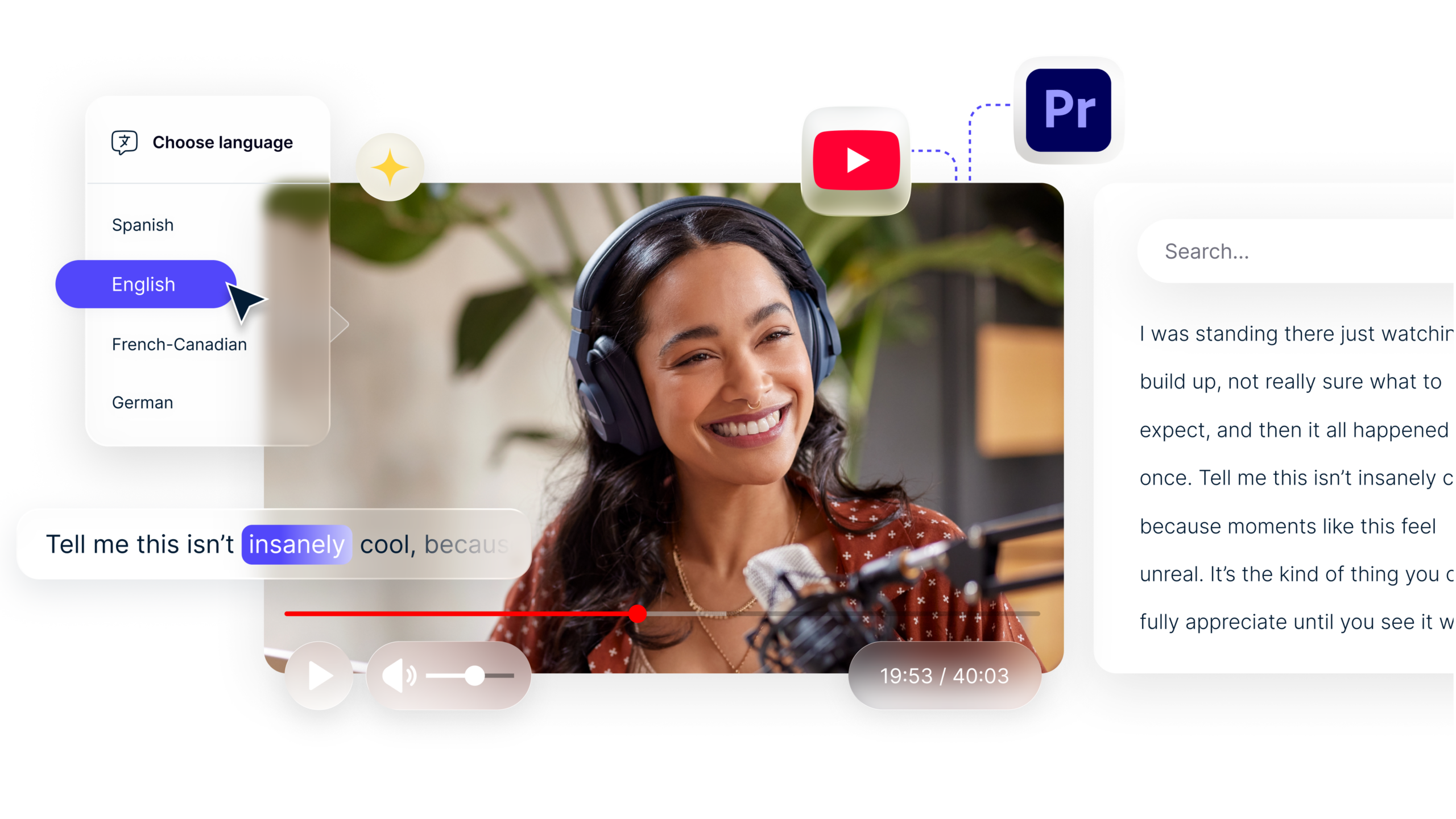
Key Takeaways from this Localization eBook
Localization in 2026 is both a revenue and growth engine. The most successful organizations are those that don’t stop after creating and distributing content in its original language. Those that strategically focus on repurposing existing content for new markets in languages where digital audiences are expanding rapidly will win in audience engagement and revenue in 2026. Key insights from this comprehensive localization guide for 2026 include:
- 65% of audiences prefer to consume content in their native language.
- Target high-growth languages like Hindi, Arabic, Portuguese, French, Bengali, Urdu, Indonesian, and Mandarin to unlock new audience segments and revenue streams.
- Localized video content will drive real revenue increases through higher watch time, conversion, and subscription rates.
- Repurposing existing content for multiple languages maximizes ROI and reduces content fatigue.
- Invest early in emerging markets to capitalize on digital adoption trends and projected growth.
- AI-powered translation and AI dubbing technologies allow organizations to scale content localization efforts without drastically increasing production costs.
- Measure engagement, conversions, and revenue per language to prioritize localization efforts effectively.
- Reaching diverse audiences with localization transforms accessibility investments into tangible business growth.
- Place the audience first: understand which languages, platforms, and formats will most effectively drive engagement and revenue for your organization.
- See success by focusing on revenue-driving content formats, including marketing campaigns, tutorials, webinars, and product training materials.
- Partner with professional localization providers like Verbit to scale your efforts, streamline workflows, ensure quality and accuracy, and maintain brand consistency.

Introduction: Why Localization Is Critical for Revenue and Growth in 2026
In 2026, content will move faster and further than ever. A video published in one market can gain traction halfway across the globe within hours, and an educational webinar or corporate training session can suddenly find relevance in multiple regions. The challenge is no longer making content accessible. Instead, it’s making content resonant and profitable across multiple languages and cultures.
Localization in 2026 is not just about translation; it is about connecting with global audiences in a meaningful way. Companies that invest in content localization see clear business outcomes: increased engagement, stronger brand trust, higher conversion rates, and direct revenue growth. Research indicates that 30% of consumers rarely purchase from English-only websites, and another 30% never do. Additionally, 65% of audiences prefer to consume content in their native language. This data demonstrates that offering content in the languages your prospective targets use daily is a clear driver of both audience and revenue expansion.
As one example, organizations like Banijay Rights are leveraging Verbit’s solutions like dubbing and subtitles to localize and scale their video content across the Latin America market, resulting in increased international reach and monetization. By integrating AI-powered translation, subtitles, and dubbing, organizations and content creators alike can efficiently deliver content in multiple languages – cost-effectively while also maintaining quality and brand consistency.
This guide draws from the latest research and trends to help organizations and creators understand which languages are driving growth, how to approach localization strategically, and what technologies and partners can maximize both audience and revenue outcomes in 2026.

Understanding Content Localization in 2026
Localization is about more than converting words from one language to another. It’s about creating experiences that feel native to the target audience. This includes adapting tone, cultural references, visual elements, and the platform experience, alongside technical components like subtitles, captions, and AI-powered dubbing.
Effective localization increases engagement, boosts retention, and ultimately drives revenue. For example, 77% of Gen Z viewers in India actively watch dubbed or translated content, highlighting the financial and engagement potential of reaching audiences in their preferred language.
One of the strongest localization methods to enlist to meet these trends is to integrate more AI-driven workflows that also allow for human quality checks. Solutions like Verbit Dub enable organizations to scale localization without sacrificing accuracy, consistency, or brand integrity. Brands and creators should turn to professional AI dubbing, translation, and subtitling services, which are particularly effective for driving engagement of video content and increasing revenue as a result.

Localization as a Key Revenue Driver
While accessibility regulations, including upcoming ADA Title II deadlines, have become a key focus for brands and creators in 2026, they do not mandate multilingual content. Localization, however, unlocks new revenue opportunities by expanding the addressable market and improving customer engagement. It therefore presents an opportunity that should not be missed.
Research shows that companies offering native-language experiences see a 25% increase in customer satisfaction and higher conversion rates. Further, video content in local languages consistently achieves higher completion rates and conversions.
By aligning localization strategy with revenue objectives, organizations can convert global reach into measurable financial outcomes, making localization a direct contributor to the bottom line.
Language Trends Shaping Revenue and Audience Growth in 2026
Rather than emphasizing English only, organizations should prioritize languages with high growth potential and revenue opportunity. Last year, Verbit published this eBook focused on the 10 fastest-growing languages. Our original list still holds up, with one key update: Indonesian has steadily risen into the top 10 by total speakers, replacing Urdu in many global ranking reports for 2025.
Research on emerging digital audiences in 2025 indicate which languages are most impactful for 2026:
- Hindi and Arabic: Rapid adoption and engagement across mobile-first platforms.
- Portuguese and French: Strong engagement in multiple regional markets with significant purchasing power.
- Bengali, Urdu, Indonesian: Fast-growing online communities and emerging digital economies.
- Mandarin: Large, digitally active audience capable of driving substantial revenue in streaming, education, and enterprise content.
Focusing on translating, dubbing, and subtitling video content for these languages can help companies and creators maximize both engagement and revenue potential.

A Deep-Dive into the Top 10 Languages by Total Number of Speakers
1. English: ~1.5 billion speakers
The dominant global lingua franca and the most widely learned second language. English plays a major role in international business, media, and technology, but it’s not always the best sole target for localized revenue growth.
2. Mandarin Chinese: ~1.18 billion speakers
The largest language by native speakers, with strong digital consumption and market potential across Asia.
3. Hindi: ~609 million speakers
A rapidly expanding digital audience, especially on mobile, with growing engagement in video, e-commerce, and social platforms.
4. Spanish: ~558–636 million speakers
Deep penetration in the Americas and Europe and strong online content consumption.
5. Arabic:~450+ million speakers
A broad language family with significant regional content demand, digital engagement, and cultural market expansion.
6. French: ~310 million speakers
Spoken across Europe, Africa, and parts of North America, offering cross-regional reach that is strategically important for media and global brands.
7. Bengali: ~280–284 million speakers
Based in densely populated South Asia with growing online participation, especially on video and news platforms.
8. Portuguese: ~260–267 million speakers
Brazil anchors this language’s global digital presence, with strong online engagement in e-commerce, video, and entertainment.
9. Russian: ~255–260 million speakers
Remains influential across Eastern Europe and Central Asia with consistent online and media engagement.
10. Indonesian: ~260 million speakers (new in many 2025 Top 10 rankings, replacing Urdu)
A climbing digital audience with high local consumption. Indonesian consistently appears in global lists by total speakers in 2025, making it increasingly relevant for global strategies.

How this Data Should Influence Your 2026 Localization Strategy
Understanding which languages are growing is only the first step. The real advantage in 2026 comes from how organizations act on this insight, aligning localization decisions with audience behaviors, market readiness, and revenue potential.
In 2026, localization strategies should be shaped by where audiences are consuming content and spending money, not simply where languages are spoken. Large speaker populations matter, but digital engagement, platform usage, and economic growth are what convert reach into revenue. Consider:
- Prioritizing languages where digital engagement and growth intersect with revenue potential, not just headcount (e.g., Spanish, Mandarin, Hindi, Indonesian).
- Recognizing regionally strategic languages – like French and Arabic – that connect diverse markets with strong cultural and economic relevance.
- Monitoring emerging digital languages – even those outside the top 10 – as users increasingly consume media and commerce in mobile-first regions.
- Conduct data analysis to uncover answers to questions most pertinent to your business or brand: Where are we seeing the highest engagement from non-English audiences? Which regions show growing demand for our products, services, or content?
This refreshed perspective ensures your localization investments earn both audience expansion and revenue growth rather than merely checking a global language box.

Video Localization: Driving Conversions and Revenue
It’s likely no surprise that video is the most effective content format for audience engagement and revenue generation.
40% of YouTube views now come from non-English-speaking audiences, and yet English-only content dominates many creators’ strategies, leaving revenue on the table.
Localized video content increases watch time, subscription rates, and customer conversions. In fact, the global video localization market is projected to reach $4.02 billion in 2026.
With advancements in AI and the right system of quality assurance checks in place, organizations and individual creators can leverage AI dubbing, translation, and subtitling to scale content localization efforts efficiently, turning engagement into revenue. Before, professional human translation solutions came at far too high of a cost to be considered. Success stories, such as Banijay Rights’ partnership with Verbit to use a hybrid localization method, highlight how strategic localization expands reach and monetization.

How Different Industries Use Localization to Grow
Each industry sector sees measurable returns when localization is approached strategically.
Media & Streaming
- Reach global audiences
- Increase watch time
- Drive subscriber growth & ad revenue
Content Creators & Publishers
- Access new markets
- Grow crossborder engagement
- Unlock more sponsorships and affiliate revenue
- See higher subscriber growth numbers and increased ad revenue
Enterprises & Corporations
- Localize training, marketing, communications
- Support global teams and customers
- See increased adoption & sales
Government & Public Sector
- Engage multilingual populations
- Deliver more inclusive experiences and aid in comprehension
- Maximize engagement with paid programs or public initiatives
Higher Education
- Attract global learners
- Localize coursework for international impact
- Drive enrollment revenue
Overcoming Localization Challenges to Maximize Revenue
Concerns about cost, speed, and quality are addressed by modern solutions:
- AI + human workflows ensure accuracy and scalability.
- Cloud-based content management reduces turnaround time.
- Prioritizing languages by growth and revenue potential maximizes ROI.
By integrating these practices, localization becomes a sustainable growth engine rather than a costly burden.
Choosing a Localization Partner: Maximize Revenue and Scale
Selecting the right localization partner is critical to turning audience growth into measurable revenue. A strong partner should do more for you than translate content. They should provide you with an end-to-end solution that ensures quality, consistency, and scalability across the languages and key markets important to you.
Here are some recommendations to look out for when selecting a localization solution partner:
- Comprehensive services: Look for a partner that offers you with flexible choices. Think AI-powered translation, dubbing, subtitling, and captioning, but also opportunities to enlist human quality review or human-produced services when needed for high stakes content. This allows you to localize all content types, from video marketing campaigns to webinars, e-learning courses, and corporate communications, without juggling vendors or sacrificing quality when you need top-notch results and multiple solutions fast.
- Scalable workflows with measurable impact: Enlist a partner that has technology and processes that enable you to quickly adapt your content for new markets. Scalable solutions include bulk upload capabilities to upload multiple files for translation, subtitling or dubbing all at once, as well as unlimited bandwidth to help ensure localization efforts don’t stall as your content volume grows. Integrations are also key to your ability to scale and distribute content quickly. Look for a provider who offers easy integrations and helpful APIs into the video platforms and data storage systems you’re already using for easy push-and-pull.
- Industry expertise and quality oversight: Localization is not just about language accuracy; it’s about context, tone, and cultural relevance. Experienced partners offer industry-specific insights and human quality checks that preserve your brand voice while ensuring your content resonates with local audiences. This is essential in order to maintain authenticity and ensure your content comes off professionally and accurately no matter which language you’re releasing it in.
Verbit’s team aims to serve as a strategic partner for organizations aiming to maximize both reach and revenue. With AI-driven solutions that combine cutting-edge machine learning with human review, you can receive fast, accurate, and consistent localization at scale.
Key benefits of working with Verbit for localization include:
- Accurate AI-powered & human translation: Rapidly translate large volumes of content into 28+ languages, while maintaining accuracy and context without sacrificing speed. Choose from human translation or AI translation based on your exact needs.
- AI dubbing and voice solutions: Provide fully localized audio for video content, allowing viewers to engage in their preferred language and improving retention, watch time, and conversions. Choose from AI dubbing or human-produced dubbed tracks based on your specific content needs.
- Multilingual captions and subtitles: Improve comprehension across diverse markets and reach your audiences in their native languages, while also enhancing SEO performance for video content with complementary transcripts.
- Integrated workflows: Manage translation, dubbing, and subtitling in a single platform, reducing time-to-market and operational complexity.
- Gen AI insights: Receive helpful, automatic insights with Verbit’s proprietary generative AI on any transcript produced, including summaries, titles, keywords, chaptering, and more.
Organizations are leveraging Verbit to efficiently scale their content internationally, resulting in broader global reach, improved engagement, and higher monetization opportunities. By combining AI efficiency with human quality oversight, Verbit enables you to focus on strategy and creative growth while ensuring that every piece of content delivers maximum impact in both audience reach and revenue potential.
Partnering with Verbit allows organizations to treat localization not just as a tactical effort, but as a strategic lever for growth, positioning video and audio content to generate measurable business outcomes across international markets.

Conclusion: Turning Localization Into Revenue in 2026
Localization in 2026 is not optional. It is a direct driver of revenue and audience growth. Companies that invest in high-impact languages, leverage AI and human workflows, and measure outcomes can expand their market reach while increasing conversions and monetization opportunities.
Start with Scalable Wins, Then Expand
Localization doesn’t need to happen everywhere at once. To be successful, begin by:
- Localizing your highest-performing content into 2–3 strategic languages
- Measuring engagement, retention, and revenue impact by language
- Expanding into additional languages based on performance data
This phased approach reduces risk while allowing your teams to demonstrate ROI early, helping localization efforts gain internal buy-in and budget support.
Build Localization into Long-Term Growth Planning
The most effective organizations treat localization as a core growth function, not a one-off initiative. This means:
- Integrating localization into content planning cycles
- Selecting partners and platforms that scale easily
- Using performance data to continuously refine language and market priorities
With AI-powered translation, dubbing, and subtitling solutions like Verbit’s, organizations can now scale localization efficiently while maintaining quality and brand consistency in order to turn global audiences into sustained revenue growth.
Don’t put off integrating localization into your content strategy. Start unlocking new markets, enhancing engagement, and extending the value of every piece of content now. Those who put thoughtful investment in localized video – from social content to marketing to training to entertainment to education – will emerge as clear winners in 2026.
Verbit is built to help creators and content teams grow globally without adding friction. Beyond AI dubbing, Verbit’s platform supports multilingual captions, translation, and localization workflows that help content reach new audiences, increase watch time, and unlock additional revenue opportunities across platforms. By making content easier to discover, understand, and engage with in more languages, Verbit enables creators to turn global reach into sustained growth. Learn more about our additional solutions here.