
Court reporters, legal agency administrators, litigation support managers, and legal professionals.
Key Takeaways
Digital court reporting combines advanced recording equipment with artificial intelligence to capture and document legal proceedings efficiently. This resource addresses common questions from court reporting agencies, explaining how hybrid workflows and human oversight maintain strict accuracy standards.
AT A GLANCE
- Hybrid transcription workflows combine automated speech recognition with professional human verification.
- Advanced platform tools help agencies accelerate transcript turnaround times without sacrificing quality.
- Secure infrastructure complies with industry standards to protect sensitive judicial documentation.
WHO SHOULD READ THIS
Estimated Reading Time
12 min read
The court reporting industry is at an inflection point. As demand for certified court reporting services grows and the pool of available stenographers continues to shrink, court reporting agencies, law firms, and courts are asking hard questions about how to maintain accuracy and scale coverage without compromising quality.
Digital court reporting – and the technology that supports it – is increasingly central to the answer. But it comes with its own set of questions: What exactly is a digital court reporter? How do digital reporters and stenographers compare? How does AI fit into a profession where every word matters?
Below, we’ve answered the questions we hear most often from legal professionals, court reporting firms, and court reporting agencies exploring legal tech and Verbit’s solutions.
FAQs: Digital Court Reporting
Q: What is a digital court reporter?
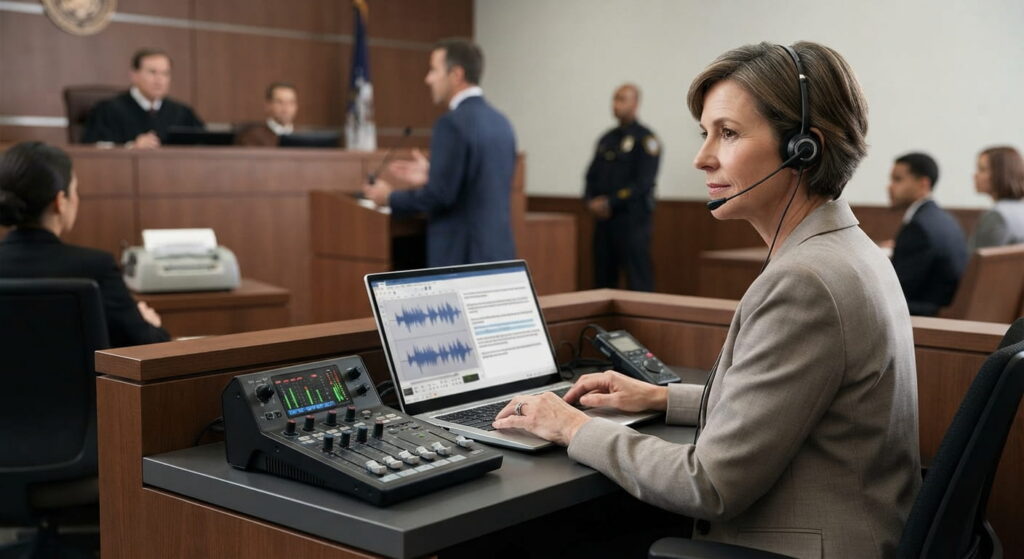
A digital court reporter is a certified legal professional who uses digital recording technology — rather than a stenography machine — to capture the official record of legal proceedings. Digital reporters monitor audio equipment, manage speakers and exhibits, administer oaths, and oversee the integrity of the record, just as traditional court reporters do. The key difference is the tools they use.
Digital court reporters typically earn certification through the American Association of Electronic Reporters and Transcribers (AAERT), which has offered the Certified Electronic Court Reporter (CER) and Certified Electronic Transcriber (CET) designations since 1995. These are recognized by courts across the US and increasingly in other countries.
AI-assisted transcription tools like Verbit’s Legal Capture support digital reporters by generating real-time transcripts, rough drafts, and final certified transcripts — enabling reporters to work more efficiently while maintaining the professional accountability the legal system requires.
Q: Digital court reporter vs. stenographer - what's the difference?
The roles are more similar than many people assume. Both court reporters and stenographers are responsible for creating an accurate verbatim record of legal proceedings. Both can administer oaths, mark exhibits, and serve in an official professional capacity. The core distinction comes down to method.
A stenographer uses a specialized shorthand machine to capture speech in real time, a skill that typically requires two to four years of intensive training. A digital court reporter uses audio and video recording technology, often paired with AI-assisted transcription software, and can become certified in significantly less time.
Neither approach is inherently superior — they serve different workflows and contexts. Many court reporting agencies today operate a hybrid model, deploying stenographers for proceedings that require real-time feed or specific steno-based deliverables, and digital reporters for depositions, hearings, and other matters where digital tools offer efficiency advantages. Technology like Verbit Legal Capture is designed to complement both workflows.
Q: Why are court reporting agencies switching to digital or hybrid court reporting?
Several converging pressures are driving court reporting agencies to evaluate digital and hybrid models:
A growing personnel shortage.
The average court reporter in the US is now in their mid-50s, and retirements are outpacing new entrants to the profession. The Bureau of Labor Statistics projects tens of thousands of court reporting positions will need to be filled over the next decade. Digital reporters can enter the workforce faster — and court reporting agencies are using technology partners like Verbit to expand their coverage capacity without proportionally expanding headcount.
The permanent shift to remote proceedings.
Remote and hybrid depositions are now standard practice across the legal industry. Digital court reporting is purpose-built for this environment, making it a natural fit for agencies serving geographically dispersed clients.
Business scalability.
For court reporting companies of all sizes, digital tools reduce the risk of turning down work due to reporter availability. Smaller court reporting firms can compete more effectively when they’re not constrained by the physical availability of personnel. See how Verbit streamlines courtroom workflows.
Faster turnarounds and cost efficiency.
Digital court reporting services can deliver rough drafts within an hour and final transcripts within 24 hours. This speed is increasingly expected by legal teams under case pressure.
Q: Are digital court reporters certified?
Yes. The primary certification body for digital court reporters is the American Association of Electronic Reporters and Transcribers (AAERT), which offers two credentials: Certified Electronic Court Reporter (CER) and Certified Electronic Transcriber (CET). The organization launched these programs in 1995, and they are recognized by courts throughout the US, Canada, and internationally as the leading standard for digital reporters.
As with any court reporting service, working with certified professionals is essential — particularly when transcripts may be used as legal evidence or relied upon in appellate proceedings. Courts and law firms evaluating court reporting companies should always confirm that digital reporters hold appropriate certifications.
Q: Who hires the digital court reporter - the law firm or the court reporting agency?
In most cases, the court reporting agency hires the digital court reporter and manages the relationship with the law firm or court. The agency is responsible for ensuring the reporter is appropriately certified and that the technology infrastructure — including any transcription software — meets the requirements of the proceeding.
Q: Do digital court reporters perform the same duties as traditional court reporters?
Yes. Digital court reporters are notaries and serve in the same official capacity as other court reporters. They administer oaths, submit speaker information, mark exhibits, manage on- and off-the-record designations, and oversee the integrity of the proceeding’s record. They also actively manage the room — reminding participants not to speak over one another and requesting clarification when needed. The professional responsibilities are substantively the same; it’s the recording and transcription tools that differ.
Q: Will switching to digital or hybrid court reporting affect reporter pay?
Pay structures are determined by individual court reporting agencies, not by their technology partners. If you’re a court reporter considering a transition to digital or hybrid reporting, the conversation about compensation happens with your agency. Verbit, as a transcription technology provider, does not influence or set individual agency payment policies.
Many reporters find that digital tools allow them to take on a higher volume of proceedings — which can be a meaningful factor in overall earnings
FAQs: Verbit's Court Reporting Solution & Legal Transcription Process
Q: What is Verbit's Legal Capture solution?
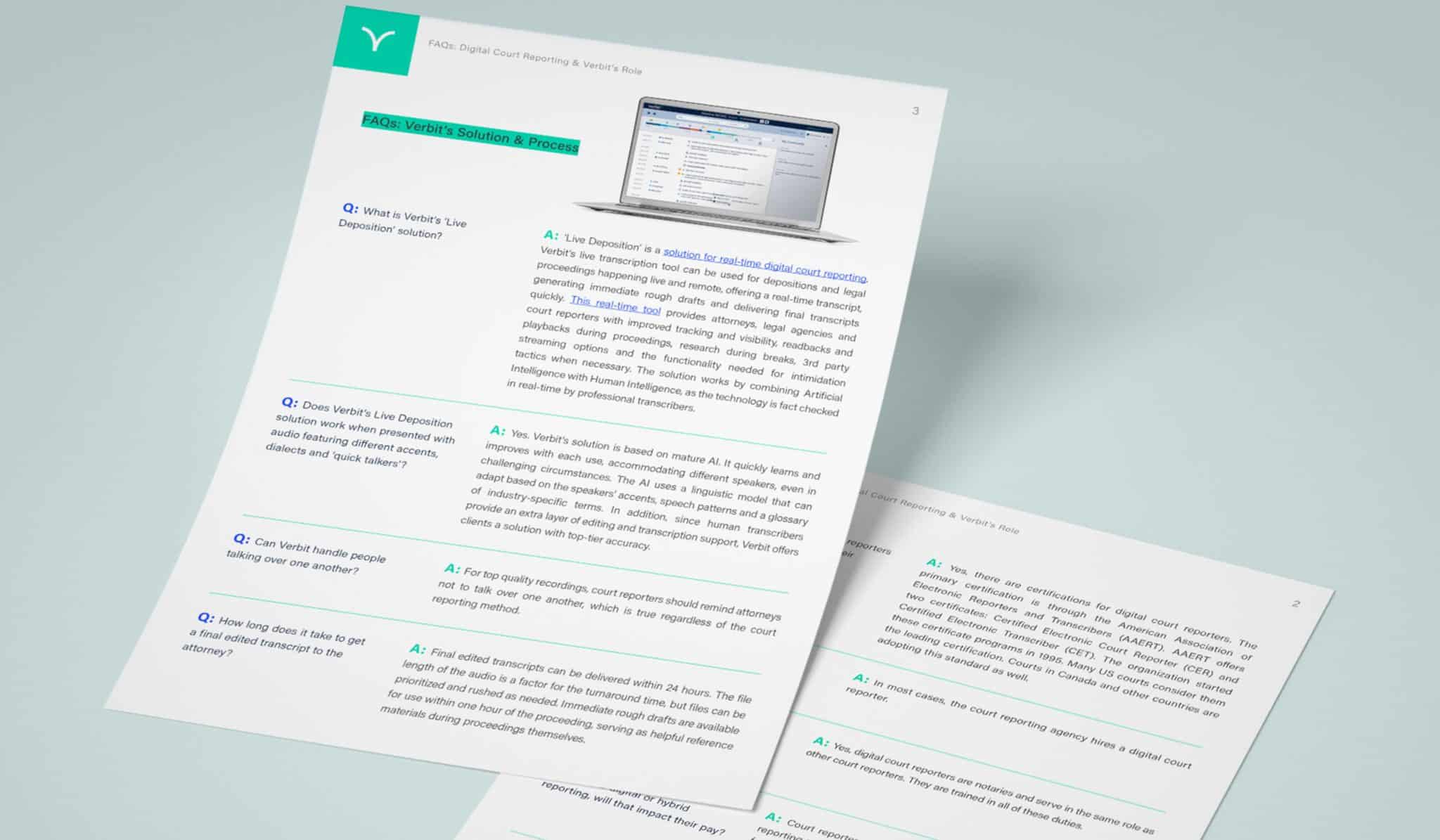
Legal Capture is Verbit’s purpose-built solution for digital court reporting across depositions, trials, hearings, and other legal proceedings — whether they happen in person, remotely, or in a hybrid format.
The solution combines Verbit’s proprietary AI speech recognition with real-time human review by professional transcribers. This hybrid approach means digital reporters and legal teams get the speed of AI with the accuracy assurance of human oversight — delivering rough drafts within an hour of a proceeding and final certified transcripts within 24 hours.
Legal Capture provides:
- Real-time transcription with live readbacks and playbacks during proceedings
- Searchable transcripts formatted to client specifications
- Exhibit management and annotation tracking
- Third-party streaming for remote participants
- 99%+ accuracy on final transcripts
The platform is used by court reporting agencies, law firms, and courts nationwide. Learn more about how Verbit is helping clear courtroom backlogs.
Q: Does Legal Capture handle different accents, dialects, and fast talkers?
Yes. Legal Capture is built on Verbit’s mature AI speech recognition engine, which adapts to speakers’ accents, dialects, and speech patterns over the course of a proceeding. The system uses a legal-domain linguistic model and can be pre-trained with a glossary of case-specific terms, names, and locations before a proceeding begins.
Human transcribers provide an additional layer of real-time review, catching edge cases and ensuring accuracy even when audio conditions are challenging. This human-in-the-loop approach is what separates Verbit’s court reporting service from purely automated solutions.
Q: Can Verbit handle multiple speakers talking over one another?
For proceedings of any kind, the best practice — regardless of the reporting method — is to ensure participants speak one at a time. Digital court reporters using Legal Capture are trained to remind attorneys and deponents of this at the outset. When crosstalk does occur, the combination of AI and human review helps maintain accuracy, but clear audio is always the foundation of a high-quality transcript.
Q: What is the longest proceeding Legal Capture has supported?
Verbit’s Legal Capture supports depositions and hearings of any length. There is no session cap.
Q: How quickly can attorneys receive a final transcript?
Rough draft transcripts are available within one hour of the conclusion of a proceeding – useful for attorney review during breaks or immediately after testimony. Final edited, certified transcripts are typically delivered within 24 hours. Rush or prioritized turnaround is available when case timelines require it.
Q: Do transcribers need to attend the deposition live?
Verbit can provide live transcriptionists who work in the background during a proceeding, or transcriptionists who work from the audio or video recording after the fact. The appropriate approach depends on the agency’s workflow and the specific requirements of the proceeding. Real-time court reporting with a live transcriber is sometimes preferred for high-stakes depositions where immediate readbacks are expected.
Q: How are speakers identified when transcription happens after a proceeding?
The digital court reporter typically provides Verbit with supporting materials – including the Notice of Deposition, participant list, and a case-specific glossary – that allow the platform to pre-identify speakers and terminology before transcription begins.
When those materials aren’t available, Legal Capture’s AI uses voice differentiation to distinguish speakers in the recording. Human transcriptionists then review and confirm speaker identification for accuracy. Providing context materials upfront consistently produces faster, more accurate results.
Q: How does Verbit certify transcripts?
Verbit provides the digital infrastructure that enables certified transcripts, including formatted cover pages. The assigned digital court reporter – who holds the professional certification and serves as the official reporter of record – is responsible for certifying the transcript.
Q: How do "Q" and "A" symbols appear in a transcript? Can participants see them live?
In real-time proceedings using Legal Capture, Q&A markers appear in the live transcript after an initial warm-up period of a few minutes – the time the system uses to identify and differentiate participant voices. From that point forward, markers appear in real time.
The real-time transcript also includes examination markings, swear-ins, objections, on/off-the-record notations, exhibits, and readbacks – everything needed for a court-ready record.
Q: How is the final transcript formatted?
Legal Capture can format transcripts to any agency’s or client’s specifications. The platform is fully customizable, accommodating court-specific templates, firm preferences, and jurisdiction requirements.
Q: How does Verbit protect the security and privacy of legal proceedings?
Privacy and data security are foundational to Verbit’s platform design. Legal Capture is HIPAA, SOC 2, HECVAT, VPAT, and GDPR compliant. All data is handled in accordance with strict legal industry security standards.
For court reporting agencies and law firms handling sensitive matters – personal injury cases, medical records, privileged attorney-client communications – Verbit’s compliance posture means transcription support doesn’t introduce new risk into the workflow. Learn more about Verbit’s trust and data policies.
Q: How can digital court reporters benefit from Verbit?
Verbit is designed to make digital court reporters more capable, not to replace them. Benefits for reporters and the agencies that deploy them include:
- Real-time readbacks and playbacks during proceedings
- Rough drafts within one hour of conclusion
- Final transcripts within 24 hours, with rush options
- Searchable transcripts and audio files formatted to client requirements
- 99%+ accuracy on certified final transcripts
- AI-driven insights on all legal transcripts, including summaries and more
- White-label delivery for agencies that prefer to present Verbit’s support under their own brand
- Companion tools like Legal Visor for in-proceedings discovery insights, chaptering, and virtual collaboration
For court reporting companies facing personnel shortages, Legal Capture functions as a force multiplier, allowing agencies to accept more proceedings without compromising on quality or turnaround.
Q: Will my clients know I'm using Verbit?
Verbit offers white-label services, so agencies can present Verbit’s capabilities under their own brand. Whether to disclose the use of a transcription technology partner is entirely the agency’s decision.
Q: How much does it cost to incorporate Verbit?
Verbit offers customized pricing based on volume, degree of customization, and products used. Contact us here for a conversation about your specific needs.
Real-World Results: Verbit and the Court Reporting Industry
Trusted by Leading Court Reporting Agencies
Understanding the theory behind digital court reporting is one thing. Seeing how it performs in practice is another.
Q: Which court reporting agencies use Verbit?
NAEGELI Deposition & Trial, one of the country’s most respected court reporting companies, has been partnering with Verbit for three years to strengthen their ability to deliver fast, accurate transcripts across a high volume of proceedings. The results reflect what court reporting firms consistently find when they integrate Verbit into their workflows: greater coverage capacity, faster turnaround, and confidence in the accuracy of every transcript.
Read the NAEGELI Deposition & Trial customer study to see how this top-tier court reporting agency uses Verbit to deliver on its commitment to excellence, and what that model could mean for your court reporting firm. Read the NAEGELI + Verbit case study.
Ready to expand your court reporting capacity?
Whether you run a regional court reporting agency or a national court reporting firm, Verbit’s legal tech, including Legal Capture, can help you take on more work, deliver transcripts faster, and compete in an increasingly digital industry – without replacing the professionals who make it possible.
Connect with us | Explore Legal Capture