Instructional designers, university accessibility officers, and higher education faculty.
Key Takeaways
Universal Design for Learning creates flexible academic environments that accommodate how every student absorbs and processes information. Discover how designing coursework with multiple ways to engage, learn, and express ideas empowers all students to thrive in higher education.
AT A GLANCE
- Flexible learning options give every student room to learn at their own pace.
- Varied course materials spark deeper curiosity and keep students energized to succeed.
- Inclusive classrooms ensure all learners share their unique perspectives with confidence.
WHO SHOULD READ THIS
Estimated Reading Time
10 minutes
Universal design for learning isn’t new. Educators have used the framework since the ’90s, and plenty of faculty already follow pieces of it without calling it UDL. So why are universities taking a fresh look now?
Because the case for UDL has never been stronger. 21% of undergraduates report a disability, yet only 8% are registered with their campus disability office – meaning most students who could use support never ask for it. Over half of college students now take at least one online course, which multiplies the video, slides, and documents that need to work for everyone. CAST refreshed the framework with UDL Guidelines 3.0, and the ADA Title II rule asks public colleges to make digital learning materials accessible by default, starting April 2027 for larger institutions.
In other words, the “accommodate on request” model is running out of road. Universal design for learning offers the alternative: build flexibility and access into courses from day one, so fewer students have to ask. Here’s what the framework involves, what the research says, and how universities are scaling it with tools like Verbit’s Campus Complete.
What Is Universal Design for Learning and Why It Matters More in 2026-2027
What is universal design for learning? It’s an approach to teaching that plans for learner variability from the start. Instead of designing a course for an imagined “average” student and retrofitting accommodations later, universal design for learning assumes variability is the norm and builds flexible options into goals, materials, methods, and assessments.
The idea grew out of Universal Design, an architecture movement that made buildings and products usable by as many people as possible. CAST, a nonprofit education research organization, adapted those ideas to learning, drawing on neuroscience research showing that how people learn varies widely from one individual to the next. Its CAST UDL Guidelines are now the field’s standard reference.
The best way to explain UDL is the curb cut effect. Sloped curbs were built for wheelchair users, but they also help parents with strollers, travelers with suitcases, and delivery workers with carts. Course design works the same way. Captions added for students who are Deaf or have hearing loss also help students learning English, students reviewing for exams, and anyone watching a lecture on a noisy train.
So what is UDL in practice today? It’s less a single technique than a habit of asking, “Who might this lesson leave out, and what option would bring them in?”
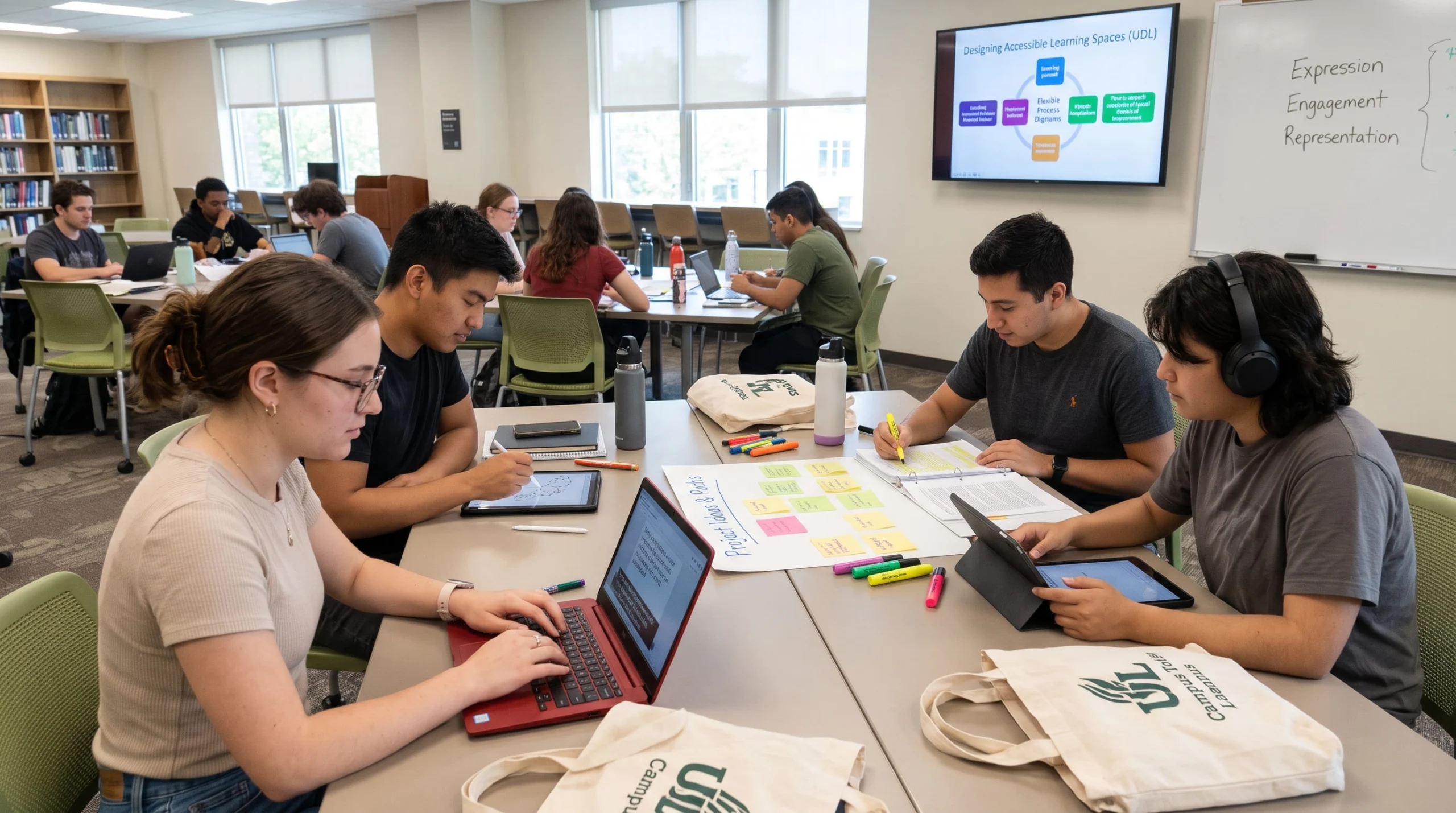
The Three UDL Principles That Transform Learning
The UDL principles map to three broad networks in the brain involved in learning: affective (the why), recognition (the what), and strategic (the how). Each of the three UDL principles asks educators to offer multiple pathways for one of those networks. UDL Guidelines 3.0 keeps all three while adding attention to learner identity, bias, belonging, and joy across the framework.
Engagement: The Why of Learning
The first of the UDL principles focuses on motivation. What is UDL in education if not a recognition that students learn more when they care about the work? This principle encourages instructors to spark interest, sustain effort, and help students manage their own learning.
In practice, that can mean letting students choose a topic or format, connecting assignments to real careers, or offering a podcast or infographic option alongside a traditional paper – all measured against the same learning goals. Choice isn’t about lowering standards; it’s about recognizing there’s more than one valid route to rigorous outcomes.
Representation: The What of Learning
The second principle covers how information is presented. Students perceive and process content differently, so presenting it in more than one format helps everyone build understanding.
Picture a lecture on a complex science concept. A UDL version might pair the live talk with real-time captions, a recording with an interactive transcript, diagrams, and readings at different levels. Students who are Deaf or have hearing loss get full access, and so do students who learn visually, review at their own pace, or are studying in a second language.
This is also where UDL and accessibility overlap most. Research backs it up: a review of more than 100 studies found captions improve comprehension, attention, and memory for video – and not only for viewers with hearing loss. Verbit has written more about how captions and transcripts support inclusive learning. For visual content, AI audio description and professional audio description extend the same principle to students who are blind or have low vision.
Action & Expression: The How of Learning
The third principle addresses how students show what they know. What is UDL if not a framework that respects different ways of demonstrating mastery?
Timed written exams may not reflect learning for students with certain disabilities, test anxiety, or strengths outside rapid writing. The UDL framework encourages varied options – presentations, projects, portfolios, or practical demonstrations – while holding everyone to the same objectives. The rigor stays; the format flexes.
The Impact of UDL Education on Student Success
Faculty and administrators want to know whether UDL education actually improves outcomes. The research is encouraging, if still maturing. A 2023 meta-analysis of 13 studies found UDL had a positive effect on learning, though results varied widely across settings and study designs.
What’s clearer is who benefits. UDL education helps students with and without disabilities, and it reaches the many students who never request accommodations. That matters when only 8% of undergraduates are registered with disability services, and when students with disabilities still earn bachelor’s degrees less often than their peers – 23% versus 38% within five years for students who started college in 2012.
There’s an operational payoff too. Faculty who design flexible courses up front typically field fewer one-off accommodation requests, freeing disability services teams to focus on students with more complex needs.
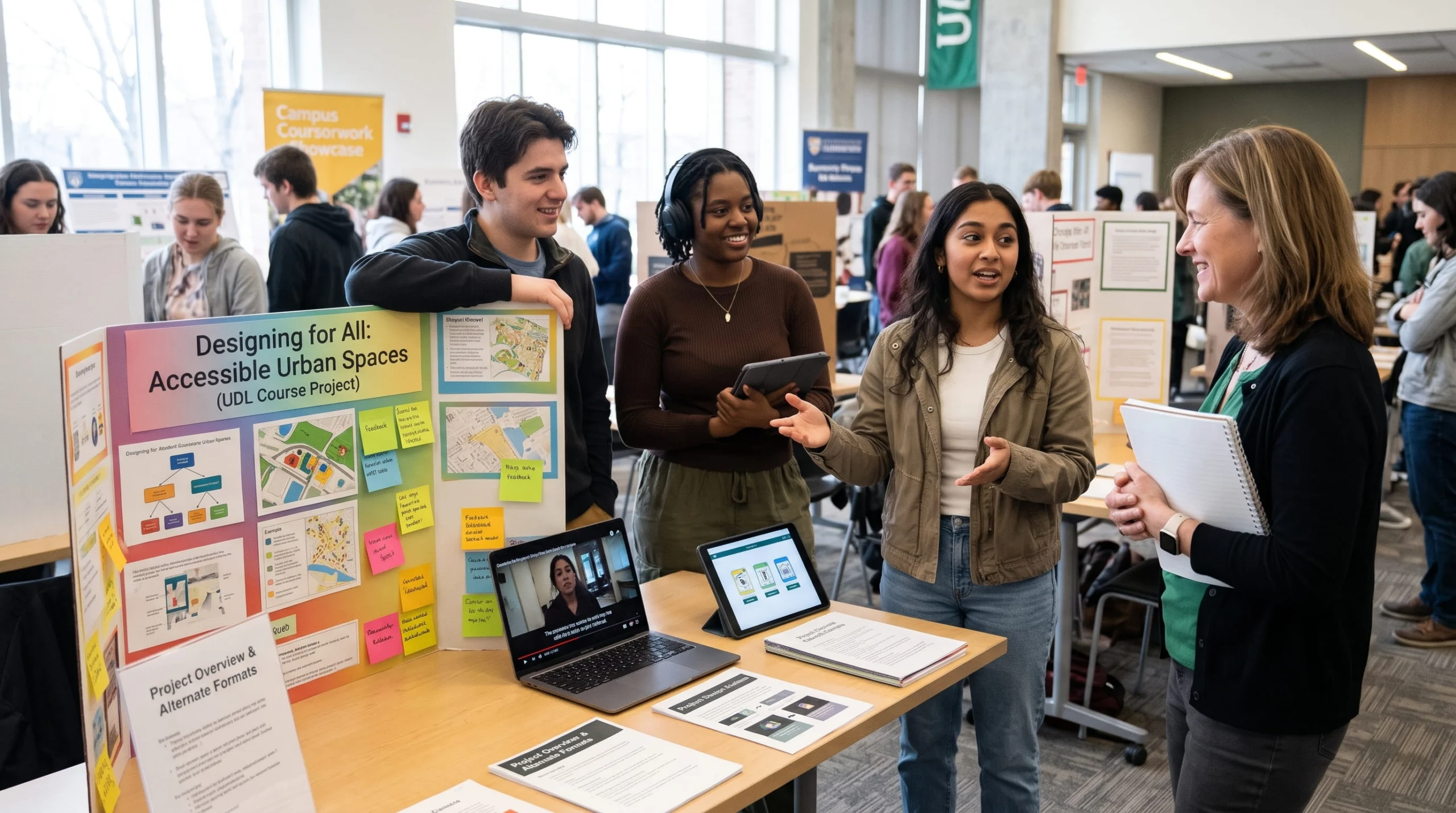
Following UDL Guidelines for ADA Title II Compliance
For public colleges and universities, UDL guidelines now line up with a hard regulatory timeline. Under the DOJ’s ADA Title II rule, public institutions must make web content and mobile apps meet WCAG 2.1 Level AA by April 26, 2027 for larger entities and April 26, 2028 for smaller ones. That scope includes course materials: as James Madison University’s guidance notes, materials posted in Canvas still need to meet the standard.
Private institutions aren’t exempt from scrutiny either. Harvard and MIT both settled captioning lawsuits brought on behalf of people who are Deaf or have hearing loss, agreeing to caption public online video.
Here’s where the UDL framework becomes strategic. When faculty follow UDL guidelines for representation – captions on video, transcripts for audio, alt text for images, and accessible documents – they’re building Title II compliance into everyday course design instead of treating it as a separate project. The CAST UDL Guidelines and WCAG aren’t the same thing, but they point in the same direction.
Implementing the UDL Framework with Technology Solutions
The UDL principles are simple to explain and hard to scale. A single university can produce thousands of lecture recordings, guest talks, and course videos each semester, and few faculty have time to caption them by hand.
Verbit’s higher education solutions help close that gap. Captivate, Verbit’s speech recognition technology, generates captions and transcripts quickly, with human review available when accuracy or compliance requires it. Integrations with Canvas, Blackboard, Brightspace (D2L), Moodle, Kaltura, Panopto, and Zoom mean captions appear where students already learn. Verbit has supported universities like Stanford and eLearning platforms like Udacity with accessible content at scale. It’s therefore easier than ever to align your university’s content with UDL principles.
Verbit Campus Complete: UDL Implementation at Scale
Campus Complete is Verbit’s subscription plan built for colleges and universities preparing for ADA Title II. Instead of managing accessibility lecture by lecture or course by course, institutions get one plan covering captioning, transcription, and audio description across campus.
Campus Complete supports the UDL framework in practical ways:
- Representation at scale: live captions for lectures and events, captions and transcripts for recorded lessons, and audio description for visual content.
- Less faculty lift: captions flow into the LMS and video platforms faculty already use.
- Compliance alignment: built to support ADA Title II, WCAG 2.1 AA, and Section 508, with AI plus human quality assurance where accuracy matters most.
- Budget predictability: one subscription instead of per-minute billing that’s hard to forecast.
For students in multilingual classrooms, subtitle translation adds another layer of representation.
Leveraging CAST UDL Guidelines for Implementation
For universities starting or deepening their UDL work, the CAST UDL Guidelines are the roadmap. They break the three principles into nine guidelines and, in version 3.0, 32 specific considerations, moving from broad goals to concrete strategies.
Under representation, for example, the CAST UDL Guidelines include options for perception (alternatives to visual and auditory information), language and symbols (clarifying vocabulary), and building knowledge (activating background knowledge and highlighting key ideas). Version 3.0 also asks educators to examine whose perspectives course materials center and to address bias.
Many universities use the CAST UDL Guidelines as the backbone of faculty development. Faculty who understand the reasoning and have practical examples tend to become champions for inclusive teaching – which works better than top-down mandates. The guidelines are free to download in multiple formats, modeling the flexibility they describe.
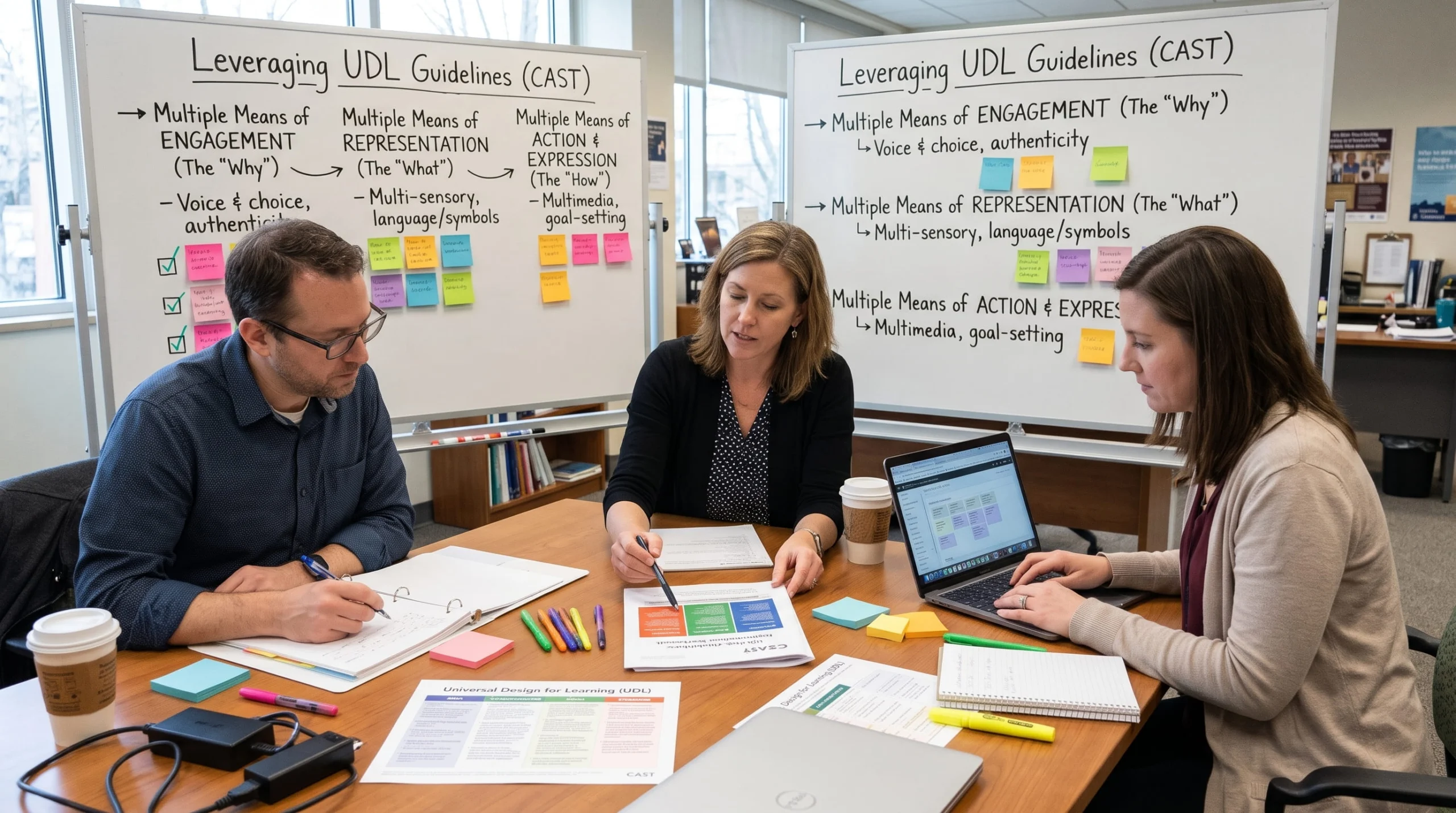
Building a Culture of Accessibility and Inclusion
Universal design for learning sticks when it becomes part of campus culture rather than a one-time initiative. Four ingredients make the difference:
- Leadership commitment: clear goals, dedicated resources, and accountability for progress.
- Faculty development: workshops and communities of practice where instructors apply UDL principles to their own courses.
- Accessible infrastructure: an accessible LMS and tools like Campus Complete that make captions, transcripts, and audio description routine.
- Measurement: tracking metrics like the share of course videos with captions, accommodation request volume, and student feedback.
Verbit’s ADA Title II webinar series covers how accessibility leaders are building these workflows. For hybrid and online programs, see how captioning supports blended learning.
Your Path Forward: Adopting UDL Principles as a Strategic Imperative
Universal design for learning has been around for decades, but 2026-2027 changes the stakes. Student populations are more varied, more learning happens online, the CAST framework has been refreshed, and the ADA Title II deadlines are fixed. Universities that treat UDL as a strategy rather than a side project will be better positioned on all four fronts.
The curb cut lesson still applies: design for the students at the margins, and everyone moves more easily. With the CAST UDL Guidelines as a roadmap and Verbit’s Campus Complete handling captions, transcripts, and audio description at scale, universities can make UDL the default rather than the exception.
Interested in learning more on how to scale universal design for learning on your campus?
See how Campus Complete supports ADA Title II while improving learning for every student.
FAQs on Universal Design for Learning
What is universal design for learning?
Universal design for learning (UDL) is a framework for designing courses that work for a wide range of learners from the start. Instead of retrofitting accommodations, it builds flexible options into how content is presented, how students engage, and how they show what they know.
What is UDL in education?
In education, UDL means planning lessons with learner variability in mind – for example, pairing lectures with captions and transcripts, offering choice in assignments, and allowing more than one way to demonstrate mastery.
What are the three UDL principles?
The three UDL principles are multiple means of engagement (the why of learning), representation (the what), and action and expression (the how).
What changed in the CAST UDL Guidelines 3.0?
CAST released UDL Guidelines 3.0 in July 2024. The three principles stay the same, but the update adds learner identity, bias, belonging, and joy across nine guidelines and 32 considerations.
How does UDL support ADA Title II compliance?
UDL’s representation principle – captions, transcripts, audio description, and accessible documents – overlaps with WCAG 2.1 Level AA, the standard public colleges must meet by April 26, 2027 (or April 26, 2028 for smaller entities).