


Not sure which approach fits your content library and compliance timeline?
Verbit’s AI-powered audio description makes visual content accessible to audiences who are blind or have low vision – combining the speed and scalability of automation with the quality and compliance standards your organization requires. Generate WCAG 2.1 Level AA compliant audio descriptions for single videos, large video libraries, and ongoing content production – across education, media, corporate, and government content. Options for expert human review for complex or specialized materials and access to a team ready to help you with ADA Title II requirements.
The Verbit advantage: Our AI is prepped on hundreds of thousands of hours of professionally described content across film, education, government, and media. It’s trained to understand context, pacing, and accessibility standards—not just object detection like generic computer vision tools.
Generate AI audio descriptions across large video libraries quickly, without slowing down production or workflow.
Use AI-generated descriptions alone or add expert human review for high-stakes, public-facing, or compliance-critical content.
Designed for media, education, enterprise, and digital teams managing high volumes of video efficiently.
Supported by Verbit’s expertise in accessibility, ADA Title II compliance, and inclusive video across industries.
Explore our AI Audio Description samples across science, mathematics, and history. Each one pairs the original lesson with a synchronized audio description track, captions, and a transcript in a single player, so blind and low-vision audiences get the full story.
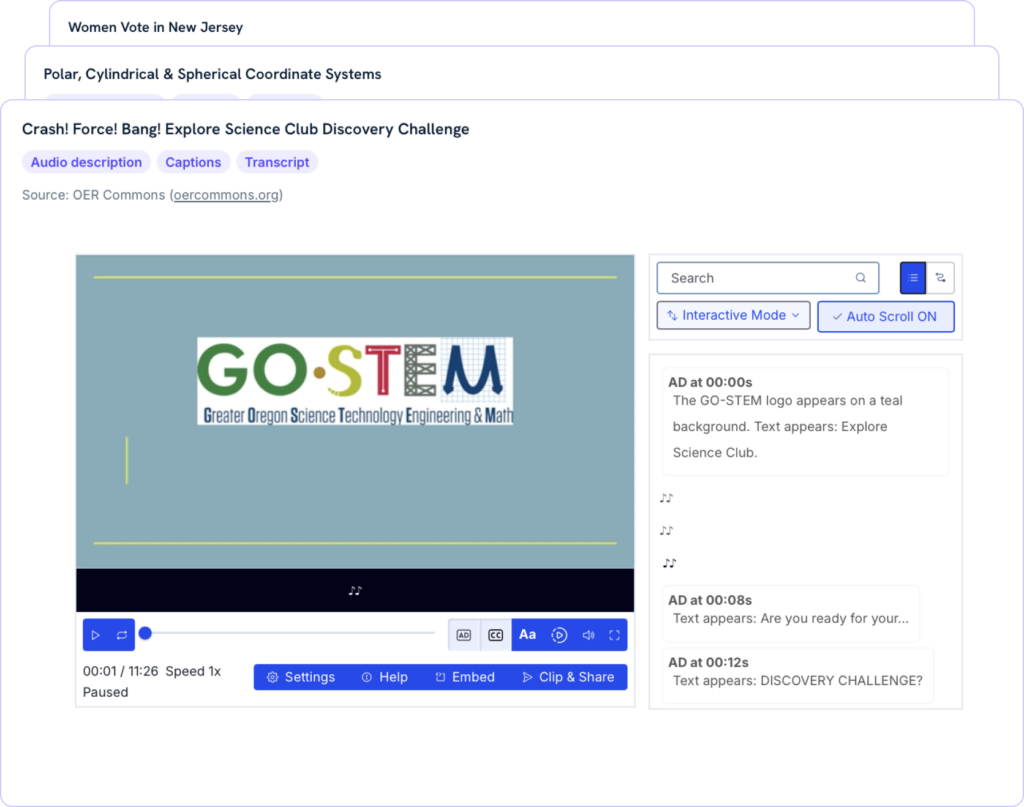
Upload your video to Verbit’s secure platform. Our AI instantly analyzes the visual content frame-by-frame, identifying actions, objects, settings, facial expressions, text on screen, and scene transitions.
The AI generates descriptive narration using natural language processing trained on professional audio description standards. It identifies optimal insertion points during dialogue pauses and ensures descriptions don’t overlap with essential audio.
Unlike basic computer vision tools, our AI understands context. It knows when to describe a “confident smile” vs. a “nervous smile,” when setting details matter vs. when action is paramount, and how to match the tone of your content (educational, dramatic, informational).
For content requiring absolute precision or artistic nuance, our accessibility experts review and refine the AI-generated descriptions. This hybrid approach delivers enterprise quality at AI speed and cost.
Receive your audio description in your preferred format:
– Separate audio track for video platforms
– Timed text file for manual recording
– Integrated with your distribution system
– Compatible with all major video players and LMS platforms
Most audio described content is delivered within 24-48 hours, depending on QA. Rush services available for urgent needs.
Verbit’s AI Audio Description is aligned with WCAG 2.1 guidelines and helps organizations meet ADA Title II video accessibility requirements. Public institutions, government agencies, and enterprise organizations all benefit when automating AI Audio Description to move beyond accommodation-only use, and implement comprehensive accessibility across all video assets.
Colleges and universities manage large libraries of lectures, instructional videos, and departmental media. With ADA Title II deadlines come into effect in 2027, and scalable solutions are critical.
Verbit’s AI Audio Description helps institutions:

Corporations rely on video for training, onboarding, marketing, and customer support. Verbit’s AI Audio Description helps corporate teams:
By automating high-quality AI Audio Description, media platforms, broadcasters, and FAST channels, can make visually rich content accessible, unlock new audiences, improve discoverability, and ensure that every viewer experiences video content fully.
Local, state, and federal agencies are using video more than ever for public communication, civic engagement, and training. Verbit’s AI Audio Description and Civic Complete ADA Title II solution help these organizations:

AI Audio Description is the right choice for educational institutions, media companies, government agencies, and enterprises with hundreds or thousands of videos requiring audio description. AI scales effortlessly where manual description would take months or years. Those subject to ADA Title II compliance by April 2027 can’t afford to wait and need an audio description solution they can trust across their large content libraries and for ongoing content production.
| Compare tiers | Traditional Audio Description | Recommended Verbit AI Audio Description | Free Audio Description Tools |
|---|---|---|---|
| Best for | One-time projects and artistic content needing nuanced interpretation | Large content libraries, ongoing production, and ADA Title II compliance | Creators without budget. Not for professional or compliance use |
| Turnaround | Several business days per video | Minutes, roughly the length of the video file | Varies |
| Cost | Higher per-minute pricing | Accessible pricing for volume content | Free |
| Scalability | Limited by human describer capacity | Handles large video libraries efficiently | High volume is possible, but errors compound |
| Quality & accuracy | Trained experts with cultural and contextual nuance | Consistent standards across all content, with optional expert human review | Basic object detection without context, and frequent errors |
| Compliance (WCAG 2.1 AA, ADA, Section 508) | Meets requirements | Meets requirements | Rarely meets requirements |
| Human review | Fully human | Choose fully automatic, with optional expert human review | None |
| Best applications | Feature films, theatre, and complex artistic works | High-volume media, education, and enterprise libraries | Not suitable for professional distribution |
Our AI models are trained on hundreds of thousands of hours of professionally created audio descriptions across multiple industries. This isn’t generic computer vision — it’s specialized accessibility AI that understands industry best practices.
✓ WCAG 2.1 Level AA Compliant
✓ ADA Title II & III Requirements
✓ Section 508
✓ Audio Description Coalition Best Practices
✓ Support for FCC CVAA Standards
ADA Title II deadlines come into effect in 2027, and scalable solutions are critical.
Every AI model update undergoes validation testing by certified accessibility professionals. We measure accuracy, timing precision, contextual appropriateness, and regulatory compliance before deployment.
For content requiring absolute precision (artistic productions, high-profile pieces), our hybrid model offers expert human review. You get AI speed and low cost with human quality assurance.
Our AI learns from every project. Feedback from accessibility experts and users with vision disabilities continuously refines description quality, ensuring improvement over time rather than static performance.

Layer AI Audio Description, extended audio descriptions, and captions over any online video with interactive playback features like transcript search, clip and share, and more. The Smart Player makes videos fully accessible while enhancing engagement, discoverability, and usability for all viewers.
Not sure which approach fits your content library and compliance timeline?
AI Audio Description automatically generates spoken narrations of important visual elements in video content using advanced AI, enabling accessible video for people who are blind or have low vision.
AI audio description uses artificial intelligence to identify and describe key visual elements in video, inserting spoken descriptions that complement existing dialogue and audio. This accessibility technology helps organizations include individuals who are blind or navigating vision loss.
Verbit’s AI Audio Description solution uses advanced AI and computer vision to produce natural, time-synced narration for all your videos. AI audio description software is great for digital, educational, and internal content as it presents a practical, scalable method to quickly generate audio descriptions aligned with real-world content workflows.
AI audio description is ideal for speed, scale, and efficiency — while expert audio description services offer enhanced storytelling, tone control, and compliance support. Verbit enables organizations to choose the right approach for each project, all within one platform.
Verbit’s AI audio description achieves high accuracy rates — significantly higher than free automated tools which typically reach only 60-70%. Our AI audio description is specifically trained on professional audio description content, not generic computer vision, which explains the superior accuracy. It’s highly effective for identifying and describing visual elements quickly. For premium content or videos requiring absolute precision, our hybrid model adds human expert review to enhance accuracy and narrative quality.
Verbit’s AI Audio Description complements expert services designed for WCAG 2.1 and ADA Title II video accessibility requirements by increasing speed and scale. Many organizations use AI for high-volume content and expert describers for broadcast, film, or regulated media.
AI Audio Description uses automated AI-generated narration to deliver accessibility at scale, while human audio description is created manually. Verbit offers optional human review for high-visibility or critical content.
Free audio description tools typically use basic computer vision that identifies objects (“a person,” “a car”) without context or nuance. Verbit’s AI understands context, emotion, and narrative, describing “a nervous student entering the classroom” vs. just “a person walking.” Our AI also handles timing precisely, placing descriptions in dialogue pauses rather than overlapping essential audio. Free tools rarely meet professional or regulatory quality standards.
AI audio description works especially well for training videos, internal communications, educational content, digital media, and large content libraries. Verbit’s AI Audio Description integrates seamlessly with nearly all video formats and learning management systems, making it easy to implement at scale.
Yes. Verbit’s AI audio description meets the threshold needed for WCAG 2.1 Level AA standards, ADA Title II and III requirements, and Section 508 compliance. Our AI is trained specifically on compliant audio description examples and undergoes regular validation testing by certified accessibility professionals.
Yes, audio description can improve SEO and discoverability. The descriptive narration adds meaningful, indexable text that improves search engine visibility and video engagement across platforms like Google and YouTube.