
Higher education leaders, instructional designers, and eLearning administrators.
Key Takeaways
Bring your videos to life for every viewer by turning essential visual details into clear, spoken narration. This resource explores how new audio description tools empower audience members who are blind or have vision loss to fully experience digital course videos and media.
AT A GLANCE
- Spoken narration tracks explain key visual elements that occur during quiet video moments.
- Audio description is now needed for WCAG 2.1 compliant video to meet ADA Title II requirements.
- AI audio description can help educational institutions meet these compliance needs at scale, with professional human oversight also available.
WHO SHOULD READ THIS
Estimated Reading Time
4 min read
The Department of Justice’s ADA Title II rule requires public colleges and universities to make their web content and mobile apps conform to WCAG 2.1 Level AA – and that includes video. In April 2026, DOJ extended the compliance dates: institutions in jurisdictions of 50,000 or more people now have until April 26, 2027, and smaller jurisdictions until April 26, 2028. Institutions that receive HHS funding face a parallel Section 504 deadline of May 11, 2027.
The 2026-2027 extension offers a gift of time, but for universities managing thousands of hours of lecture capture, course video and recorded events, the smartest move is to use this window wisely: audit, prioritize, and build audio description into standard workflows before the deadline arrives. Doing so also delivers what the rule is really about – equal access to education for students who are blind or have low vision.
Verbit offers institutions two ways to get there: professional audio description from trained describers and voice artists, and AI Audio Description for high-volume libraries, with optional expert review. Verbit’s AI Audio Description is also offered on an unlimited basis to institutions who enroll in our Campus Complete plan. Both options are built to help institutions meet ADA Title II requirements while delivering accessible content that serves every learner.
The Growing Need for Audio Description in Higher Education
The need is large. According to the American Foundation for the Blind’s analysis of the 2024 National Health Interview Survey, 49.5 million U.S. adults report some trouble seeing even with glasses or contacts, or are blind.
Those numbers show up in lecture halls, online degree programs and recorded research presentations. Without audio description, students who are blind or have low vision miss the visual information their sighted peers take in automatically – diagrams and charts, on-screen text, lab demonstrations and what a professor is pointing to on the whiteboard.
Demand for audio description services has grown as institutions recognize both the compliance requirement and the learning benefits. Yet a common first question among faculty and accessibility teams is still: what is audio description, and how is it different from captions?
What Is Audio Description and Why Does It Matter for Education?
Many educators ask what is audio description and how it differs from closed captions or transcripts. The audio description meaning goes beyond simple narration to include strategic timing and educational context.
Audio description is narration of important visual elements – actions, settings, facial expressions, on-screen text and graphics – delivered during natural pauses in dialogue. It gives people who cannot see the screen access to the same information as everyone else. For a deeper primer, see our beginner’s guide to audio description.
Understanding audio description meaning in an academic context helps institutions plan effectively. Captions transcribe what is said; audio description fills in what is shown. It’s the difference between knowing a professor is speaking and knowing they’re pointing to a critical equation on the whiteboard while they speak. You may also see the term descriptive narration used for the same practice.

Who Needs to Provide Audio Description: Understanding Your Obligations
The question of who needs to provide audio description matters more as the 2027 compliance date approaches. Here’s how the rules apply in higher education.
Public colleges and universities are covered by ADA Title II as instrumentalities of state and local government. Under the DOJ rule, their web content and mobile apps must conform to WCAG 2.1 AA, which includes audio description for prerecorded video (Success Criterion 1.2.5). That covers lecture recordings, online courses, course media in the LMS, and public-facing video such as admissions and event content.
Institutions receiving federal funding also have obligations under Section 504 of the Rehabilitation Act. Colleges that receive HHS funding – including many research universities and medical schools – fall under HHS’s Section 504 web accessibility rule, with a May 11, 2027 compliance date for recipients with 15 or more employees.
Online programs and eLearning partners that deliver course content on behalf of public institutions need that content to meet the same standard.
The core test is simple: if a video’s audio doesn’t convey the same information that’s shown visually, audio description is required. It can be delivered as a separate audio track, as open description mixed into the video, or as extended audio description that pauses the video when a visual needs more explanation than a natural pause allows. (WCAG 2.1 AA requires standard audio description; extended audio description is a Level AAA best practice.)
For a full breakdown of video requirements, see our video accessibility guidelines for ADA Title II and answers to the top Title II questions from schools and universities.

How Does Audio Description Work: Professional and AI Audio Description Workflows
Understanding how does audio description work helps institutions choose the right approach for each type of content. Verbit offers two workflows, and most universities use both.
Professional Audio Description
Verbit’s professional audio description is delivered by trained audio description professionals and experienced voice artists:
- Content analysis and script development: Describers review the video, identify the visual elements that need description and write a script. For a chemistry lecture, that means accurately conveying molecular structures and reactions; for a history course, the significance of archival photographs and maps.
- Professional voice recording: Voice artists record the description track with clarity, appropriate tone and pacing – clear enough to follow, unobtrusive enough not to distract.
- Precision timing: Descriptions are timed to fit natural pauses in dialogue. When a visual needs more time, extended audio description adds pauses for richer narration.
- Quality assurance: Accessibility experts review every description for accuracy, consistency and compliance.
- Flexible delivery: Separate audio tracks, open audio description embedded in the main audio, or integration with video players and LMS platforms.
AI Audio Description
For high-volume libraries, Verbit’s AI Audio Description generates descriptions faster and at lower cost, and can still be trusted to deliver the high level of accuracy institutions need:
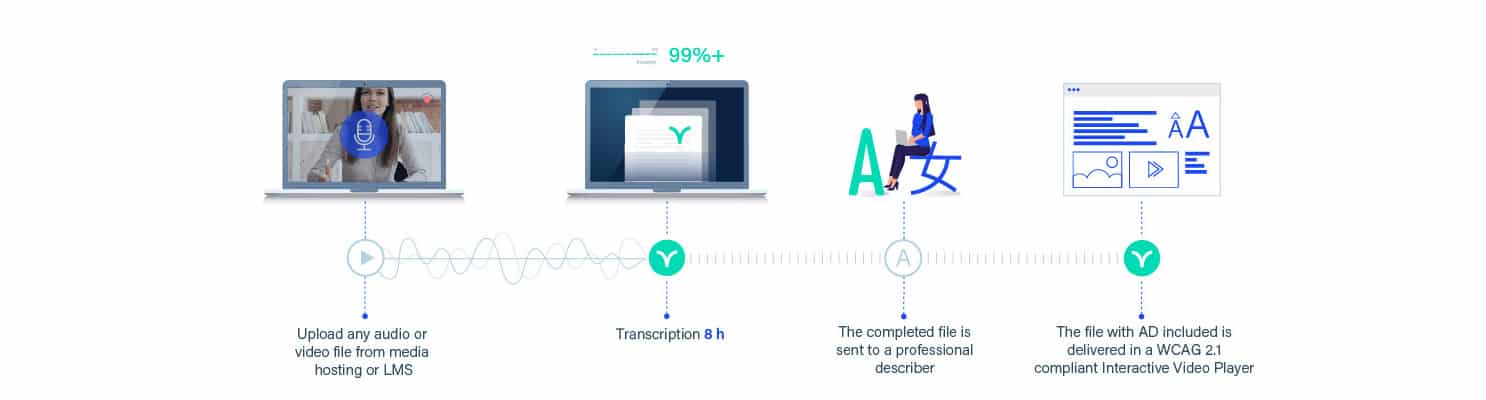
- Upload and AI analysis: Video is analyzed frame by frame.
- Script generation: AI trained on professional description standards writes the script.
- Context-aware refinement: The system goes beyond basic object detection to understand what matters in the scene.
- Optional expert review: Accessibility experts review and refine descriptions for high-stakes or public-facing content.
- Format and deliver: As a separate audio track, a timed text file, or directly to your video platform or LMS.
Most AI audio described content is delivered within 24-48 hours, depending on QA, with rush options available. Learn more about the benefits of AI Audio Description for ADA Title II compliance.
Choosing the Right Approach
Many institutions use AI Audio Description to cover large back-catalogs of lecture capture and course video, then reserve professional audio description – or AI with expert review – for flagship courses, complex STEM content and public-facing video. That mix lets accessibility teams scale coverage without giving up quality where it counts most.
On delivery, note that platforms handle audio description differently. YouTube, for example, supports uploaded audio description text files, while Verbit’s Smart Player can pause video to play extended descriptions. See our guide to audio description on YouTube for details.
Implementing Audio Description for eLearning Platforms
Implementing audio description for eLearning works best when it fits the tools faculty and instructional designers already use. Verbit integrates with major LMS and video platforms, including Canvas, Blackboard, Moodle, Panopto, Kaltura, Zoom, YouTube, Vimeo and Brightcove, so audio description for eLearning can be requested and delivered inside existing workflows.
That matters for institutions managing large libraries across multiple platforms. Instead of separate workflows or manual uploads, accessibility becomes part of standard content creation rather than an afterthought. Verbit has also supported eLearning platforms such as Coursera, Skillshare, and Udacity, bringing experience at the scale online learning demands.
Flexible delivery means learners can access described content whichever platform their institution uses – a separate audio track where the player supports it, or an integrated described version where it doesn’t.

Why Professional Audio Describer Expertise Makes the Difference
Even as AI speeds up production, the judgment of a trained audio describer remains essential for complex educational content. A professional audio describer brings objectivity and precision, conveying visual information accurately without overwhelming the viewer or disrupting learning.
Consider a science demonstration. A basic object-detection tool might say “liquid is poured into beaker.” A professional audio describer – or context-aware AI with expert review – understands the teaching goal: “Clear liquid from the graduated cylinder is slowly poured into the 250 ml beaker, filling it about halfway.” The container, measurement, pace and volume give students who are blind or have low vision what they need to follow the experiment.
That’s why Verbit’s approach pairs technology with human expertise. Institutions have the flexibility to go back and forth between options to match the level of review to the stakes of the content, and scale with confidence.
Roberto Santiago, Associate Director, Disability Program at San Francisco State University, put it simply: “As a large organization, we’ve had a really good experience with Verbit, and that’s why we keep renewing the contract every year.”
Benefits of Audio Description in Education Beyond Compliance
The benefits of audio description in education reach well beyond compliance.
Enhanced Content Discoverability
When description scripts and transcripts are published alongside video, they add indexable text that helps search engines understand what your content shows. Institutions exploring the benefits of audio description in education often find that accessible video is also easier for prospective students to find.
Broader Audience Engagement
Audio description helps more than viewers with vision loss. Students watching on a phone in bright sunlight, learners who benefit from information in more than one mode, and international students still building language proficiency can all get value from it. Pair it with multilingual translation and subtitles to reach even more learners.
Institutional Reputation and Inclusion
Colleges and universities increasingly recognize audio description as part of meeting accessibility regulations and their broader commitment to inclusion. It signals to prospective students, faculty and partners that every learner is expected and welcome – and gives accreditation reviewers and grant applications tangible evidence of that commitment.
Getting Started: Your Path to 2027 Compliance
The path to compliance doesn’t have to be overwhelming. Start by auditing existing video to identify what needs audio description, then prioritize by usage, course requirements and compliance risk. Our ADA Title II checklist for accessible digital content is a practical starting point.
Verbit Campus Complete brings it together in one annual subscription built for ADA Title II: unlimited AI captions, transcripts, AI Audio Description, multilingual translations, and subtitles. It offers a human review option for high-stakes content and LMS integrations – with no per-minute overages. Implementing an ADA Title II solution like Verbit’s Campus Complete means working with fewer vendors which also means less strain on already stretched teams. Explore more on this in why vendor consolidation helps overwhelmed accessibility teams.
With April 26, 2027 about seven months out for larger jurisdictions, now is the time to pilot high-priority courses, refine your process and then scale. Key success factors include choosing a partner with proven higher education experience, integrating with your existing technology, and training faculty and content creators so accessibility becomes part of how content is made.
The Future of Accessible Education
Audio description is moving from optional enhancement to essential requirement. But the shift is about more than regulation – it reflects how institutions think about accessibility and inclusion.
Accessibility technology keeps advancing, and AI now makes it realistic to describe entire video libraries, not just a handful of flagship courses. The principle stays the same: education should be accessible to every learner.
Verbit combines AI Audio Description and professional audio description to help institutions meet this moment, with fast turnaround, WCAG 2.1 AA and ADA Title II support, and the flexibility to match quality to the stakes of each video.
The question isn’t whether to implement audio description – the ADA Title II rule settles that. It’s how to do it effectively and efficiently, in a way that truly serves learners. Institutions that use the time they have now, partner with experienced providers and build accessibility into everyday workflows will be ready well before 2027. Explore Verbit’s education accessibility solutions or talk to our team about Campus Complete.
FAQs on Audio Description Technology
What is audio description?
Audio description is narration of key visual elements in a video – actions, settings, facial expressions, on-screen text and graphics – delivered during natural pauses in dialogue so people who are blind or have low vision can follow along.
What is the meaning of audio description vs. captions?
Captions put spoken words and sounds on screen for people who are deaf or hard of hearing. Audio description does the reverse: it puts the visual information on-screen information into audio format through pauses in the video for people who cannot see the screen, are blind or have vision loss.
What does an audio describer do?
An audio describer watches the content, decides which visual details matter, writes concise and objective descriptions, and times them to fit pauses in the audio. A voice artist or synthetic voice then records the track.
Do colleges have to provide audio description?
Public colleges and universities covered by ADA Title II must make web content, including prerecorded video, conform to WCAG 2.1 AA, which requires audio description where visuals aren’t conveyed by the audio. The compliance date is April 26, 2027 for jurisdictions of 50,000+ people and April 26, 2028 for smaller ones.
Is AI audio description good enough for compliance?
AI Audio Description can cover large video libraries quickly and cost-effectively. For high-stakes, public-facing or complex STEM content, Verbit recommends adding expert human review or using professional audio description.