Media and entertainment producers, higher education accessibility and video teams, government compliance officers, and corporate communications leads.
Key Takeaways
Captions are now how most audiences watch video, and new regulations put firm dates on getting them right. This guide breaks down the FCC and ADA requirements for 2026-2027, the four standards that define caption quality, and how to match AI, human, or hybrid captioning to each type of content.
AT A GLANCE
- 87% of Americans use captions at least sometimes.
- FCC display rules took effect in August 2026, and ADA Title II deadlines start April 2027.
- Caption quality comes down to accuracy, synchronicity, completeness, and placement.
- Domain-trained AI with human review is the safest path to compliance.
WHO SHOULD READ THIS
Estimated Reading Time
5 min read
Here’s the captioning statistic that catches people off guard: 87% of Americans use captions at least sometimes, and nearly half use them always or often, according to a May 2026 study. Netflix reports that nearly half of viewing hours on its US platform alone happen with subtitles or captions on. Closed captioning isn’t a niche accommodation – it’s how audiences watch TV, stream series, and consume social clips, lectures, and public meetings.
That trend – coupled with a ticking clock on regulations – make adding effective captions to your content a high priority. The FCC’s new caption display settings rule took effect in August 2026, the DOJ’s ADA Title II deadline arrives in April 2027 for larger public entities, and UK and EU regulators are setting caption expectations for streamers. Understanding closed captioning standards is essential for meeting 2026-2027 requirements, whether you run a newsroom, live events, or a content calendar for a company or university.
Below, we break down the standards that apply across media and entertainment, education, government, and corporate video – plus practical lessons from Verbit’s work captioning everything from live sports to city council meetings.
What Is Closed Captioning and Why It Matters in 2026-2027
Many organizations ask what is closed captioning and how it differs from basic subtitles. Closed captioning is a text version of a video’s audio that viewers can turn on or off. To understand what is closed captioning in practice, know that it covers more than dialogue: speaker identification, sound effects, music cues, and any other audio a viewer needs to follow along. When people ask what are captions, they’re often surprised by how much non-speech information good captions carry.
The closed caption meaning also has a regulatory side. In the U.S., the closed caption meaning is shaped by FCC rules for TV programming (including TV content later posted online) and by Web Content Accessibility Guidelines (WCAG) for websites, apps, and learning platforms. “Closed” means viewers can toggle captions; “open” captions are burned into the video.
Captions give people who are Deaf or have hearing loss independent access to news, emergency information, education, entertainment, and work. That’s a large audience: over 70 million U.S. adults – more than 1 in 4 – report having a disability, according to the CDC. Captions also serve the many viewers who simply prefer them, so captioning decisions now affect engagement and reach as much as compliance.

What Are Captions vs. Subtitles: Understanding the Difference
Understanding what are captions helps organizations see their value beyond basic accessibility. Captions are written for viewers who can’t hear the audio, so they include dialogue plus speaker labels and cues like [music playing] or [door slams]. Subtitles assume the viewer can hear but may not understand the language, so they typically cover dialogue only, often translated.
| Closed captions | Subtitles | |
|---|---|---|
| Primary audience | Viewers who are Deaf or have hearing loss, plus anyone watching muted | Viewers who prefer an alternative to the audio's original language |
| Language | Same as the audio | Usually a translation |
| Non-speech audio | Included (sound effects, music, and speaker IDs) | Usually omitted |
| Meets FCC and WCAG caption requirements | Yes, when accurate and complete | No, on their own |
Netflix, for example, offers both: an SDH/CC track with audio cues and, since 2025, a dialogue-only subtitle option. For ADA and WCAG compliance, you need captions – not just subtitles. For global distribution, you’ll often need both, which is where subtitle translation and localization come in.
ADA Captioning Requirements and Extended Compliance Timelines
ADA captioning requirements for state and local governments now have a firm timeline. On April 20, 2026, the DOJ published an interim final rule that extended Title II deadlines for web and mobile accessibility by one year. The dates changed, but the requirement didn’t: covered entities still need to meet WCAG 2.1 Level AA.
Title II covers state and local governments, public colleges and universities, courts, and special districts. Organizations should understand ADA captioning requirements now: the DOJ has said it expects to enforce the rule at the new deadlines, and existing ADA effective-communication obligations apply in the meantime.
| Public entity | Original deadline | Extended deadline |
|---|---|---|
| Total population of 50,000 or more | April 24, 2026 | April 26, 2027 |
| Total population under 50,000, and special district governments | April 26, 2027 | April 26, 2028 |
For video and audio, WCAG 2.1 Level AA means synchronized captions for prerecorded media, real-time captions for live media, and audio description for prerecorded video where visuals aren’t conveyed in the soundtrack.
Private businesses, including media companies and corporate employers, fall under ADA Title III instead. Title III has no equivalent technical rule, but courts and plaintiffs routinely point to WCAG, making it the safest benchmark.
The extra year is best used to plan, not pause. Colleges and universities can map content and workflows with Campus Complete for higher education, and agencies can do the same with Civic Complete for government agencies, Verbit’s subscription plans that bundle captions, transcripts, and audio description for Title II.
FCC Captioning Requirements: What Changed in August 2026
FCC captioning requirements work in three layers, and media teams often conflate them:
- Caption quality standards (2014): TV programming must meet the FCC’s four caption quality standards – accuracy, synchronicity, completeness, and placement. Programmers own caption quality; distributors handle delivery and equipment monitoring.
- Internet protocol (IP) captioning: Programming shown on TV with captions must keep captions when it’s distributed online, including many clips.
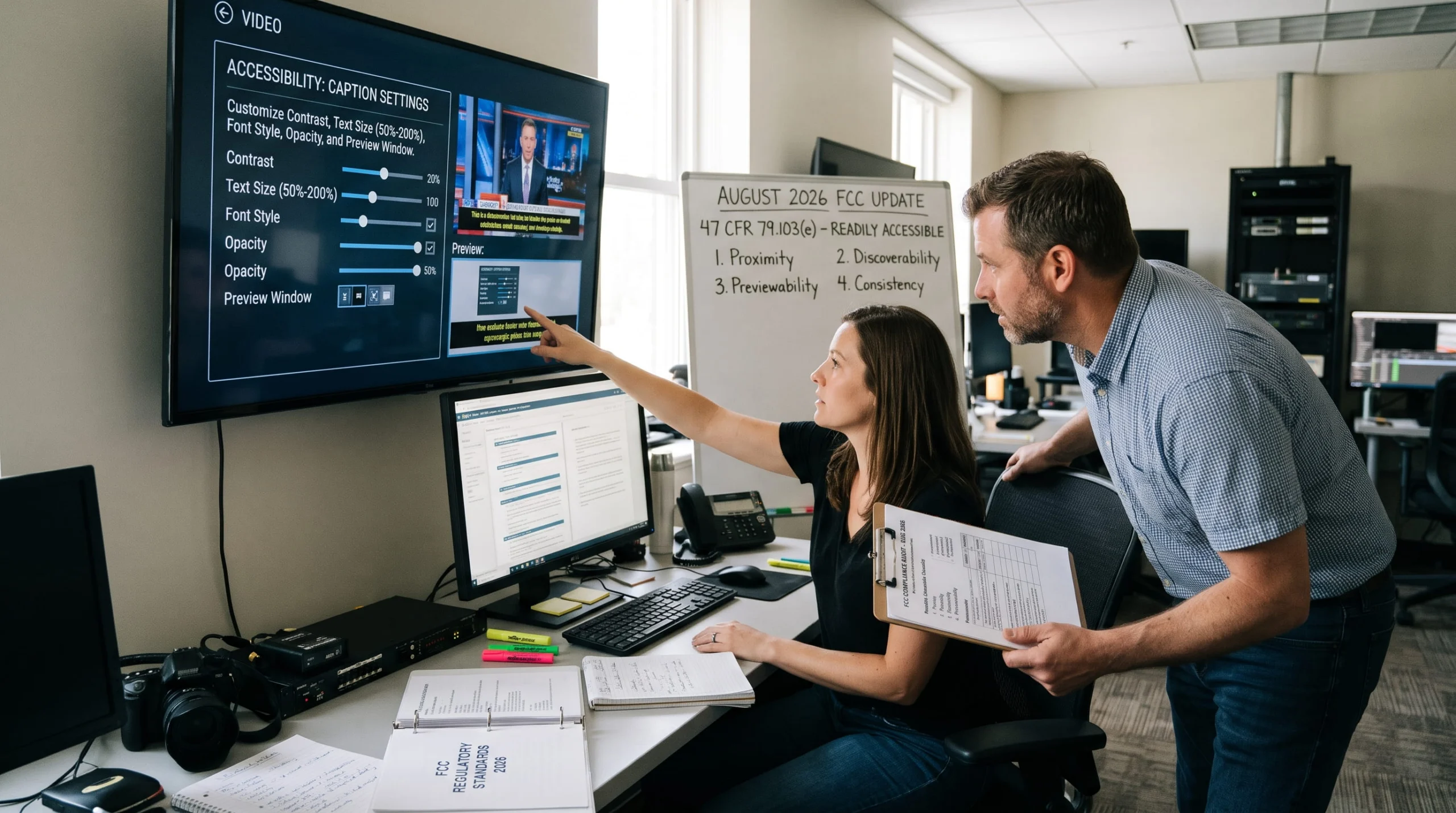
- Caption display settings (2026): Manufacturers of covered devices and multichannel video programming distributors (MVPDs) must make caption display settings “readily accessible.”
The FCC set August 17, 2026 as the compliance date for that third layer. It applies to devices using next-generation operating systems deployed after that date; older equipment can still be sold and used. The FCC weighs four factors: proximity, discoverability, previewability, and consistency and persistence.
In practice, meeting FCC captioning requirements now means captions that meet the quality standards and settings viewers can find without digging through menus. Verbit covered the FCC caption display deadline in more detail when the date was set.
Captioning Standards for Media and Entertainment
Media and entertainment organizations face the most layered captioning standards – and the most visible, since millions of viewers notice a missed name or a caption covering the scoreboard.
- Broadcast and cable: FCC quality standards apply to live and prerecorded programming. Live news and sports are the hardest cases, with names, jargon, and crosstalk landing in real time.
- Streaming and VOD: Online distribution of TV content triggers the FCC’s IP captioning rules. In the UK, Ofcom’s draft Tier 1 Accessibility Code would require major streamers to subtitle 80% of their catalog, audio describe 10%, and sign 5%, with final codes expected later in 2026.
- EU distribution: The European Accessibility Act has applied since June 28, 2025, including to services that provide access to audiovisual media.
- Advertising: Only 28% of TV/CTV ads in the U.S. included captions in 2025, even though 61% of 25-34-year-olds say captions make them more likely to pay attention to ads.
The practical answer for most media teams is tiered workflows. Live broadcasts benefit from AI trained on show-specific prep – Verbit’s Captivate for media, for instance, uses custom dictionaries and prep materials and displays speaker names in live captions. In post-production, high-volume libraries can run on AI captioning, while premium or distribution-bound releases add human QC. That’s the split behind Captivate Post and Post Plus, which add sound-effect labels, music notes, caption placement review, and offscreen speaker identification. Teams expanding internationally can add AI dubbing and localization on the same platform.
Caption Guidelines: The Four Pillars of Quality Standards
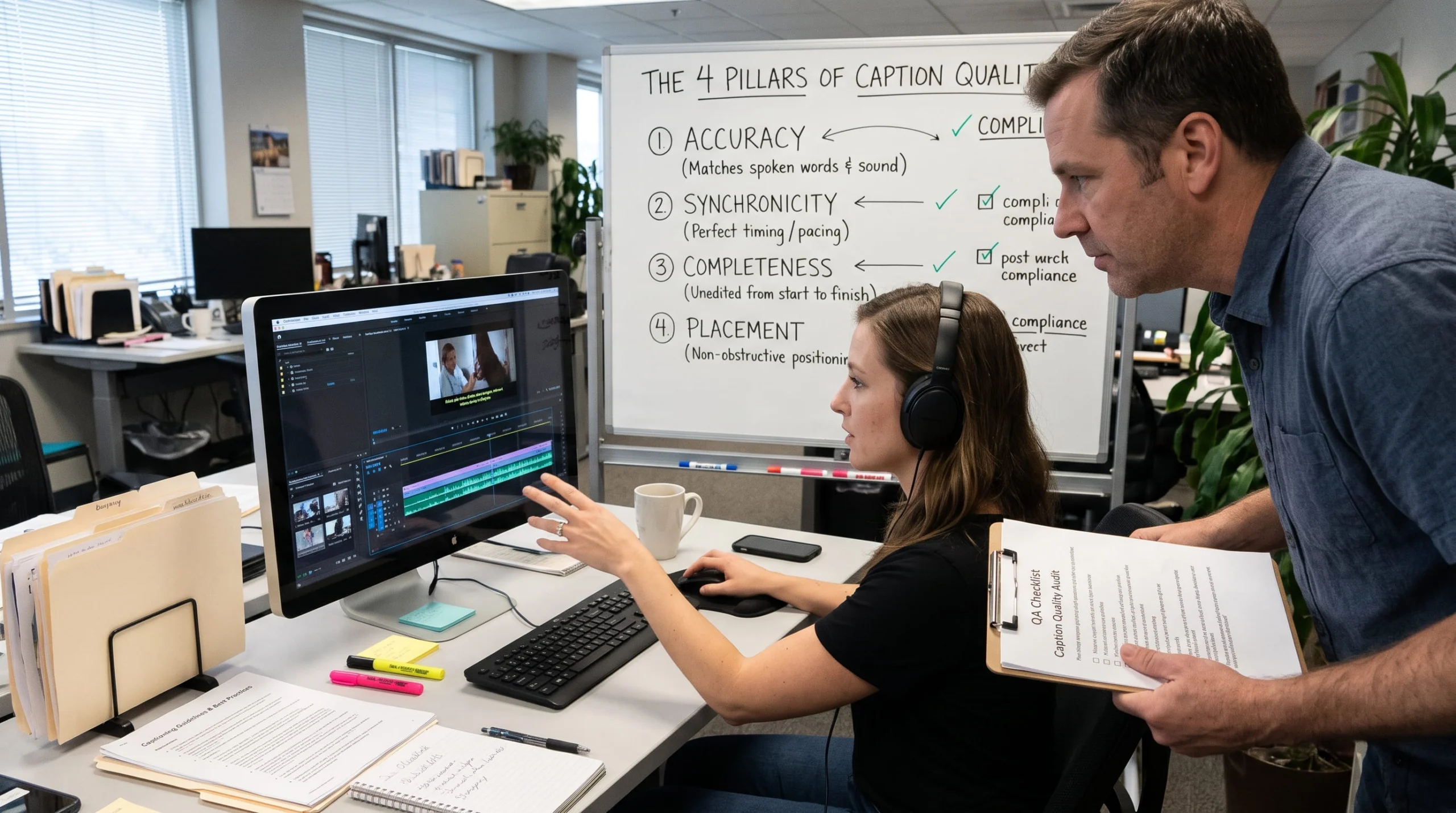
Following caption guidelines helps your content meet both FCC and ADA expectations, whether it airs on TV or lives on a website. Professional caption guidelines rest on the same four pillars the FCC uses.
Accuracy
Captions should match the spoken words, including proper names, technical terms, speaker identification, and relevant non-speech audio. The FCC doesn’t set an accuracy percentage; it weighs errors in context and recognizes that live captioning is harder than prerecorded. The biggest accuracy wins come from preparation – names, show rundowns, syllabi, or meeting agendas loaded before captioning starts.
Synchronicity
Captions should appear in time with the audio and stay on screen long enough to read. Lag makes it hard to match words to speakers and ruins timing-dependent moments like punchlines or play-by-play.
Completeness
Captions should run from start to finish, including dialogue, off-screen narration, meaningful sound effects, and song lyrics when they matter.
Placement
Captions shouldn’t block faces, on-screen text, lower thirds, or graphics like sports scores. They should stay legible against changing backgrounds and adapt to different screen sizes and aspect ratios, including vertical video.
Captioning Technology Advancements: AI vs. Human Captioning in 2026-2027
AI has transformed the speed and cost of captioning, but generic, off-the-shelf AI captions still fall short on quality standards that matter for compliance.
| Common AI weakness | Quality standard at risk | Example |
|---|---|---|
| Non-speech audio omitted | Completeness | Missing [applause], [music], or [phone rings] |
| Accents and dialects | Accuracy | Regional speech misheard |
| Technical terminology and names | Accuracy | Player names, legal terms, or STEM terms garbled |
| Speaker changes | Accuracy | Crosstalk captioned as one speaker |
| Context | Accuracy | Homophone errors (their/there/they're) |
| Caption position | Placement | Captions covering on-screen text or scores |
Whoever creates your captions, the organization publishing the video owns the compliance risk, so validate vendor output against the four pillars.
Using a Hybrid Approach to Meet Captioning Standards
Industry best practices today come down to choosing a workflow – human, AI, or a combination – that matches the content’s risk and needs. Often times, domain-trained AI is now used to handle large content volumes at speed. Human review comes in to cover content where accuracy, completeness, or distribution standards are non-negotiable or companies don’t have the bandwidth to check the AI’s work. Verbit’s Captivate speech recognition offers users the best of both – delivering high levels of accuracy with AI alone, and up to 99% targeted accuracy when paired with professional review. Verbit’s Captivate Post Plus offers the same dual method and flexibility to media and entertainment professionals.
A typical hybrid workflow runs AI transcription and timing first, then human review to add non-speech audio, correct names and terminology, verify speaker IDs, and check sync and caption placement.
Business Impact of Captioning: Viewer Engagement & Expectations
Captions are now a mainstream viewing habit, driven by younger viewers. In the XR study, nearly 60% of 18-24-year-olds use captions always or often, compared with 27% of viewers over 65. An AP-NORC poll from 2025 found the top reasons people use subtitles are to catch every word and follow accents.
Captions also keep people watching. In a widely cited 2019 Verizon Media and Publicis Media study, 80% of consumers said they’re more likely to watch an entire video with captions, and 69% said they watch with the sound off in public.
SEO Benefits of Captioning: Making Video Content Discoverable
Search engines and AI answer engines can’t ‘watch’ a video, but they can read a transcript. Caption files and transcripts turn spoken content into indexable, keyword-rich text that supports search visibility, watch time, and engagement signals. For media publishers, transcripts also feed show notes, clips, and metadata. Here’s more on how captions and transcripts improve SEO.
Who Benefits from Captions?
| Audience | Primary benefit | Impact |
|---|---|---|
| People who are Deaf or have hearing loss | Essential access | Legal compliance and inclusion |
| Non-native English speakers | Comprehension support | Better understanding and retention |
| Viewers in noisy places | Audio alternative | Watching on transit, in gyms, or in offices |
| Viewers in quiet places | Silent viewing | Late-night viewing, libraries, and shared spaces |
| Neurodivergent viewers and learners | Multi-modal processing | Easier focus and comprehension |
| Younger audiences | Default viewing habit | Higher engagement and ad attention |
Transcript Guidelines for Educational, Government, and Corporate Content
Transcripts are the accessible alternative for audio-only content like podcasts and recorded calls, and a useful companion to captioned video. Following transcript guidelines – speaker labels, accurate terminology, and notes on relevant non-speech audio – creates searchable, accessible archives. Implementing transcript guidelines consistently also turns meetings, lectures, and hearings into reusable records. Verbit’s transcription services support all three sectors below.
Education Sector Applications
Public colleges and universities face the April 2027 and 2028 ADA Title II deadlines. Verbit’s education accessibility solutions, including Campus Complete, cover live captioning for lectures and hybrid classes, captions for recorded lessons in learning management systems, and both AI audio description and professional audio description. eLearning platforms such as Coursera, Skillshare, and Udacity have worked with Verbit on captioning at scale.
Students use captions and transcripts to review material, follow technical vocabulary, and study in a second language, so accessible content supports far more learners than those who request accommodations.
Government Sector Requirements
Federal agencies follow Section 508 of the Rehabilitation Act, and state and local governments follow ADA Title II; both point to WCAG. Verbit’s government accessibility services cover live captioning for public meetings, transcripts for the public record, audio description, and multilingual access. Civic Complete packages them in one plan with SOC 2 Type II security and a GSA Schedule for procurement.
Corporate Sector Applications
Companies use video for town halls, training, onboarding, earnings calls, and marketing. Captions and transcripts serve employees and customers who are Deaf or have hearing loss, address Title III and European Accessibility Act exposure, and make internal knowledge searchable. Verbit’s corporate captioning and transcription covers live events, recorded content, and translation, with security and data protections built for enterprise content.
Quality Counts: Accuracy and Delivery Standards
Accuracy is the foundation of closed captioning. Without it, meaning gets lost, especially with accents, fast speech, crosstalk, and background noise. Organizations that caption in-house often spend more time than expected on cleanup and still miss names and non-speech audio.
Delivery matters just as much. Live captions need low latency so viewers aren’t a sentence behind the speaker, whether they’re watching a newscast, a game, or a lecture. For live broadcasts, sports, and events, Verbit’s Media Live captioning combines Captivate with professional captioners.
Implementing Compliant Captioning Solutions into 2027
Closed captioning has moved from “nice to offer” to expected – often required by law and preferred by most viewers. With the FCC display rule in effect and ADA Title II deadlines set for 2027 and 2028, now is the time to plan:
- Audit your library by risk. Separate compliance-critical and premium content from high-volume, lower-stakes video.
- Match the workflow to the content. Use AI for volume and human review where accuracy and completeness can’t slip.
- Check against the four pillars. Confirm captions include non-speech audio, speaker IDs, and proper placement.
- Plan for live content. Public meetings, lectures, broadcasts, and events need real-time captions.
- Don’t stop at captions. WCAG also calls for audio description of prerecorded video.
- Think globally. For UK or EU distribution, factor in Ofcom’s streaming code, the European Accessibility Act, and subtitle translation.
Verbit’s captioning solutions for live and recorded video combine Captivate speech recognition with professional captioners, so media companies, schools, agencies, and businesses can choose the right level of AI and human review for each piece of content.
FAQs on Closed Captioning Standards
What is closed captioning?
Closed captioning is a text version of a video’s audio that viewers can turn on or off. Unlike basic subtitles, it includes speaker identification, sound effects, and music cues, so people who are Deaf or have hearing loss – and anyone watching muted – get the full experience.
What are captions vs. subtitles?
Captions are in the same language as the audio and include non-speech information like [laughter] or [door slams]. Subtitles usually translate dialogue only, for viewers who can hear but don’t speak the language. Accessibility laws and WCAG require captions, not subtitles alone.
What are the FCC captioning requirements in 2026?
TV programming must meet the FCC’s four quality standards: accuracy, synchronicity, completeness, and placement. Captioned TV content must stay captioned online. And since August 17, 2026, covered devices and MVPDs must make caption display settings readily accessible.
What are the ADA captioning requirements for 2027?
Under ADA Title II, state and local governments and public colleges with populations of 50,000 or more must meet WCAG 2.1 Level AA by April 26, 2027. Smaller entities and special districts have until April 26, 2028. That includes captions for prerecorded and live media.
Are AI-generated captions compliant?
They can be, if they meet the quality standards. Generic AI captions often miss non-speech audio, names, and speaker changes. Domain-trained AI with human review for compliance-critical content is the most reliable way to meet FCC and WCAG expectations at scale.
Do captions help SEO?
Yes. Search engines and AI answer engines can’t watch video, but they can index caption files and transcripts. That text helps videos surface for relevant searches and supports longer watch time.