

Litigation teams and attorneys, court reporting agencies and digital reporters, and court administrators managing high-volume depositions, hearings, and trials who need transcription that scales.
Key Takeaways
Court stenographers are retiring five times faster than new ones enter the field, right as litigation demand hits its highest point, leaving legal teams with a real capacity problem. This piece covers how AI transcription is stepping in to close that gap, and where human review and ethical oversight still have to stay in the loop before anything becomes a certified final transcript.
AT A GLANCE
- ~1,100 stenographers retire yearly vs. only ~200 new reporters entering the field
- AI speeds up rough drafts and cuts cost, but certified transcripts still need human review
- ABA Formal Opinion 512 requires attorney oversight before AI-assisted output goes to court
WHO SHOULD READ THIS
Estimated Reading Time
8 minutes
The legal industry has a math problem. Roughly 1,100 court stenographers retire every year, while only about 200 new reporters enter the field to replace them, a gap that’s been widening for years and shows no sign of closing on its own. At the same time, litigation demand just had its strongest year since the financial crisis, according to the Thomson Reuters Institute’s 2026 Report on the State of the US Legal Market, and firms are pouring money into AI to keep up without fully rethinking how they bill or staff for it.
Put those two facts together and you get an industry that needs more accurate, more available, more scalable transcription capacity than ever, right as the traditional supply of that capacity is shrinking. That’s the real story behind “AI in legal transcription” in 2026. It’s not a novelty feature anymore. For courts, court reporting agencies, and litigation teams, it’s becoming core infrastructure.
Here’s where the technology actually stands, where it fits into legal work more broadly, and what to know before your firm adopts legal AI solutions.
Where AI Is Already Doing Legal Work
Transcription is the most visible use case, but it’s one piece of a much broader shift. Legal teams are now using AI across the case lifecycle:
- Legal research, where machine learning tools surface relevant case law and precedent far faster than manual review
- Contract review, flagging risk language and non-standard clauses across large document sets
- Document management, making case files searchable instead of buried in folders
- Drafting support, using precedent to help produce first drafts of routine documents
- Predictive case analysis, using historical outcomes to inform strategy and risk assessment
- Back-office automation, handling repetitive work like intake and billing
If that list sounds familiar, it should. It’s the same territory covered in more depth in Verbit’s Top Legal AI Trends for 2026 and how law firms are actually adopting legal tech right now, worth a read if you want the fuller picture. The throughline across all of it: the firms getting real value aren’t the ones chasing the flashiest tool. They’re the ones solving a specific, well-defined workflow problem.
Transcription is arguably the clearest example of that, because the workflow problem is so concrete: someone has to turn spoken testimony into an accurate, usable, admissible written record, at volume, under time pressure, without errors.
Why Legal Transcription Specifically Is Under Pressure
Depositions, hearings, arbitrations, and trials generate enormous amounts of spoken record, and legal teams need that record fast, searchable, and precise. Traditional stenography is still the gold standard in many courtrooms, but it’s also a shrinking resource. The National Court Reporters Association has tracked an aging membership and a certification pipeline that isn’t keeping pace with retirements, which is part of why “digital court reporting,” a hybrid of audio capture and AI-assisted transcription, has moved from workaround to standard practice in many jurisdictions.
This is where AI-powered transcription earns its keep. It doesn’t replace the judgment of a skilled reporter or the certification process a transcript needs to be court-admissible. What it does is compress the time between “testimony happens” and “usable transcript exists,” and it does that at a scale human transcription alone can’t match anymore.

Legal Capture: Built for the Realities of a Live Proceeding
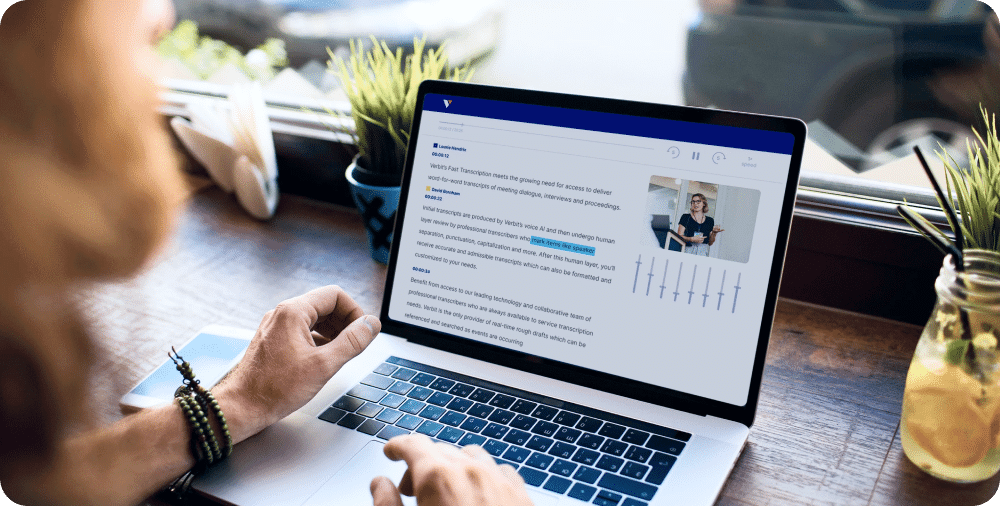
Verbit’s platform for this is Legal Capture, real-time and recorded transcription purpose-built for legal proceedings rather than adapted from a general-purpose transcription tool. A few things worth knowing about how it actually works:
- Real-time editing to help correct the record as it’s written, offering live corrections without annotations, to help fix mispronounced names, technical terms, or an unclear utterance the moment it occurs using real-time context you don’t get with recordings.
- Voice-signature speaker identification learns individual speakers’ voices during a proceeding and applies that recognition automatically, rather than relying on manual tagging.
- Automatic Q&A labeling picks up examination patterns and carries them through the rest of the session.
- Instant rough drafts are available the moment a proceeding ends, so counsel isn’t waiting days for a usable record.
- Certified final transcripts still go through professional review before delivery, which is what makes them usable in court.
- AI summaries generate searchable summaries and keyword indexing across long transcripts, useful for quickly finding the moment in a six-hour deposition that actually matters.
It’s worth noting Legal Capture is one part of a broader stack. Litigation teams doing heavy deposition work often pair it with Legal Visor which is designed to help attorneys with real-time inconsistency detection during testimony, and rely on Verbit’s overall legal transcription services for the certified, court-ready final product across in-person, remote, and hybrid proceedings.
The Actual Benefits of Using Legal AI, Not the Marketing Version
Cutting through the sales language, here’s what AI-assisted transcription changes in practice:
Turnaround. Rough drafts that used to take days are available same-day, sometimes immediately, which matters when counsel needs to prep for the next session using what was just said in this one.
Cost. AI-assisted workflows are generally more affordable than pure human transcription at scale, which matters more now that reporter scarcity is also pushing rates up.
Accuracy on hard audio. Legal-trained speech models handle domain terminology, overlapping speakers, and accents more reliably than general-purpose transcription, though accuracy still depends heavily on audio quality and proper setup.
Searchability. A transcript that’s automatically indexed and summarized is dramatically more useful than one that just exists as a static document. This is arguably the most underrated benefit: it’s not just about producing the transcript, it’s about what a legal team can do with it afterward.
Scale. Firms handling high case volume or multi-jurisdiction litigation can flex capacity up or down without being capped by reporter availability in a given market.
Time. Every hour not spent formatting or hunting through a transcript is an hour back on actual case strategy or options to take on more transcription jobs, which is the point of adopting any of this technology in the first place.
The Part That Doesn't Get Talked About Enough: Ethics and Oversight
Because this is now infrastructure, not a novelty, it comes with obligations. The American Bar Association’s Formal Opinion 512 on generative AI lays out what lawyers are on the hook for: understanding the tools they use (competence), protecting client data when using them (confidentiality), and, critically, reviewing AI-assisted output before it goes anywhere near a filing or the record. A transcript is only as good as the review process behind it, and “the AI did it” is not a defense if an error makes it into a certified record.
That’s also the argument for working with a platform built specifically for legal use, with real certification, security compliance (SOC 2 Type II, ISO 27001), and human review built into the workflow, rather than a general consumer transcription app. It’s a meaningfully different risk profile. If your firm is formalizing its approach to AI-assisted proceedings, Verbit’s guide to modern deposition preparation is a good next read for what that looks like in practice.
Want to see how Legal Capture handles a live proceeding, or talk through where it fits into your firm’s current workflow? Request a demo to meet live with a Verbit legal specialist.
Frequently Asked Questions on Legal AI Transcription
Is AI-generated legal transcription admissible in court?
Yes, when it goes through the proper certification process. AI accelerates the initial transcription (rough drafts, real-time capture), but certified final transcripts, the ones that carry evidentiary weight, still go through professional reviewer sign-off. The AI speeds up the process; it doesn’t replace certification.
How accurate is AI transcription for depositions and hearings?
Legal-specific AI models trained on domain terminology and multi-speaker audio significantly outperform general-purpose transcription tools on legal proceedings, but accuracy is still affected by audio quality, background noise, and speaker overlap. That’s why platforms like Legal Capture combine AI transcription with human review for anything that needs to be certified.
What's the difference between Legal Capture and Legal Visor?
Legal Capture handles the transcription itself, real-time and recorded, live editing, rough drafts, certified finals. It is used mainly by court reporters and digital court reporting firms, including NAEGELI Deposition & Trial. Legal Visor operates on top of that and is designed mainly for attorneys, surfacing real-time AI insights and inconsistency detection during a deposition so litigators can act on what’s being said as it happens. Attorneys at law firms like Smith, Gambrell & Russell are seeing great benefit in using Legal Visor in the work.
Why is there a court reporter shortage, and does AI solve it?
Retirements are outpacing new certifications by a wide margin, a trend the NCRA and multiple state courts have flagged for several years. AI doesn’t replace certified reporters, but AI-assisted “digital court reporting” workflows let the existing pool of reporters and reviewers cover far more volume than manual transcription alone, which is functionally how the industry is managing the gap today.