

Executive leadership and HR professionals at multi-state or federal-contractor employers, plus corporate compliance/legal teams and business strategists thinking about talent acquisition.
Key Takeaways
Disability inclusion has shifted from a values statement to a business case: more people with disabilities are actively job-hunting even as federal DEI policy pulls back and states like Minnesota and California push accommodation protections forward. This piece unpacks the 2026 employment data, the diverging federal-vs-state legal landscape, and what multi-state employers should actually do about it.
AT A GLANCE
- Labor force participation for people with disabilities is rising even as employment ratio dips slightly
- Federal DEI rollback (EO 14398) contrasts with advancing state laws (MN, CA) on accommodation
- Structured hiring programs can scale: Disability:IN's program alone placed 400,000+ people
WHO SHOULD READ THIS
Estimated Reading Time
11 minutes
Here’s why disability inclusion in the workplace belongs on every executive’s radar in 2026: the companies getting it right are pulling ahead on talent, innovation, and risk, while everyone else scrambles to catch up. This stopped being a values exercise a while ago. It’s a competitive one now.
That urgency is backed by real momentum: more people with disabilities are entering the labor force and actively job hunting than in recent memory, even as the job market stays tight for them. That’s a deep, motivated talent pool sitting there for employers who show up for it.
Timing makes it more urgent still. Federal policy is pulling back some protections just as states are adding new ones, so staying committed to disability inclusion now also means managing legal risk better than the competition. It’s not a compliance box to check anymore. It’s a strategic advantage, and the only real question is how fast you catch up.
The scale already proves it. Disability:IN’s Inclusion Works program has placed more than 400,000 people with disabilities into jobs, and hundreds of companies now track their progress against it every year. Prioritize disability inclusion and you gain a workforce of over 6.4 million employed workers with disabilities, sharper thinking from diverse teams, and a real edge in a labor market where good talent is hard to find.
The Current State of Disability Inclusion: May 2026 Employment Data
So what does the data actually say? In May 2026, about 6,484,000 workers with disabilities were employed in the United States, or 4.3% of the total working-age workforce, according to the May 2026 nTIDE report from the Kessler Foundation and University of New Hampshire. That’s real progress, but it also shows there’s still plenty of room to grow.
Look year over year and a pattern jumps out. Employment among people with disabilities slipped a touch, from 38.0% in May 2025 to 37.8% in May 2026. At the same time, labor force participation climbed from 41.4% to 42.0%. Translation: fewer people with disabilities are employed relative to the population, but more of them are actively job hunting than before.
The gap between people with and without disabilities is still wide. In May 2026, the employment-to-population ratio for people without disabilities sat at 75.0%, nearly double the rate for people with disabilities. That gap is the clearest sign that structural barriers, not a lack of willingness, are still keeping people out of the workforce.

| Employment Metric | May 2025 | May 2026 | Change |
|---|---|---|---|
| Employment-to-Population Ratio (with disabilities) | 38.0% | 37.8% | -0.2 pts |
| Labor Force Participation Rate (with disabilities) | 41.4% | 42.0% | +0.6 pts |
| Employment-to-Population Ratio (without disabilities) | 74.8% | 75.0% | +0.2 pts |
| Total Workers with Disabilities Employed | -- | 6,484,000 | -- |
Source: nTIDE Jobs Report, Kessler Foundation & University of New Hampshire Institute on Disability
Why is this happening? Economic pressure is a big part of it. Kessler Foundation researcher Dr. Andrew Houtenville points out that people with disabilities are more than twice as likely to live in families with incomes below the poverty line, which makes rising costs especially painful for these households. So the surge in job hunting isn’t just ambition, it’s necessity: people with disabilities are looking for work to keep up with inflation and build some financial footing.
Legislative Changes Reshaping Disability Inclusion in the Workplace
Federal policy is adding real urgency here, especially for contractors. On March 26, 2026, Executive Order 14398, “Addressing DEI Discrimination by Federal Contractors,” told federal agencies to add clauses to their contracts requiring contractors to agree they don’t engage in “racially discriminatory DEI activities.” The order is mainly about race and ethnicity, but it’s part of a broader rollback of diversity, equity, inclusion, and accessibility (DEIA) initiatives that have long benefited people with disabilities too.
The order spells out what counts as a violation (disparate treatment based on race or ethnicity in hiring, promotions, and other employment decisions) and backs it up with real teeth, including contract termination for noncompliance. That’s serious pressure for federal contractors, and it raises a fair question: will this chill disability inclusion programs along the way?
This isn’t the first time protections have been rolled back. Executive Order 11246, signed by President Lyndon B. Johnson to prohibit discrimination in federal contracting, was rescinded in January 2025. Legal experts are quick to point out that lawful DEIA initiatives, things like employee resource groups and accessibility training, aren’t inherently discriminatory. Rolling them back could even backfire, since those programs often serve as a contractor’s best defense against discrimination lawsuits in the first place.
State-Level Advances Strengthening Protections
States are telling a different story. Minnesota’s 2026 legislative session delivered real wins, amending the Minnesota Human Rights Act to clarify exactly how reasonable accommodations should be determined. The headline change: failing to even engage in that accommodation process can now count as discrimination on its own.
California moved just as fast. Its new Workplace Know Your Rights Act (SB 294), effective February 1, 2026, requires employers to send an annual written notice covering employee rights, including workers’ compensation and union organizing protections. Other new California laws tackle pay equity, personnel file access, and bias mitigation training, all pushing toward more inclusive employment practices.
For companies operating across state lines, that creates a real headache: comply with a federal environment that’s pulling back, while keeping pace with states that are pushing forward. Multi-state employers now need disability inclusion programs sturdy enough to satisfy the strictest state on the map.

Corporate Initiatives Driving Inclusive Employment Forward
The business case for disability inclusion keeps getting stronger. Disability:IN’s Inclusion Works program has grown from 339 new hires in 2015 to more than 400,000 people with disabilities hired as of November 2024, solid proof that structured hiring initiatives can scale. In 2024, 542 companies across eight countries submitted to the 2024 Disability Equality Index®, and by 2025 participation had already topped 500 corporations globally. Disability inclusion has clearly gone mainstream: it’s a core piece of corporate strategy now, not a side initiative. Verbit recently joined Walmart and Disability:IN for a live conversation on exactly this shift.
Frameworks like the Disability Equality Index® matter because they give companies something to measure against. Instead of guessing what’s working, organizations can benchmark themselves against peers, spot the gaps, and fix them year over year.
And the payoff goes well beyond compliance. Professionals with disabilities are advancing in their careers, often by switching companies, which points to a genuinely dynamic, competitive labor market. Companies that invest in disability inclusion aren’t just checking a box: they’re competing for experienced people who have real options and aren’t afraid to use them.
Looking ahead, three opportunities keep coming up: leveraging generative AI to expand participation and spark new ideas, building neuroinclusive workplaces that support neurodivergent employees, and supporting every employee across their full journey with the company. All three point the same direction: disability inclusion is becoming a genuine driver of business success, not just a defensive move.
Implementing Disability Inclusion Training and Best Practices
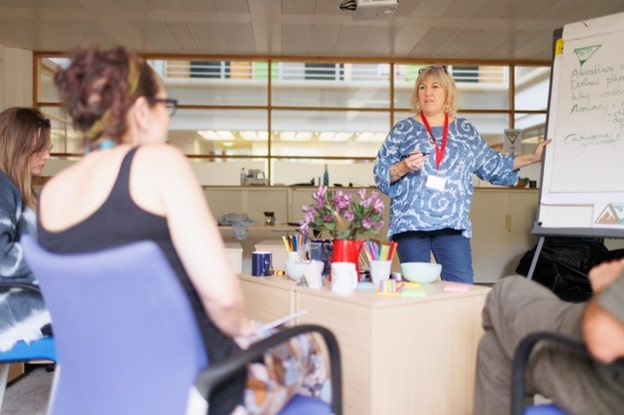
Getting this right takes more than good intentions. It takes policy support and real commitment to accessibility. Best practices for disability inclusion in the workplace start with reasonable accommodation processes and accessibility audits that catch barriers before they become problems. Good disability inclusion training helps employees actually understand how accommodations work, building a culture where everyone can do their best work.
Why a Diversity Training and Support Center Pays Off
Companies that invest in disability inclusion training see it pay off twice over: a stronger workplace culture and lower discrimination risk. A well-designed diversity training and support center gives employees and managers one clear place to go for guidance, whether that’s accessible communication norms or assistive technology integration. Keep that support centralized and consistent, and people actually use it when they need it. Live captions for team meetings and company town halls go a long way here too, turning a session some employees could only partially follow into one everyone can engage with in real time. It’s worth the investment too: research shows accessibility accommodations also boost workplace productivity across the board.
Physical accessibility is still the foundation. Think wheelchair-accessible entrances and facilities, adjustable workstations and ergonomic furniture, accessible restrooms and common areas, clear signage with braille and large print, and lighting and acoustics tuned for different sensory needs. None of this only helps employees with disabilities either. It makes the whole workspace more comfortable and functional for everyone.
Digital accessibility matters just as much in a technology-driven workplace. Websites, intranets, and internal tools need to meet Web Content Accessibility Guidelines (WCAG) standards under the Americans with Disabilities Act. In practice, that means captions on recorded training videos and onboarding materials, transcripts employees can search and reference long after a meeting ends, alt-text on images, full keyboard navigation, and screen reader support that actually works. Partnering with inclusive employment services helps turn all of this from a policy on paper into something candidates and employees experience every day.
Building Workforce Inclusion Through Accessibility and Accommodation
Real workforce inclusion means building an environment where neurodivergent employees can thrive, not just get by. That means dropping the one-size-fits-all approach and accepting that different people need different kinds of support. Flexible work, remote options, flexible scheduling, job sharing, can be the difference between someone being employed or not, and a more inclusive hiring process has to start even earlier, at the interview itself.
Technology is playing a bigger role too. Effective AI like Verbit’s can deliver real-time captioning in meetings, turn recordings into searchable transcripts employees can revisit later, convert text to speech for employees with visual impairments, and take routine tasks off someone’s plate. None of this replaces human judgment or connection. It just extends accessibility further, so more people can participate fully, which is really what celebrating neurodiversity every day should mean, not just on one awareness day a year.
The reasonable accommodation process has to actually work, not just exist on paper. Minnesota’s 2026 legislative changes make that explicit: failing to even engage in the process can count as discrimination on its own. That raises the stakes for any employer still treating accommodation requests as an afterthought. Good practice looks like this: name a clear point of contact, set real timelines for response and implementation, have an actual back-and-forth conversation with the employee, document everything, and revisit the policy on a regular cadence.
Employee resource groups for people with disabilities do double duty. They build community, and they give leadership honest feedback on what’s actually working. They’re also a natural first stop for managers who want to support their teams better but aren’t sure where to start.

The Path Forward: Urgency and Business Opportunity
A few things are converging right now to make disability inclusion urgent. Economic pressure is pushing more people with disabilities into the labor force, growing the talent pool. Federal rollbacks and state-level advances are pulling in opposite directions, adding compliance complexity for multi-state employers. And professionals with disabilities are more mobile and career-focused than ever, so companies have to actually compete for this talent instead of assuming it’ll show up.
Here’s the irony worth sitting with: rolling back federal DEIA protections could actually raise the risk of discrimination lawsuits for companies that abandon their inclusion programs altogether. Meanwhile, the evidence keeps piling up that disability inclusion drives innovation, expands market reach, and improves business performance overall. Companies that stay the course, even with policy uncertainty swirling, put themselves in position to capture those gains while everyone else hesitates.
So what should employers actually do? Four things:
- Maintain disability inclusion programs despite federal policy uncertainty, since state laws keep advancing protections regardless.
- Leverage rising labor force participation to reach untapped talent pools actively looking for work right now.
- Build out thorough reasonable accommodation processes that meet new state-level requirements.
- Measure and track disability inclusion metrics using established frameworks like the Disability Equality Index®.
The 2026 data tells a clear story: more people with disabilities are seeking work than ever before. The real question is whether your workplace is ready to meet them there, to build an environment where everyone can contribute, advance, and thrive. Say yes to that, and you gain access to talent, innovation, and an edge your competitors will struggle to match.
Ready to make your workplace more accessible? Explore how assistive technology options like Verbit’s can support your disability inclusion initiatives, or request a demo to discuss how we can partner to build a more inclusive environment where more employees can succeed.