


Court reporters, legal transcriptionists, and law firm administrators.
Table of contents
- The Crisis Driving Court Reporting
- Choosing Legal Transcription Software
- How Digital Court Reporting Addresses the Workforce Shortage
- The Rise of AI Court Reporters
- Automated Transcription for Legal Proceedings
- Real-Time Transcription for Court Hearings
- Implementation Roadmap
- The Future of Court Reporting
- The Path Forward
Key Takeaways
AI-powered transcription tools help legal professionals overcome stenographer shortages and manage heavy caseloads. By combining automated speech recognition with human review, these systems deliver fast and accurate transcripts to streamline courtroom operations.
AT A GLANCE
- Demonstrates how AI automation significantly reduces transcription turnaround times.
- Highlights solutions for bridging industry-wide stenographer and court reporter shortages.
- Explains how adaptive algorithms improve legal terminology recognition over time.
WHO SHOULD READ THIS
Estimated Reading Time
7 min read
Courts and legal teams across the country are working with a shrinking pool of certified court reporters. Nationally, there are only around 17,700 active court reporters to serve the entire country’s legal system, and fewer new reporters are entering the field each year than are retiring. That gap shows up as real scheduling friction for legal teams trying to secure documentation for depositions, hearings, and trials.
AI transcription has emerged as one practical way to help close it, not as a replacement for the expertise court reporters bring, but as another option courts and agencies can lean on when a stenographer isn’t available or when caseloads outpace staffing. As AAERT Executive Director Matt Riley put it in the association’s 2025 Court Reporting Industry Trends report, “Digital court reporting isn’t a compromise – it’s a necessary expansion of the industry.”
So will AI replace court reporters? Not in any way that’s currently on the table. The technology’s real role is as an enhancement tool: modern AI transcription systems pair artificial intelligence with human verification, so legal teams get speed without losing the oversight legal proceedings require. This hybrid approach is specifically aimed at the scheduling pressure that 76% of legal professionals cite as their biggest challenge – giving courts and firms a reliable fallback rather than a reason to delay a deposition or postpone a hearing.
The integration of AI transcription into legal workflows is a practical, incremental response to a staffing challenge the industry has been watching build for years.
The Crisis Driving Court Reporting Technology Innovation
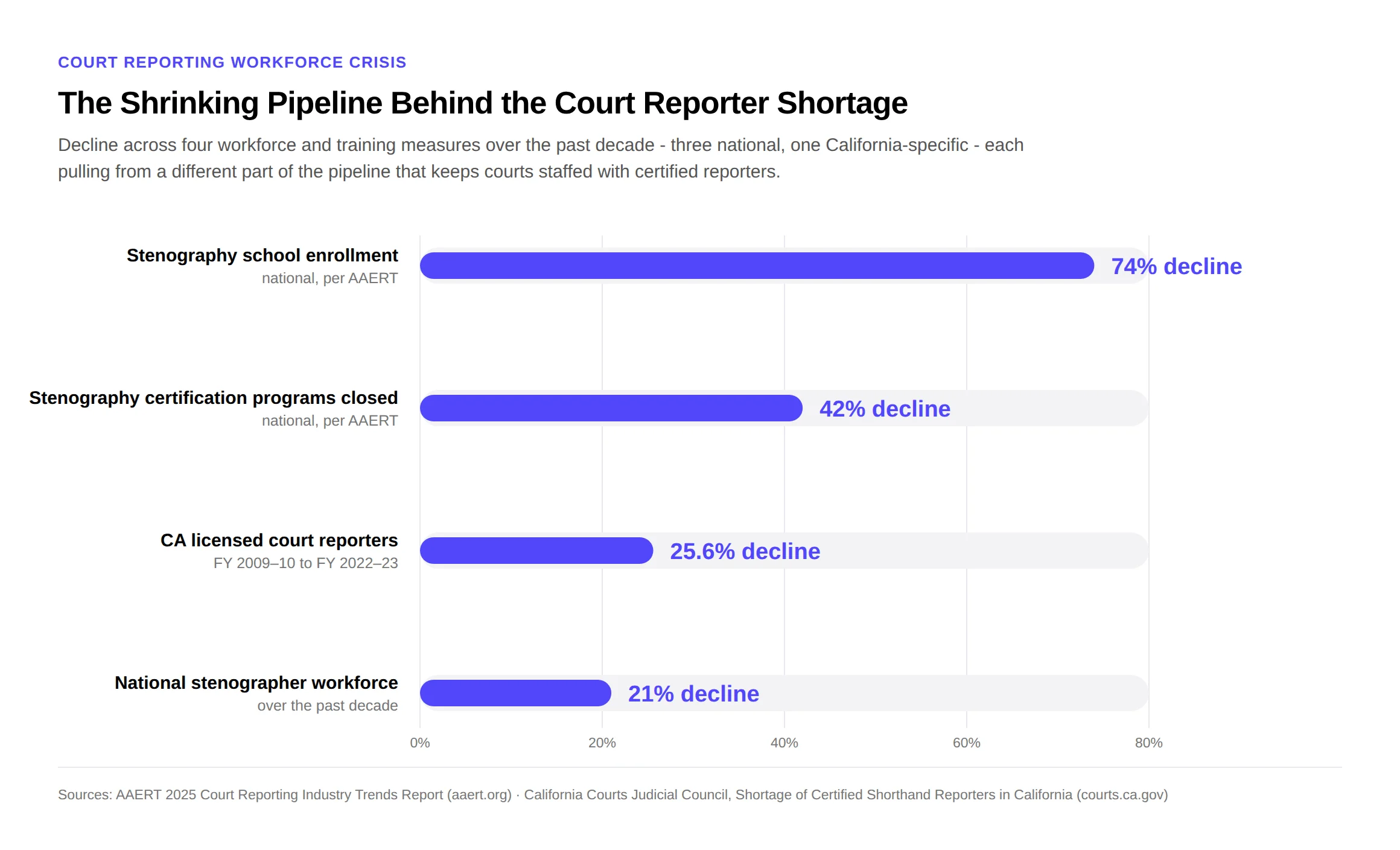
Court reporting technology has evolved to help address the shortage of traditional stenographers. The workforce decline has been steady: the profession has seen a 21% decline in stenographers over the past decade, with California specifically seeing a 25.6% decrease in active court reporters between fiscal years 2009-10 and 2022-23. The training pipeline has narrowed as well, with only eight state-recognized court reporting programs remaining open, down from 17 in 2010, alongside a 74% drop in stenography school enrollment.
The demographics add to the picture. The average court reporter is approximately 56 years old, and nearly half of active California licenses were issued 30 or more years ago – meaning a meaningful share of the current workforce is approaching retirement over the next decade. New licensing hasn’t kept pace: California issued only 176 new CSR licenses statewide in fiscal year 2024-25.
This has created real scheduling pressure for legal professionals, with 76% citing court reporter scheduling as their biggest challenge. Depositions can be delayed and hearings rescheduled while legal teams wait for reporter availability. The impact isn’t just inconvenience – it can affect case timelines and how quickly legal teams can move matters forward.
Choosing Legal Transcription Software: Accuracy and Security Standards
Understanding AI transcription accuracy in legal settings starts with recognizing there’s no single accuracy threshold that applies across every legal workflow. Courts don’t set one blanket standard, but a few real benchmarks are useful reference points: the NCRA’s RPR certification exam requires 95% accuracy for human court reporters, while the UK’s Crown Court holds suppliers to a stricter 99.5% accuracy standard. These benchmarks reflect the legal profession’s obligations around precision and the real consequences errors can carry in legal proceedings.
The gap between generic and legal-grade tools is where accuracy tends to break down. General-purpose speech-to-text can reach 95-98% accuracy on clean audio, but legal recordings rarely offer clean audio: overlapping speakers, specialized vocabulary, Latin phrases, and case citations all push accuracy down for tools that aren’t trained on legal-specific language. That’s the core distinction between consumer transcription apps and legal-grade solutions.
Leading platforms close this gap through specialized training on courtroom vocabulary, legal procedures, and the acoustic challenges specific to legal proceedings. Effective technologies trained on legal proceedings specifically can reach up to 99% accuracy rates on legal terminology, with rough drafts typically returned within minutes of a session ending. Verbit’s Legal Capture is a leading performer in this realm, delivering high quality results using AI trained specifically on legal, with options for a hybrid approach – AI transcription paired with human verification – to deliver accuracy that holds up to certification standards rather than a generic accuracy score.
Enterprise-grade legal transcription software also needs to meet real security requirements. Verbit’s legal platforms maintain SOC 2 Type II and ISO 27001 certification, HIPAA compliance, and AES-256 encryption – a baseline for any platform handling sensitive case information. The best AI transcription tools for court reporters combine legal-specific accuracy with this kind of security infrastructure, so confidential legal data stays protected throughout the transcription process.
How Digital Court Reporting Addresses the Workforce Shortage
Digital court reporting can return rough drafts quickly, often within hours of a session ending, with certified transcripts following after human review when requested. That’s a meaningful improvement over the multi-week waits that can come with traditional stenographic scheduling backlogs, and it lets legal teams review testimony the same day proceedings conclude.
The digital court reporting path also typically requires less training time than traditional stenography – often 6 to 12 months compared to the three to four years required for stenographic certification. That shorter runway helps make the profession more accessible to new entrants, which matters given how narrow the current training pipeline has become. Modern court reporting technology also lets one trained professional support more proceedings, helping agencies handle higher volumes without a proportional increase in staff.
AI court reporters combine recording equipment with AI-assisted transcription software to capture proceedings. Unlike traditional stenographers, who use specialized shorthand machines, these professionals work with high-quality audio recording systems and use AI to handle the initial transcription pass, then focus their own expertise on verification, quality assurance, and certification – so the final transcript meets legal standards while still benefiting from AI’s speed.
The role continues to evolve as the technology matures. Digital court reporters need technology proficiency with audio/video equipment and AI transcription platforms, legal knowledge of courtroom procedures and terminology, and quality assurance skills for transcript verification. Certification through organizations like AAERT (American Association of Electronic Reporters and Transcribers) provides professional credibility and a standardized training path into the field.

The Rise of AI Court Reporters: A Hybrid Approach
Automated transcription for legal work still requires human verification for certification – that hasn’t changed, and it’s central to how this technology is actually being adopted across the legal industry. The most effective model combines AI speed with human precision in a structured, three-phase workflow.
First, speech recognition creates a preliminary transcript, using legal-specific language models trained on courtroom terminology and procedural language. Verbit’s Legal Capture runs on Verbit’s proprietary Captivate™ ASR engine, trained specifically on legal terminology and courtroom acoustics.
Court reporting firms can then lean on Verbit’s trained transcriptionists to review and correct the AI output. This is where nuance gets caught – subtle distinctions in legal terminology, speaker identification across multi-party proceedings, and context that requires actual legal knowledge to interpret correctly. The human reviewer is the quality gatekeeper here, applying professional judgment the AI can’t. Of course, court reporters can use Verbit’s AI and opt to do these checks themselves as well.
Third, final transcripts receive sworn affidavits confirming accuracy and completeness, meeting the chain-of-custody requirements legal proceedings depend on. This certification step is what keeps the process aligned with the legal profession’s standards while still benefiting from AI’s speed.
Generic AI models trained on everyday speech tend to struggle with legal jargon, Latin phrases, case citations, and the formal language patterns common in courtroom settings – which is exactly why legal-specific training matters so much here. Modern court transcription services built this way can deliver rough drafts quickly and certified transcripts after human review, a meaningfully faster path than the multi-week waits that can come with traditional stenographic scheduling. That speed lets attorneys review testimony the same day, prepare for follow-up depositions with fresh context, and move case strategy forward faster.
Automated Transcription for Legal Proceedings: Real-World Applications
The practical benefits of AI-enhanced court reporting go beyond speed. Legal teams using modern platforms tend to point to a few consistent advantages.
- Faster turnaround lets attorneys review testimony the same day proceedings conclude, which helps teams prepare for subsequent depositions, catch inconsistencies while memories are fresh, and move case strategy forward without waiting weeks for a transcript.
- Scheduling flexibility directly addresses the 76% of legal professionals who cite reporter scheduling as their biggest challenge. When one trained professional can manage AI-assisted transcription across more proceedings, it eases the scheduling conflicts that have become common, helping depositions and hearings move forward without long waits for reporter availability.
- Helpful technology integrations turn transcripts into more useful working documents rather than static files. Verbit’s Legal Capture supports in-person, remote (via Zoom and Microsoft Teams), and hybrid legal proceedings, with a live client viewer, voice signature ID for automatic speaker identification, Q&A propagation, and synchronized audio-text playback for instant readback.
- Security and compliance matter just as much as speed. Verbit’s legal platforms maintain SOC 2 Type II and ISO 27001 certification, HIPAA compliance, and AES-256 encryption, with detailed audit trails – the kind of infrastructure legal work requires for handling sensitive case information.
- Cost efficiency is also a real benefit. AI-assisted court reporting can reduce transcription costs through faster initial draft generation, fewer scheduling conflicts and related delays, and lower overhead relative to maintaining large in-house stenographer pools – letting agencies handle more volume without a proportional staffing increase.
Real-Time Transcription for Court Hearings: Strategic Intelligence
Real-time transcription for court hearings lets attorneys track testimony and make in-the-moment strategic decisions rather than waiting days or weeks for a final transcript. Court transcription services increasingly offer real-time capabilities for complex depositions, giving legal teams live transcript access as proceedings happen.
Verbit’s technologies like Legal Visor also deliver real-time intelligence, drawing on more than eight years of legal speech processing experience. The platform flags admissions, inconsistencies, and follow-up opportunities while testimony is still underway, so attorneys can adjust their questioning in the moment rather than catching something during trial prep weeks later.
Speaker-attributed transcripts identify who said what, which helps reduce confusion in multi-party depositions. Outline tracking helps ensure witness coverage stays comprehensive, and cross-reference capabilities compare live testimony against prior testimony or discovery documents, helping legal teams spot patterns and contradictions across a case.
Real-time transcription is particularly useful in complex, multi-party depositions where tracking multiple witnesses is difficult; fast-moving proceedings where immediate access to prior testimony matters for follow-up questioning; and high-stakes cases where catching an inconsistency in real time can meaningfully affect strategy.
Getting the most out of real-time transcription takes some preparation: a case glossary with specialized terminology and party names, confirmation of who’s authorized to receive the live feed, a quick technology compatibility check, and an understanding that real-time transcripts are working drafts, not final certified documents.
Verbit’s searchable live transcription feeds let users look up earlier testimony instantly rather than flipping through pages or relying on memory, and its cross-reference features help teams build earlier case assessments, sharper mediation postures, and more informed questioning grounded in a fuller picture of the case before proceedings even begin.
Implementation Roadmap: Adopting AI-Enhanced Court Reporting
Organizations looking to bring AI transcription into their legal workflows generally do best with a phased approach – proving value in one area. Starting with high-volume, rule-heavy workflows tends to build confidence in the technology fastest.
Good initial use cases include routine depositions with standard questioning patterns, discovery proceedings with predictable formats, administrative hearings with established protocols, and internal investigations with consistent structures – all scenarios that make it easy to measure improvement while minimizing risk during the learning phase.
Technology selection is worth evaluating carefully. Can the platform produce court-admissible transcripts? Is the AI model trained specifically on legal terminology? Does it meet SOC 2 Type II, ISO 27001, or equivalent security standards? Will it connect with your existing case management systems? Can it meet your filing deadlines? Is there a human review layer built into certification?
Verbit’s Legal Capture and Legal Visor are built specifically for legal contexts – AI trained on legal terminology and courtroom language, recognition of speaker roles (judge, attorney, witness, court reporter), handling of legal citation formats, and adaptation to jurisdiction-specific terminology, which matters given how much certification requirements vary by state.
A few things help implementation go smoothly: case glossaries with specialized terminology for each matter, clear audio quality standards (poor audio undermines even the best AI models), compatibility testing across existing systems, staff training on AI-assisted workflows, and clear client communication about how the hybrid AI-human process works and why it’s reliable.
Governance matters too. Clear data handling protocols, defined human oversight requirements, quality assurance checkpoints, and documented certification procedures all help protect both the organization and its clients while keeping AI-enhanced workflows efficient.
The Future of Court Reporting: Evolution, Not Replacement
The future of court reporting isn’t AI replacing people – it’s AI supporting the people already doing this work. The most effective model combines AI for speed and scalability on initial transcription, human expertise for verification, certification, and nuance, technology integration for a smoother workflow, and ongoing improvement as AI accuracy gets better over time.
The profession is evolving, not disappearing. Digital court reporting offers a few real advantages as a career path: shorter training time (often 6 to 12 months versus three to four years for stenographic certification), technology skills that transfer across industries, and the same legal knowledge and quality-assurance judgment that’s always been central to the work.
A few capabilities will likely shape where this goes next: multilingual real-time transcription that expands access to justice for non-English speakers, automated legal citation linking that speeds up legal research, and better exhibit integration that connects testimony directly to referenced documents. These are incremental improvements to an already-hybrid process, not a step toward removing people from it.
The broader market trend backs this up. The AI transcription market is projected to grow from roughly $4.5 billion in 2024 to $19.2 billion by 2034, reflecting adoption across legal and other professional sectors – driven by demand for faster documentation, ongoing workforce shortages, and AI speech recognition technology continuing to mature.
The Path Forward: AI-Assisted Legal Transcription
The shift toward AI-assisted legal transcription is already underway, driven by a real staffing gap and supported by steady, measurable improvements in speed and accessibility. With around 17,700 court reporters serving the entire U.S. and a 21% decline in the stenographer workforce over the past decade, the shortage isn’t a hypothetical – it’s something courts and legal teams are actively working around today.
The hybrid AI-human model has become the standard approach precisely because it doesn’t ask anyone to choose between speed and accuracy. Verbit’s Legal Capture and Legal Visor are built around that balance – giving legal teams faster access to documentation and intelligence while keeping the human review and certification that legal accuracy and security standards require.
Legal professionals who bring this technology into their workflow thoughtfully, without cutting corners on accuracy or security, will be well positioned to keep serving their clients effectively as the shortage continues to play out. The question isn’t really whether to use AI transcription anymore – it’s how to bring it in strategically, in a way that supports the people already doing this work rather than sidelining them.
Schedule a quick demo here to meet with a member of our legal team and learn how our technology can work to serve your court reporting transcription needs.