

Corporate leaders, HR, educators, and policymakers shaping AI communication or adoption strategy.
Key Takeaways
Global AI optimism isn’t rising uniformly, it’s splitting by geography and expertise, with China at 83% optimism while the US sits at just 39%, and experts far more optimistic than the general public on nearly every measure. This piece breaks down the regional divides, the expert-public trust gap, and what’s actually driving optimism versus fear as AI adoption outpaces the internet.
AT A GLANCE
- China leads AI optimism at 83%; the US trails at 39%
- Experts are far more optimistic than the public (e.g., 73% vs. 23% on job impact)
- Generative AI hit 53% global adoption in about 3 years, faster than the PC or internet
WHO SHOULD READ THIS
Estimated Reading Time
8 minutes
Ask someone in Shanghai what they think about AI, and there’s an 83% chance they’ll tell you it’s more helpful than harmful. Ask someone in San Francisco the same question, and you’ll get that answer less than half as often. That 44-point gap isn’t a fluke. It’s the headline finding from Stanford HAI’s 2026 AI Index Report, and it’s reshaping how we think about who’s actually excited for what comes next.
AI optimism in 2026 isn’t rising or falling in a straight line. It’s splitting. Some countries are leaning in hard. Others are watching nervously from the sidelines. And within the same country, the experts building AI and the public using it are looking at completely different pictures. Understanding that split, and what’s actually driving it, tells us a lot about where technology adoption is headed next.
What Is AI Optimism, and How Is It Actually Measured?
AI optimism is typically measured by asking people a version of one question: Do you think AI products and services do more good than harm? Researchers then track how that answer shifts over time, across countries, and against how “nervous” or excited people feel about specific uses of the technology, from job automation to AI companionship.
The most rigorous version of this comes from the Stanford HAI AI Index, now in its ninth year, which pulls together global survey data alongside benchmarks on AI capability, investment, and regulation. It’s the closest thing the industry has to a definitive read on public sentiment, and its 2026 edition is packed with surprises.
The State of AI Optimism in 2026, By the Numbers
Globally, 59% of people now say AI products and services offer more benefits than drawbacks, up from 55% in 2024. That’s real movement. But so is the discomfort: 52% of people also say AI makes them nervous, up from the year before. Optimism and anxiety are climbing together, which tells you people aren’t naive about generative AI. They’re using it, benefiting from it, and still keeping one eye on the risks.
That tension makes sense once you consider the pace of adoption. Generative AI reached 53% global adoption in roughly three years, a faster climb than either the PC or the internet managed in their early years. When a technology moves that quickly, opinions don’t have time to settle. They form in real time, based on whatever people are experiencing that week.
How Does AI Optimism Vary by Region?
This is where the story gets interesting, because the gap isn’t between rich and poor countries. It’s more specific than that.
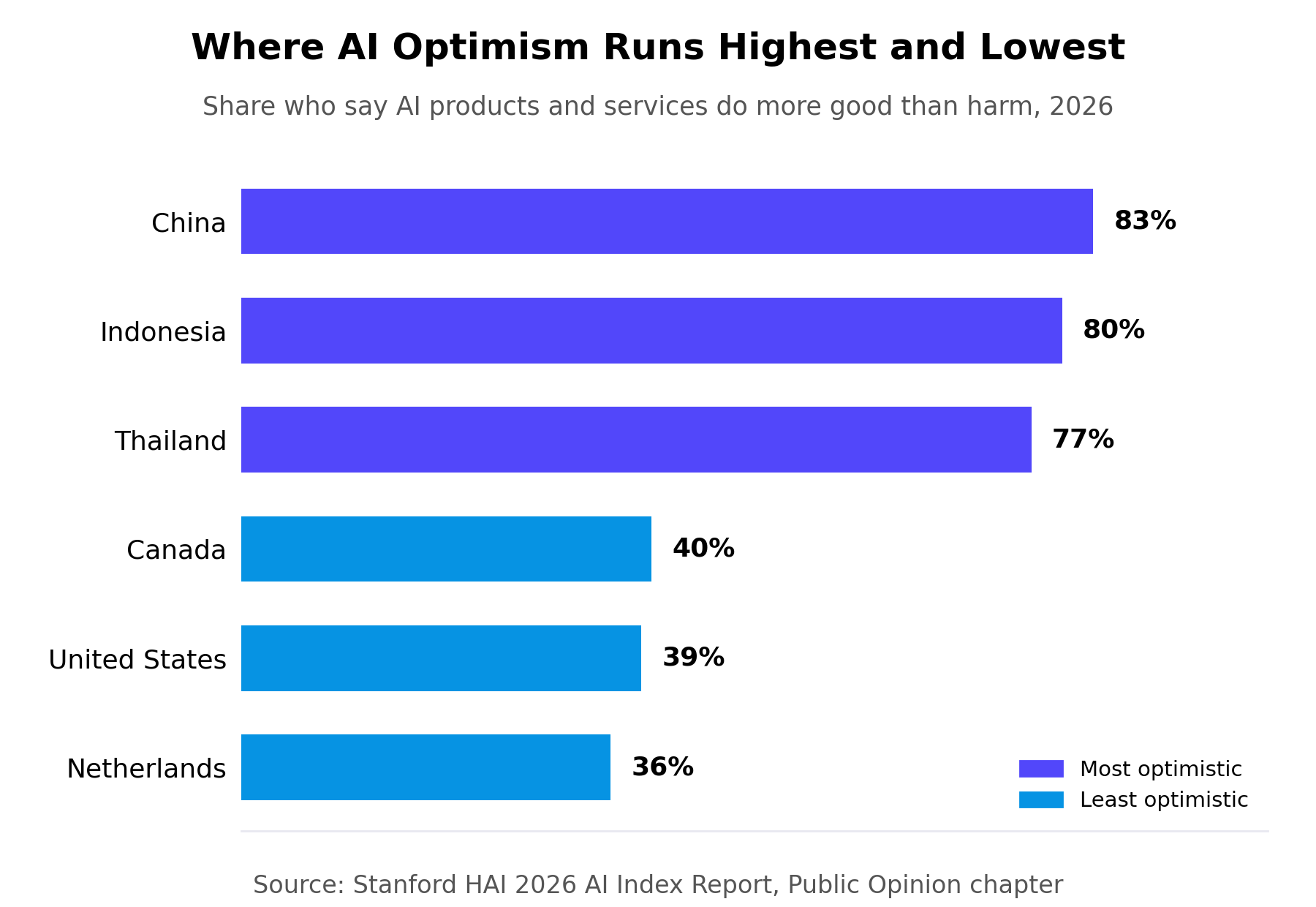
China leads the world in AI optimism at 83%, the highest of any country tracked. Indonesia (80%) and Thailand (77%) aren’t far behind. Meanwhile, in North America and parts of Europe, optimism is far more muted: 39% in the United States, 40% in Canada, and 36% in the Netherlands.
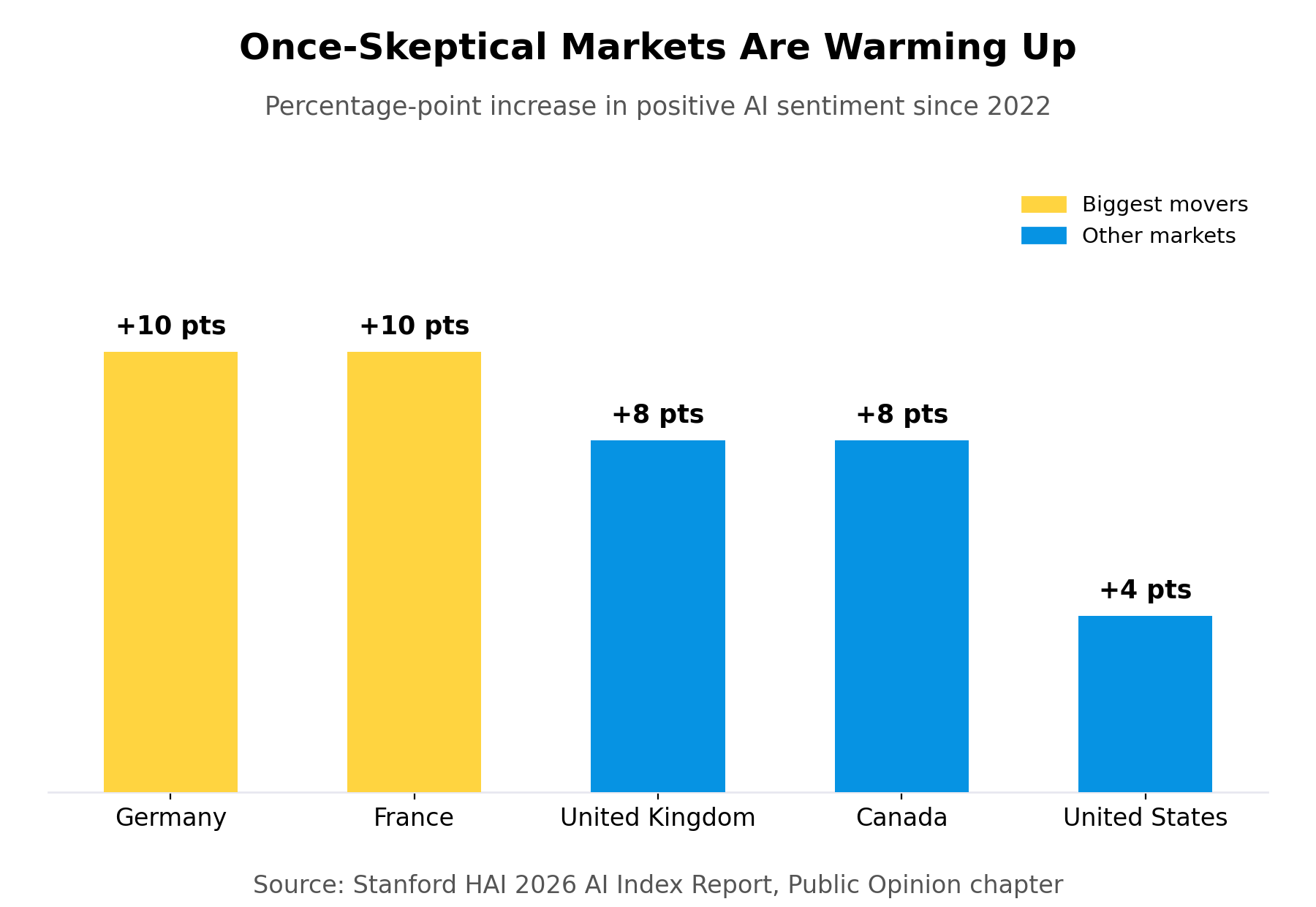
The trend line matters as much as the snapshot. Sentiment in Germany and France has climbed 10 percentage points since 2022, with the UK and Canada up 8 points and the US up a more modest 4. Western optimism is moving in the right direction. It’s just moving slower than in Southeast Asia, where more than 80% of people in Malaysia, Thailand, Indonesia, and Singapore now say AI will profoundly change their lives within the next 3-5 years, with Malaysia positing the sharpest year-over-year jump.
AI Optimism in Emerging Markets: Why Enthusiasm and Skepticism Are Rising Together
It’s tempting to file emerging markets under “uniformly optimistic,” but the 2026 data complicates that story. India, for example, saw the sharpest rise in AI-related concern of any country tracked between 2024 and 2025, up 14 percentage points, while excitement ticked up just 2 points over the same period. That’s not a country turning against AI. It’s a country engaging with it more seriously, forming more nuanced opinions as adoption deepens.
That nuance is probably a healthier signal than blanket enthusiasm. Countries with the highest technological optimism, like those across Southeast Asia, tend to pair that optimism with heavy public investment in AI infrastructure and education, which builds familiarity and trust at the same time. Optimism without friction tends to be shallow. Optimism that survives hard questions tends to stick.
The Real Divide Isn't Geography. It's Expertise.
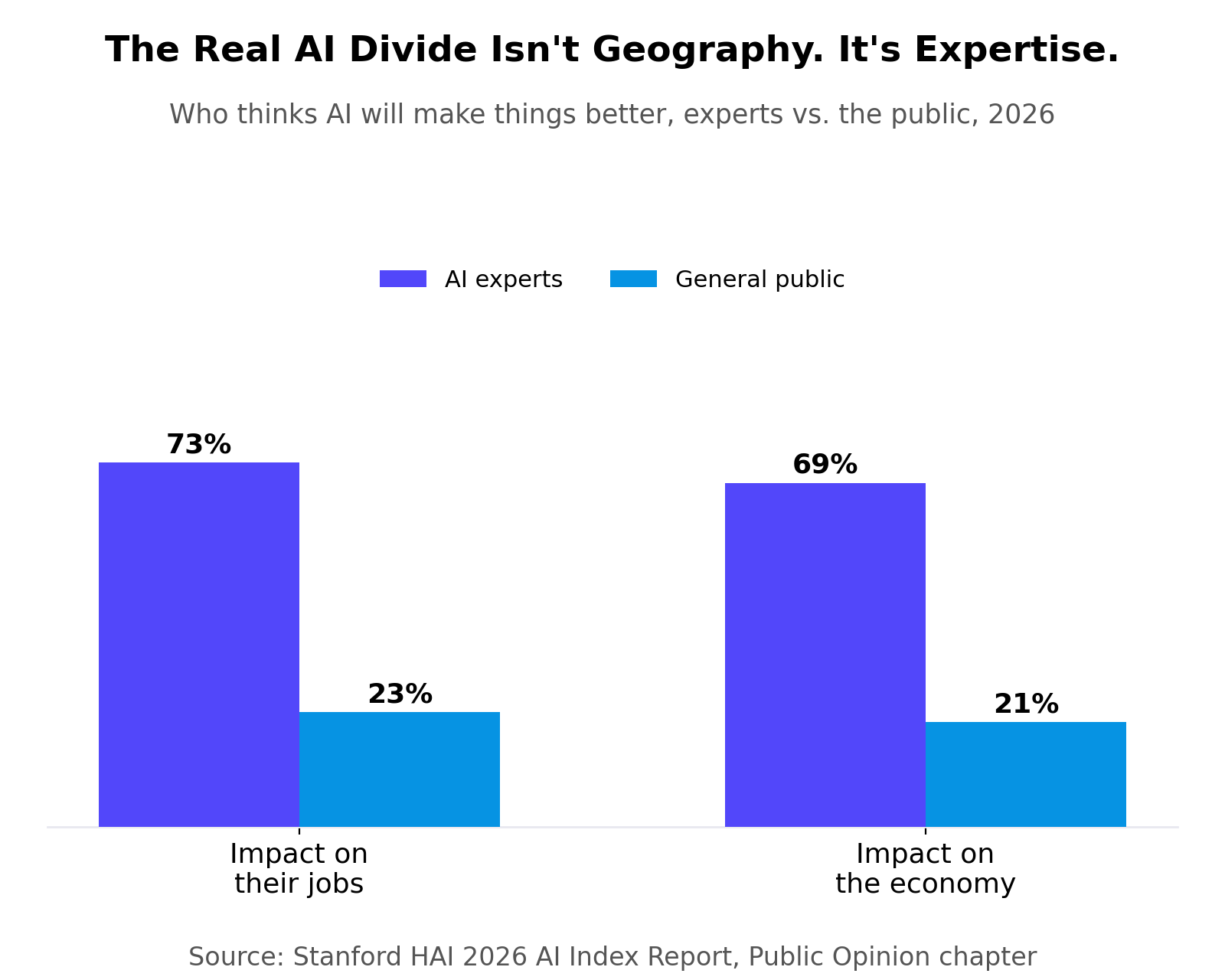
Here’s the finding that should reframe how anyone in tech talks about AI sentiment: The biggest gap in the entire 2026 AI Index isn’t between countries. It’s between experts and everyone else. 73% of AI experts expect the technology to improve how people do their jobs. Only 23% of the general public agrees. That’s a 50-point gap. On medical care specifically, 84% of experts are optimistic compared to 44% of the public, nearly the same divide all over again.
That gap is a trust problem, not an awareness problem. People aren’t uninformed about AI. They’re unconvinced that the systems being built have their interests in mind. Closing that gap requires more than a better explainer video. It requires AI applications people can actually see working, with humans still visibly in the loop, in domains where the stakes are personal.
Grappling With AI Risks
Optimism and risk awareness aren’t opposites, and the 2026 data makes that obvious. Nearly two-thirds of Americans expect AI to reduce jobs over the next 20 years, and 41% of Americans say federal AI regulation doesn’t go far enough, compared to just 27% who think it goes too far.
Trust in who’s doing the regulating varies just as widely. Americans report the lowest trust in their own government to responsibly regulate AI of any country surveyed, at just 31%, against a global average of 54%. Widen the lens to which global bodies people trust most, and a 2025 Pew Research survey across 25 countries, cited in the same Stanford HAI report, found a median of 53% trust the EU to regulate AI responsibly, compared to 37% for the US and 27% for China.
Regulators are racing to keep pace. The EU AI Act’s prohibitions on high-risk practices have applied since February 2025, with the bulk of remaining obligations, covering high-risk AI systems and transparency requirements, set to phase in starting August 2026 (some deadlines pushed further into 2027 after amendments approved this June). It’s a live, moving framework, not a finished one, and public sentiment is shifting right alongside it.
The Impact of AI on Job Automation and Optimism
Job automation remains the single biggest wildcard in the optimism conversation. The concern is not abstract: employment in AI-exposed fields among younger workers has already started to soften in early data, giving public skepticism a factual foundation rather than just a fear-based one.
But automation anxiety and AI adoption keep climbing together, not apart. Four out of five US high school and college students now use AI for schoolwork, and AI-generated summaries now top the majority of health-related Google searches. People are worried about what AI might do to their jobs, and they’re using it anyway, because the tools are already useful today, not someday. That contradiction, more than any single survey number, is probably the truest picture of AI optimism in 2026: cautious, curious, and moving forward regardless.
Where AI Trust Meets Technology
The throughline across all of this data is simple: optimism grows fastest where AI’s benefits are visible, specific, and paired with human oversight, not where AI is abstract or unaccountable. That’s exactly the model Verbit has built its transcription, captioning, and accessibility technology around. Rather than replacing human judgment, Verbit pairs AI-powered speed with options for human review, so universities can make lectures accessible to students who are Deaf or have hearing loss, global teams can meet across language barriers, and legal teams can trust the accuracy of a deposition transcript word-for-word. That’s the reason voice AI is having a moment regarding the public’s trust.
The goal should be for AI to do the heavy lifting while people stay meaningfully in control. That’s precisely the kind of application that closes the expert-public trust gap the 2026 data keeps surfacing. It’s a small example, but it’s the kind the report suggests matters most: not AI in the abstract, but AI you can see working, for people, right now.
The Bottom Line
AI optimism in 2026 isn’t a single number going up or down. It’s a live, regional, generational, and expertise-driven negotiation, and it’s happening faster than any technology shift before it. The countries and companies pulling ahead won’t be the ones with the loudest AI claims. They’ll be the ones that make the benefits tangible enough for skeptics to trust, one use case at a time.
Even those who are skeptical are remiss to not look for ways to implement AI technologies into their workloads. Helpful tools like AI-powered transcription, captioning, and translation can help teams across verticals work more quickly and efficiently with ease. Explore Verbit’s AI solutions and see what responsible, secure AI looks like in practice.