
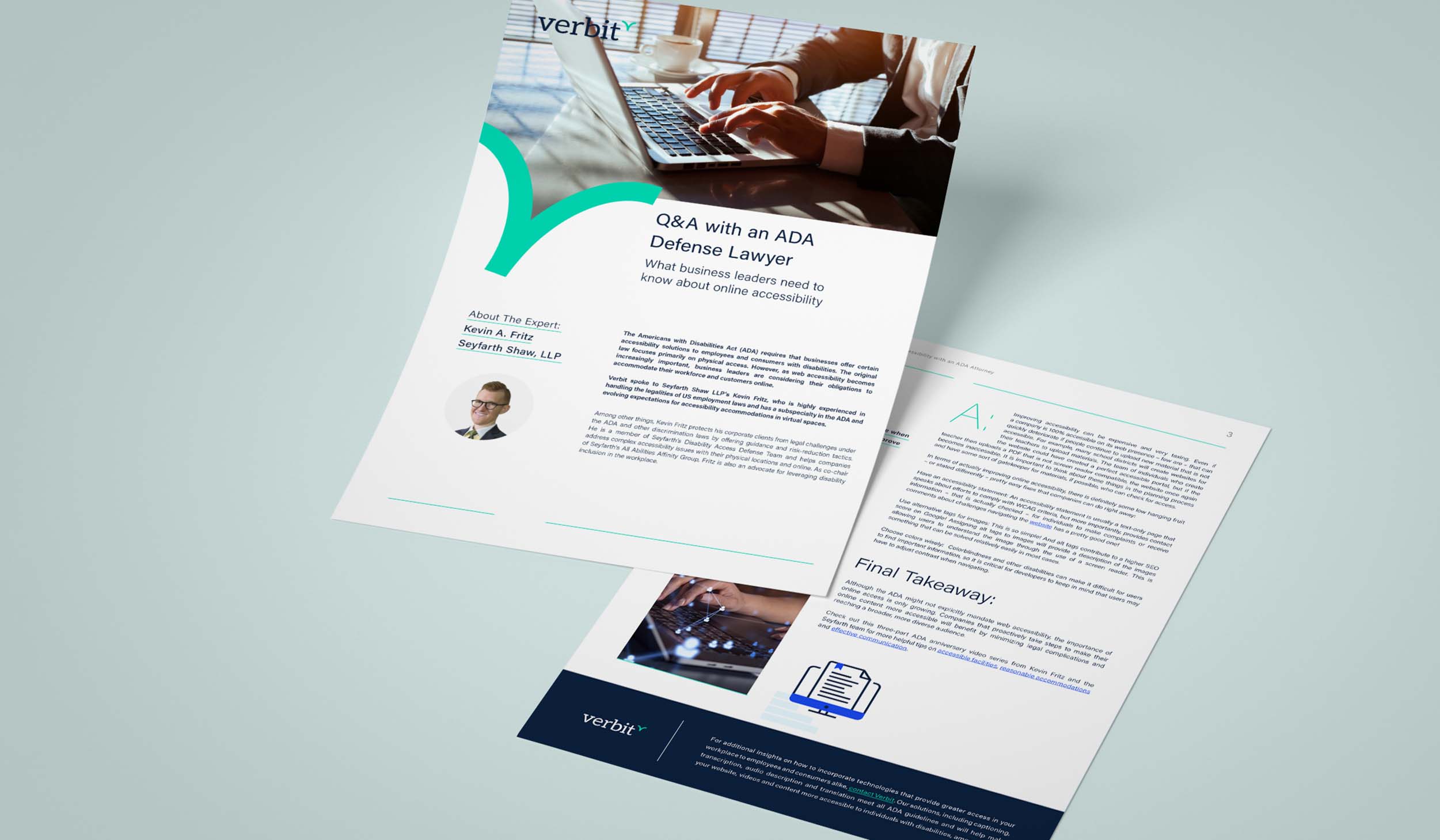
The Americans with Disabilities Act (ADA) requires that businesses offer certain accessibility solutions to employees and consumers with disabilities. The original law focuses primarily on physical access. However, as web accessibility becomes increasingly important, business leaders are considering their obligations to accommodate their workforce and customers online.
Verbit spoke to Seyfarth Shaw LLP’s Kevin Fritz, who is highly experienced in handling the legalities of US employment laws and has a subspecialty in the ADA and evolving expectations for accessibility accommodations in virtual spaces.
Among other things, Kevin Fritz protects his corporate clients from legal challenges under the ADA and other discrimination laws by offering guidance and risk-reduction tactics. He is a member of Seyfarth’s Disability Access Defense Team and helps companies address complex accessibility issues with their physical locations and online. As co-chair of Seyfarth’s All Abilities Affinity Group, Fritz is also an advocate for leveraging disability inclusion in the workplace.
Q1: News outlets are reporting that lawsuits related to violations of Title III of ADA are rising each year and that many of them relate to online accessibility. What do you think are some of the main drivers influencing the increase in online accessibility complaints?
A: The world is increasingly “online” – so the fact that more and more individuals rely on the Internet for consumption of information, data, and other – even literal – stuff, surely drives these figures. Perhaps it is simple economics. More is online, so there is more demand for Internet consumption and therefore more lawsuits about access to things on the Internet. As companies keep up with the times (social media, interesting mobile applications, etc.), it is important that they keep in mind all the challenges and potential risks. Another influencer is perhaps the fury of plaintiff firms that mobilize on the particular type of issue. For example, one law firm in southern California filed over five hundred lawsuits about hotel reservations websites starting in the fall of 2020 and continuing into 2021.
Q2: What are a few steps companies should take when they are working to improve online accessibility?
A: Improving accessibility can be expensive and very taxing. Even if a company is 100% accessible on its web presence – few are – that can quickly deteriorate if people continue to upload new material that is not accessible. For example, many school districts will create websites for their teachers to upload materials. The team of individuals who create the website could have created a perfect accessible portal, but if the teacher then uploads a PDF that is not screen reader compatible, the website once again becomes inaccessible. It is important to think about these things in the planning process and have some sort of gatekeeper for materials, if possible, who can check for access.
In terms of actually improving online accessibility, there is definitely some low hanging fruit – or stated differently – pretty easy fixes that companies can do right away:
- Have an accessibility statement: An accessibility statement is usually a text-only page that speaks about efforts to comply with WCAG criteria, but more importantly, provides contact information – that is actually checked – for individuals to make complaints or receive comments about challenges navigating the website https://www.whitehouse.gov/accessibility/ has a pretty good one!
- Use alternative tags for images: This is so simple! And alt tags contribute to a higher SEO score on Google! Assigning alt tags to images will provide a description of the images allowing users to understand the image through the use of a screen reader. This is something that can be solved relatively easily in most cases.
- Choose colors wisely: Colorblindness and other disabilities can make it difficult for users to find important information, so it is critical for developers to keep in mind that users may have to adjust contrast when navigating.
Q3: Did the move toward remote work spark any increase in Title I lawsuits related to employment accessibility online?
A: Title I of the ADA is a completely different framework. There it is all about “reasonable accommodations” – and the question is whether an individual can navigate a website for their employment. If they cannot, does the company have an obligation to make the materials accessible as a reasonable accommodation? Surely with more positions online, there will be more requests for accessible solutions. Some companies, such as Zoom, have already taken steps to address many issues that individuals who have hearing impairments face, such as real-time captioning.
Q4: Should companies be concerned about ADA exposure when working with outside vendors like website designers?
A: Under Title III of the ADA, there is no definitive statutory requirement that websites have to be accessible. Courts are split on this issue, and depending on where the lawsuit is brought or what kind of website is at issue, the answer may be different! However, when researching, keep in mind that automated testing is never as effective as actual use case “user journey” testing. Automated testing only can capture about 1/3 of all accessibility issues that may be found. Companies should always look at contracts and potential indemnification for accessibility in the event that the website is not designed properly. It is definitely a challenging thing and I encourage companies to read the fine print in their contracts with designers/vendors.
Q5: Do you think the US will eventually resolve the lack of web-access guidance through legislation and what are the consequences of attempting to address these issues through lawsuits?
A: I do. If you look at history, the updated physical standards were only really made effective about ten years ago. And yet, the ADA is over 30 years old now. I think that the ADA is a remarkably important law, and if it were written today, it would probably have something about websites. But since it was not, it’s up to courts and our judicial system/legislators to determine if and how websites/mobile applications fall in line. There are always consequences for addressing things through lawsuits because of precedent. In certain places, it may be more advantageous to file an accessibility lawsuit because of this. When it comes down to forum shopping, it can also be a hindrance because then it takes away from the power and purpose of the law to begin with and instead becomes more about finding the best venue for the best leverage. It can also certainly make lawsuits disingenuous.
Q6: Given that users can access online resources from anywhere, does a company’s location within the US matter for the purposes of online accessibility and ADA lawsuits?
A: Potentially – that’s a complicated question! It really depends on where and how the company does business. A large retailer that serves all over the nation can probably be sued in any forum, but a more localized business or entity may have a better argument to state that it does not have any transactions or occurrences or hold itself out as doing business in the location where it is being sued.
Final Takeaway:
Although the ADA might not explicitly mandate web accessibility, the importance of online access is only growing. Companies that proactively take steps to make their online content more accessible will benefit by minimizing legal complications and reaching a broader, more diverse audience. Check out this three-part ADA anniversary video series from Kevin Fritz and the Seyfarth team for more helpful tips on accessible facilities, reasonable accommodations and effective communication.
For additional insights on how to incorporate technologies that provide greater access in your workplace to employees and consumers alike, contact Verbit. Our solutions, including captioning, transcription, audio description and translation meet all ADA guidelines and will help make your website, videos and content more accessible to individuals with disabilities, among others.