Product managers, accessibility leads, and IT directors across legal, media, corporate, and higher education.
Key Takeaways
Automatic Speech Recognition (ASR) converts spoken words into accurate text by pairing acoustic sound modeling with context-aware language prediction. Explore how modern neural networks are replacing older statistical systems to deliver faster, more reliable transcription and captioning across industries.
AT A GLANCE
- Deep learning models like Conformer capture regional accents and dialects accurately, even in noisy environments.
- Self-supervised training on massive audio sets, like 1.1 million raw hours, boosts real-world recognition.
- End-to-end systems map audio directly to words, replacing tedious manual phonetic setup.
WHO SHOULD READ THIS
Estimated Reading Time
11 minutes
Automatic speech recognition (ASR) is everywhere now – in the captions on a live newscast, the transcript of your last team meeting, and the notes from a legal deposition that wrapped an hour ago. To put it plainly, ASR is AI technology that converts spoken language into written text. Behind the scenes, an automatic speech recognition system listens to the audio, figures out which sounds and words it’s hearing, and turns them into a transcript or captions – live, or after the recording ends.
ASR technology is also growing fast. The speech recognition market is projected to rise from $9.66 billion in 2025 to $23.11 billion by 2030. With so many ASR models now on the market, the big question has shifted from “Does it work?” to “How accurate is it, really – on my content?”
That’s where most ASR explainers stop short. Public leaderboards score models on clean, carefully selected test audio, but real-world audio rarely sounds like that. A model that ranks first on a benchmark can still stumble in a noisy courtroom, a fast-paced sports broadcast, or a lecture packed with technical terms.
We see that gap between test scores and real results every day at Verbit, where we build and deploy speech recognition across media, education, legal, government, and corporate settings. So this expert guide goes beyond the basics, covering the main types of ASR models, how ASR performance is measured, why benchmark scores don’t always hold up, and what to expect heading into 2027.
New to the topic? Our ASR 101 guide walks through how speech recognition works step by step, and our look at how speech recognition evolved explains why voice is fast becoming the main way people interact with AI agents.
ASR Models Explained: From Hybrid Systems to End-to-End and Speech LLMs
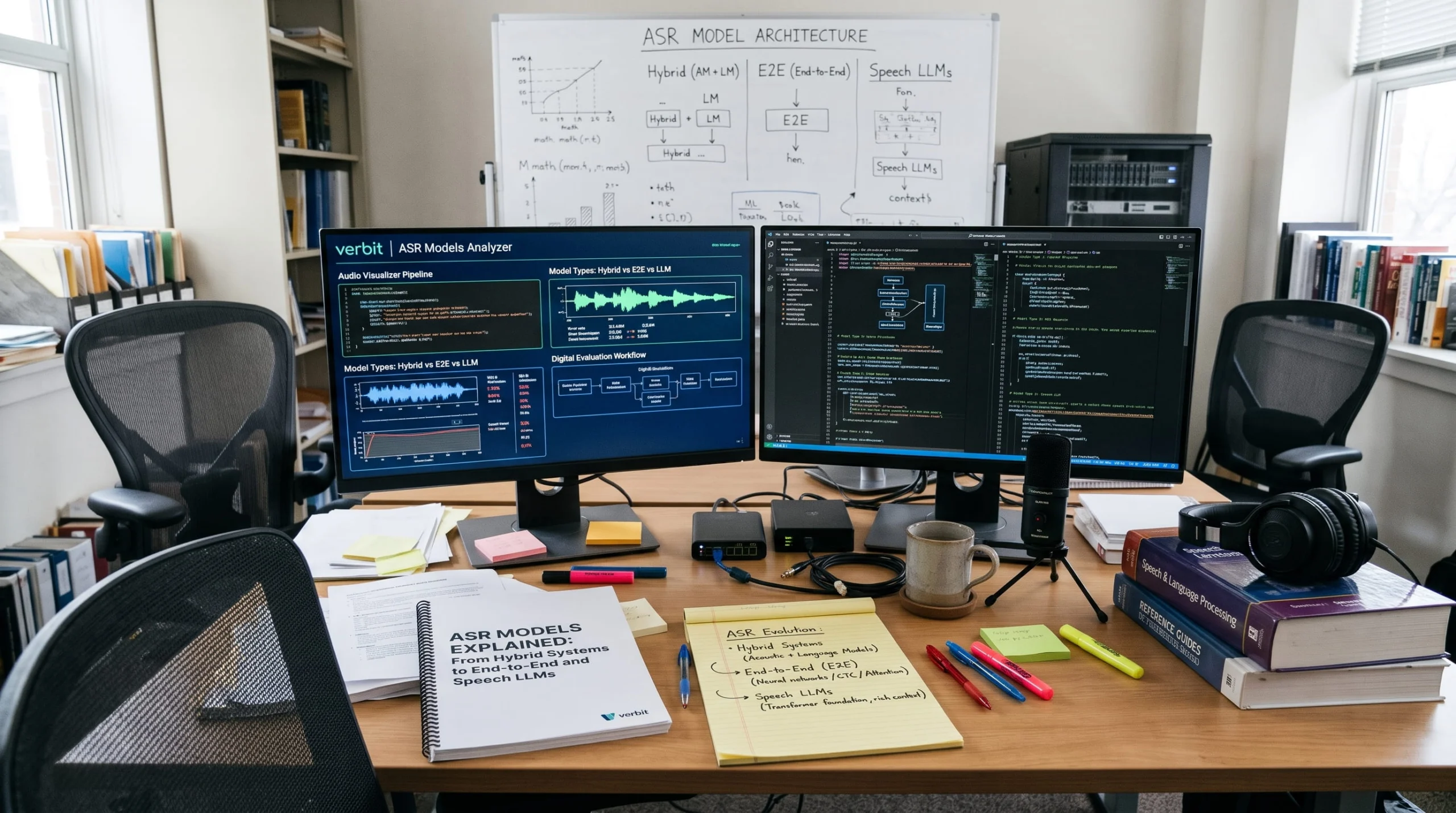
Deep learning changed how automatic speech recognition is built. Older systems were assembled from separate parts: one model to match sounds, another to link those sounds to words, and a third to predict which words usually come next. Most modern ASR models are end-to-end, meaning a single neural network learns the whole job and goes straight from audio to text. Here’s how the main types compare:
| ASR model type | How it works | Key strength | Common use |
|---|---|---|---|
| Hybrid (HMM + deep neural network) | Separate acoustic, pronunciation, and language models | Mature and well understood | Legacy and on-device systems |
| CTC models | End-to-end; predicts text for each slice of audio | Fast and efficient | High-volume and long-form transcription |
| Transducers (RNN-T, TDT) | End-to-end; built to output text as audio streams in | Low latency | Live captions and voice interfaces |
| Attention encoder-decoder | An encoder reads the audio and a decoder writes the text | High accuracy and multilingual reach | Recorded media and transcription (OpenAI's Whisper uses this design) |
| Speech LLMs | A speech encoder paired with a large language model | Can use context like names and key terms | Specialized, context-heavy content (NVIDIA's Canary-Qwen is one example) |
In a 2025 benchmark of 86 ASR systems, Conformer encoders paired with transformer-based decoders delivered the best average accuracy, while CTC and TDT decoders were faster for long-form and batch processing. In other words, the “best ASR model” depends on whether you need maximum accuracy, real-time speed, or both.
Measuring ASR Performance: WER, CER, RTF, and NER
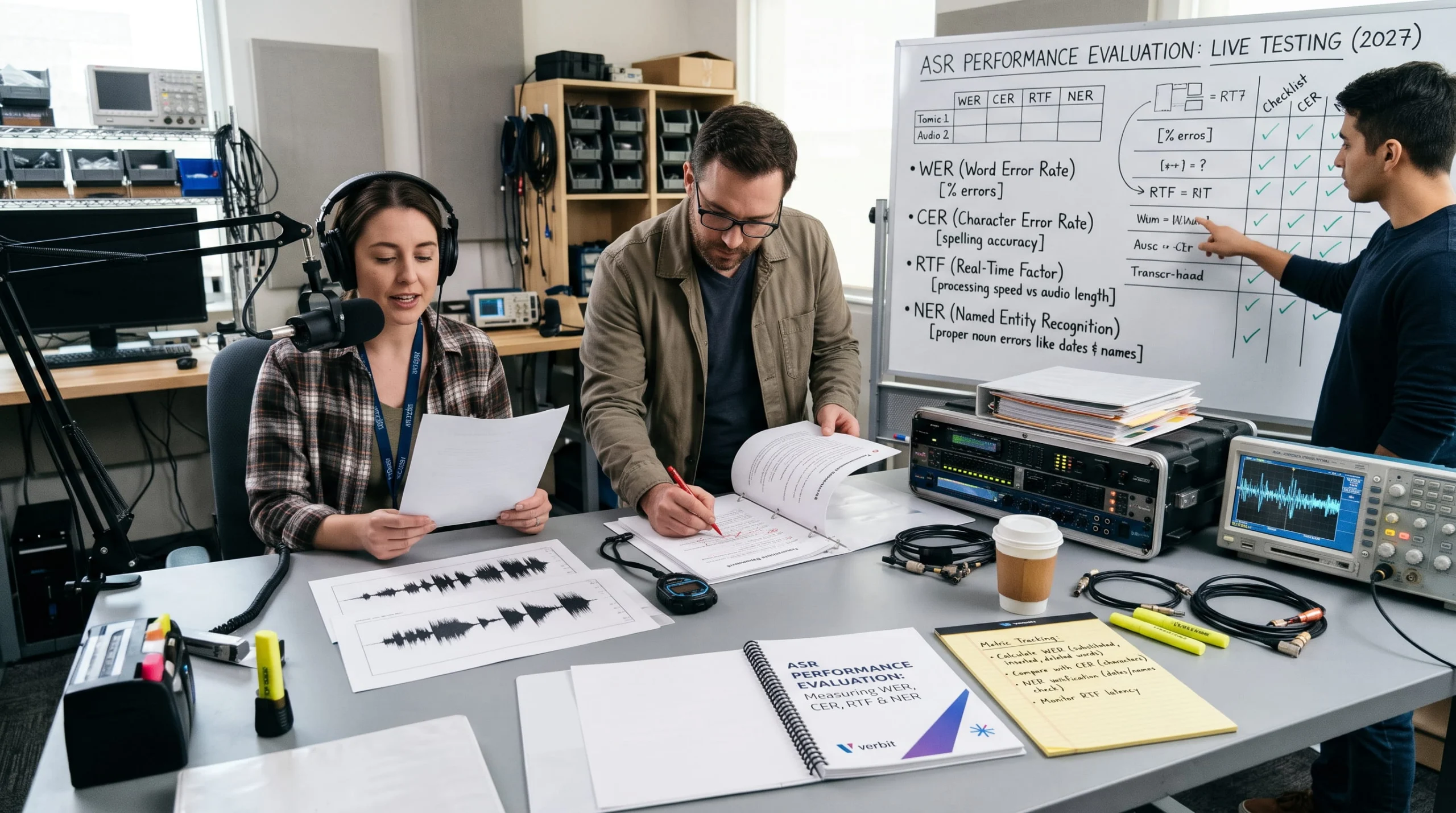
If you’re comparing ASR software, these four metrics tell you most of what you need to know.
Word Error Rate (WER)
Word error rate is the industry-standard ASR accuracy metric. It compares a machine transcript with a human reference transcript:
WER = (Substitutions + Deletions + Insertions) ÷ Total words in the reference
For example, if a 100-word reference has 3 substituted words, 1 missing word, and 1 extra word, the WER is 5%. Lower is better.
Character Error Rate (CER)
Character error rate uses the same formula at the character level. It’s especially useful for languages written without spaces, like Chinese and Japanese, and for catching small spelling errors in names and terms.
Real-Time Factor (RTF)
Real-time factor measures speed: processing time divided by audio length. An RTF of 0.1 means 10 minutes of audio is transcribed in 1 minute. Leaderboards often report the inverse (RTFx), where higher means faster. Speed matters for live captions and for processing large media libraries.
The NER Model for Live Captions
WER treats every error the same, but some errors matter more than others. That’s why live captioning quality is often measured with the NER model, which weighs each error by how much it affects comprehension. Captions need at least 98% accuracy under NER to be considered acceptable.
The Open ASR Leaderboard: How Top ASR Models Compare
The Open ASR Leaderboard, built by researchers at Hugging Face, NVIDIA, and partner institutions, benchmarks open-source and proprietary systems on both accuracy and speed across 12 datasets. On English benchmarks, top models now average roughly 5-6% WER – for example, NVIDIA’s Canary Qwen 2.5B posted a 5.63% average. Leaderboards are a great starting point, but they test curated audio, which is exactly why real-world testing matters.
ASR Accuracy Challenges: Why Benchmarks Don't Match the Real World
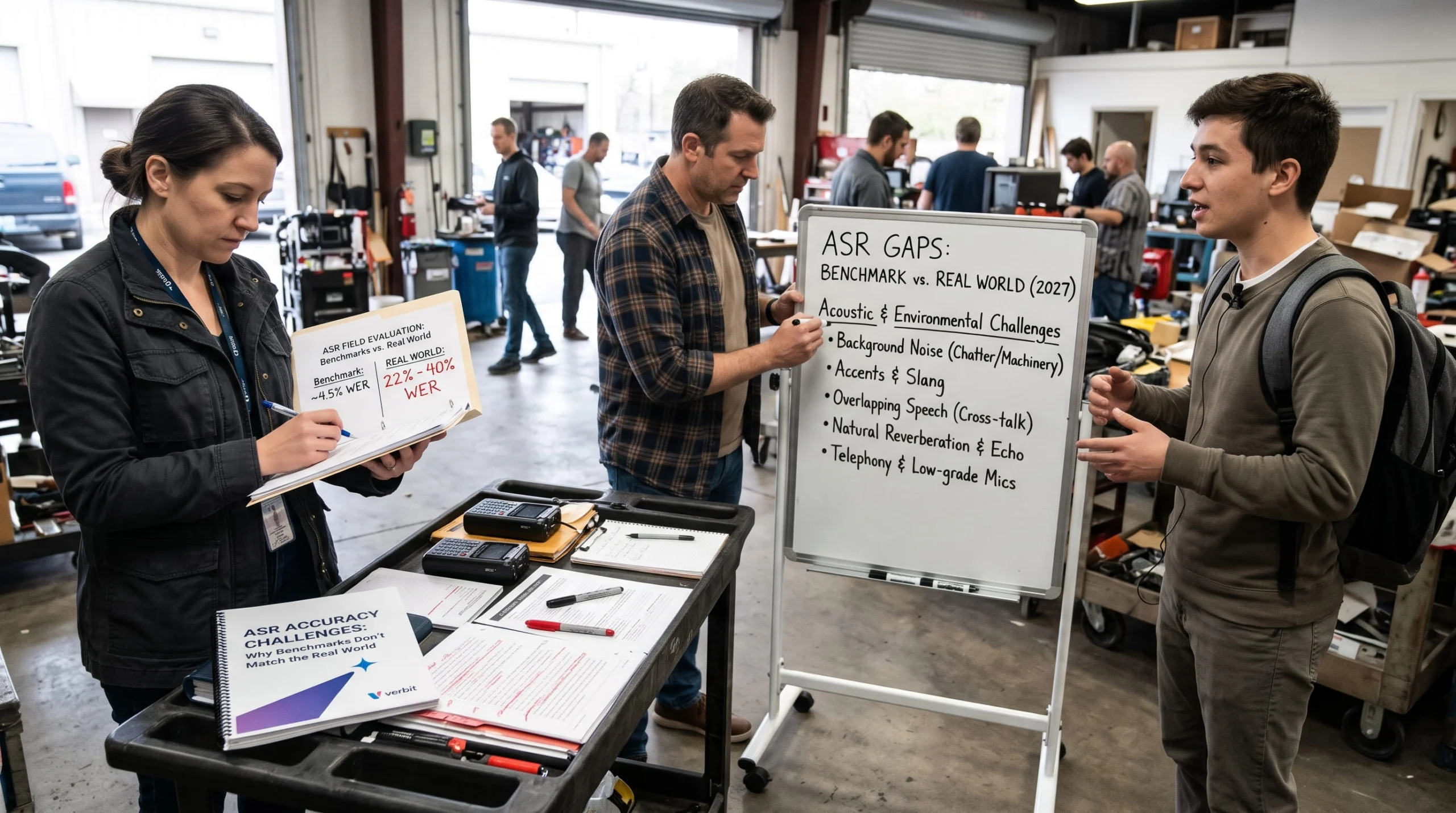
Here’s the expert insight: leaderboard scores come from curated test sets. Real audio is messier. ASR accuracy drops when it meets:
- Accents and dialects: A landmark PNAS study of five major ASR systems found an average WER of 0.35 for Black speakers vs. 0.19 for white speakers.
- Noise and crosstalk: Background sound, overlapping speakers, and remote audio all raise error rates.
- Specialized vocabulary: Legal terms, drug names, player names, and course jargon often aren’t in a general model’s vocabulary.
- Hallucinations: Some generative models can invent text. One study found about 1% of Whisper transcripts included hallucinated phrases, and 38% of those contained harmful content.
The good news? Preparation closes much of the gap. Research on live captioning found that automatic captions reached the 98% threshold when supported by human prep, like custom glossaries, script loading, and audio checks. That’s why customization and human review matter as much as the model itself – and it’s the same principle behind how Verbit preps its ASR for every customer, which we’ll get to below.
The Future of ASR: Trends to Watch Heading Into 2027
Here’s where automatic speech recognition is headed:
- Context-aware ASR. Speech LLMs and contextual biasing let systems use names, terms, and documents to get specialized language right.
- Real-time everything. Low-latency ASR is powering live captions, live translation, and real-time transcripts for meetings, broadcasts, and depositions.
- Smarter speaker identification. ASR is moving beyond “speaker 1, speaker 2” to labeling people by name in real time – something Verbit already brought to live broadcast captions in 2025.
- Open, transparent benchmarks. Public leaderboards are making accuracy claims easier to compare, and harder to inflate.
- Privacy by design. Organizations want clear policies on how their audio is stored and whether it’s used for training.
- Human-in-the-loop by default. For anything legal, public, or high-stakes, the strongest workflows combine AI speed with human review.
ASR Applications Across Industries
Automatic speech recognition now supports work across almost every sector:
- Media and entertainment: Live captions for news and sports, post-production captioning, and searchable archives. See Captivate for media.
- Education: Captions and transcripts for lectures and course videos, supporting accessibility and ADA Title II readiness. See Captivate for education.
- Legal: Real-time transcription for depositions and hearings with Legal Capture, plus real-time insights with Legal Visor.
- Government: Live captions for public meetings and transcripts for the public record. See Captivate for government.
- Corporate: Meeting, town hall, and training transcription with Enterprise Capture.
- Healthcare: Clinical dictation and documentation support.
For more examples, see 9 real-world speech recognition uses.
How Verbit Approaches ASR: CaptivateTM, Built for Real-World Accuracy
Everything in this guide points to one conclusion: the best automatic speech recognition isn’t just the model with the lowest benchmark score. It’s the one that’s prepared for your content, works in real time, and has expert backup when the stakes are high. That’s exactly how we built Captivate, Verbit’s proprietary ASR technology.
Captivate draws on decades of real-world captioning experience – Verbit is home to VITAC, with 35+ years in professional media captioning – and today it supports more than 3,000 organizations across media, education, legal, government, and corporate settings.
Prepped for your content, not just your industry
Most ASR models are trained once and shipped. Captivate is customized for each customer. Upload key terms, speaker names, glossaries, scripts, and past content, and Captivate is ready for your vocabulary before the first word is spoken. For live events, Verbit’s Global Prep Team goes further, researching names, rundowns, and show-specific terms ahead of air.
Names, not “Speaker 1”
In 2025, Verbit introduced speaker identification for live ASR broadcast captions, which was billed as an industry first for automated live captioning. Viewers see who’s speaking, by name, in real time, across news, weather, and live sports.
AI when you need speed, people when you need certainty
You don’t have to choose between automation and accuracy. Use Captivate on its own for speed and scale, add professional human review for content that’s going on the record, or mix both project by project – all in one platform.
“What ultimately made Verbit stand out to us wasn’t simply the use of AI transcription – there are many AI-only options available now – but the flexibility of having both AI and human transcription services within the same platform.” – Jeffrey Lehman, Post Supervisor, Alfred Street Industries (Project Runway), whose team ran roughly 400 hours of interview footage through Verbit in a single season
One ASR engine, built into every workflow
Captivate powers solutions designed for how each industry actually works:
- Media: live broadcast captions with Captivate for media, plus Captivate Post and Post Plus for distribution-ready post-production captions.
- Legal: real-time deposition and hearing transcription with Legal Capture, and real-time insights with Legal Visor.
- Education and government: captions and transcripts that support ADA Title II readiness.
- Corporate: live and recorded transcripts for meetings, town halls, and training with Enterprise Capture.
Delivering more than a transcript
Verbit’s generative AI turns transcripts into summaries, chapters, and keywords, and you can translate captions and transcripts into 28+ languages.
Curious how CaptivateTM would perform on your audio? The best way to evaluate any ASR is on your own content – so bring a sample and book a demo to see Captivate in action.
How to Choose ASR Software
Before picking an ASR solution, ask these questions:
- Can I customize it? Look for glossaries, term boosting, and the ability to prep with your own content.
- How is accuracy measured? Ask for WER or NER on content like yours, not just public benchmarks.
- Does it handle my audio? Test accents, crosstalk, and remote audio.
- Is human review available? You’ll want it for legal, public, or high-stakes content.
- Is it real-time? Check latency for live captions and meetings.
- How is my data handled? Review security certifications and data use policies.
Automatic Speech Recognition in 2027: Accurate, Contextual, and Human-Backed
Automatic speech recognition has never been more capable. But heading into 2027, the real advantage isn’t just having ASR – it’s having ASR that knows your content, works in real time, and comes with human expertise when accuracy matters most.
See what customized ASR can do for you. Book a CaptivateTM demo and see how Verbit delivers accurate, real-time speech recognition built around your content.
FAQs on ASR Models and Accuracy
Is ASR considered AI?
Yes. Modern automatic speech recognition is a form of artificial intelligence. It uses deep learning models – increasingly transformers and speech LLMs – trained on large amounts of audio to recognize speech and convert it into text.
What is an ASR model?
An ASR model is the neural network that turns audio into text. Common types include CTC models, transducers for real-time use, attention encoder-decoder models, and speech LLMs that can use context like names and key terms.
What is the Open ASR Leaderboard?
The Open ASR Leaderboard is a public benchmark that compares open-source and proprietary ASR models on word error rate and speed across standardized English and multilingual datasets.
What is a good word error rate for ASR?
It depends on the content. Top models average roughly 5-6% WER on public English benchmarks, but real-world audio with accents, crosstalk, or jargon usually scores higher. For live captions, the NER model sets 98% as the minimum acceptable accuracy.
Why does ASR struggle with accents?
ASR models learn from training data, and speakers, dialects, and accents that are underrepresented in that data tend to see higher error rates. Customization and human review help close the gap.
What is the NER model?
The NER model measures live caption quality by weighing each error by how much it affects a viewer’s understanding. Captions need at least 98% accuracy under NER to be considered acceptable.
What is word error rate (WER)?
Word error rate measures how many words an ASR system gets wrong – substitutions, deletions, and insertions – compared with a human reference transcript. A lower WER means higher accuracy.
Can ASR replace human transcribers?
For many everyday uses, ASR alone can be enough depending on the engine you’re using and how you can prep it in advance or with past content. For legal records, broadcast captions, and other high-stakes content, the most reliable approach combines ASR with professional human review. An ideal process or platform is one which allows you to switch simultaneously between ASR-only and ASR + human touch as needed per use case or project.