Managing partners, solo attorneys, paralegals, and litigation support staff at small law firms.
Table of contents
- Why Legal Transcription Services Matter for Small Practices
- What to Look for in Transcription Services for Law Firms
- Understanding the Role of a Legal Transcriptionist
- Legal Transcription Jobs vs. Full-Service Legal Transcription Services
- How Verbit's Legal Transcription Services Support Small Law Firms
- How to Choose Transcription for Your Small Law Firm
Key Takeaways
Small law firms use Verbit’s legal transcription to turn depositions, client calls, and hearings into searchable, court-ready text without expanding their staff. Discover how pairing legal-trained speech recognition with expert human review saves attorneys hours each week while protecting sensitive case details.
AT A GLANCE
- Fast rough drafts arrive within 24 hours, saving legal teams around five hours weekly.
- Legal-trained models capture case citations and speaker labels before human editors certify final records.
- SOC 2 Type II and ISO 27001 protections keep privileged client recordings completely confidential.
WHO SHOULD READ THIS
Estimated Reading Time
7 minutes
Running a small law firm means making every dollar – and every billable hour – count. Transcription is one place where small firms often overspend or settle for less than they need. Traditional court reporting adds appearance fees and scheduling headaches, while free automated tools leave attorneys cleaning up errors on their own time.
The pressure is growing. The number of stenographers has dropped 21% in a decade, and 76% of legal professionals now cite scheduling as their biggest court reporting challenge. At the same time, 72% of solo practitioners already use AI in some capacity, so small firms are open to faster ways of working – as long as accuracy holds up.
This guide covers what to look for in transcription for small law firms, how legal transcription services compare to freelancers and DIY tools, and how Verbit’s legal transcription combines AI speed with human expertise at a price small practices can plan around.
Why Legal Transcription Services Matter for Small Practices
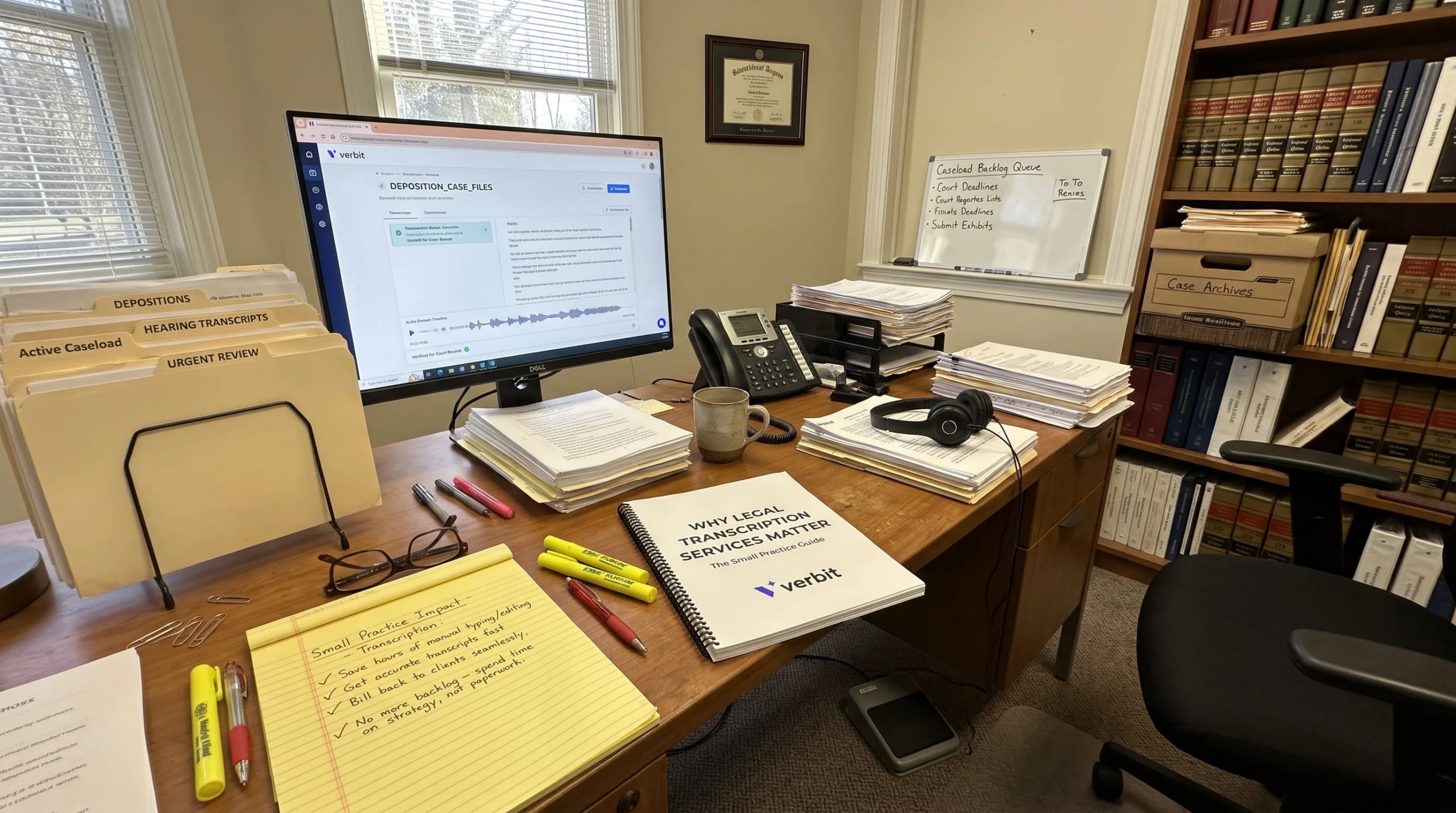
Depositions, hearings, client interviews, and witness statements all generate audio that needs to become searchable, citable text. For small firms, getting that step wrong is expensive in three ways.
The Hidden Cost of DIY Transcription
When attorneys or paralegals transcribe recordings themselves, every hour spent typing is an hour not spent on case strategy or client work. For a small team, that trade-off adds up fast.
The Budget Strain of Traditional Court Reporting
Court reporters solve the time problem but add cost. One published 2026 rate sheet lists a $295 deposition appearance fee per day plus $7.50 per page for the original transcript. For a firm handling several depositions a month, those fees quickly become a major line item.
The Accuracy Imperative
In legal work, one misheard word can change the meaning of testimony. Accuracy is the top priority for 96% of legal professionals surveyed about court reporting. The best legal transcription services capture legal terminology, speaker identification, and the formatting your matters require.
What to Look for in Transcription Services for Law Firms
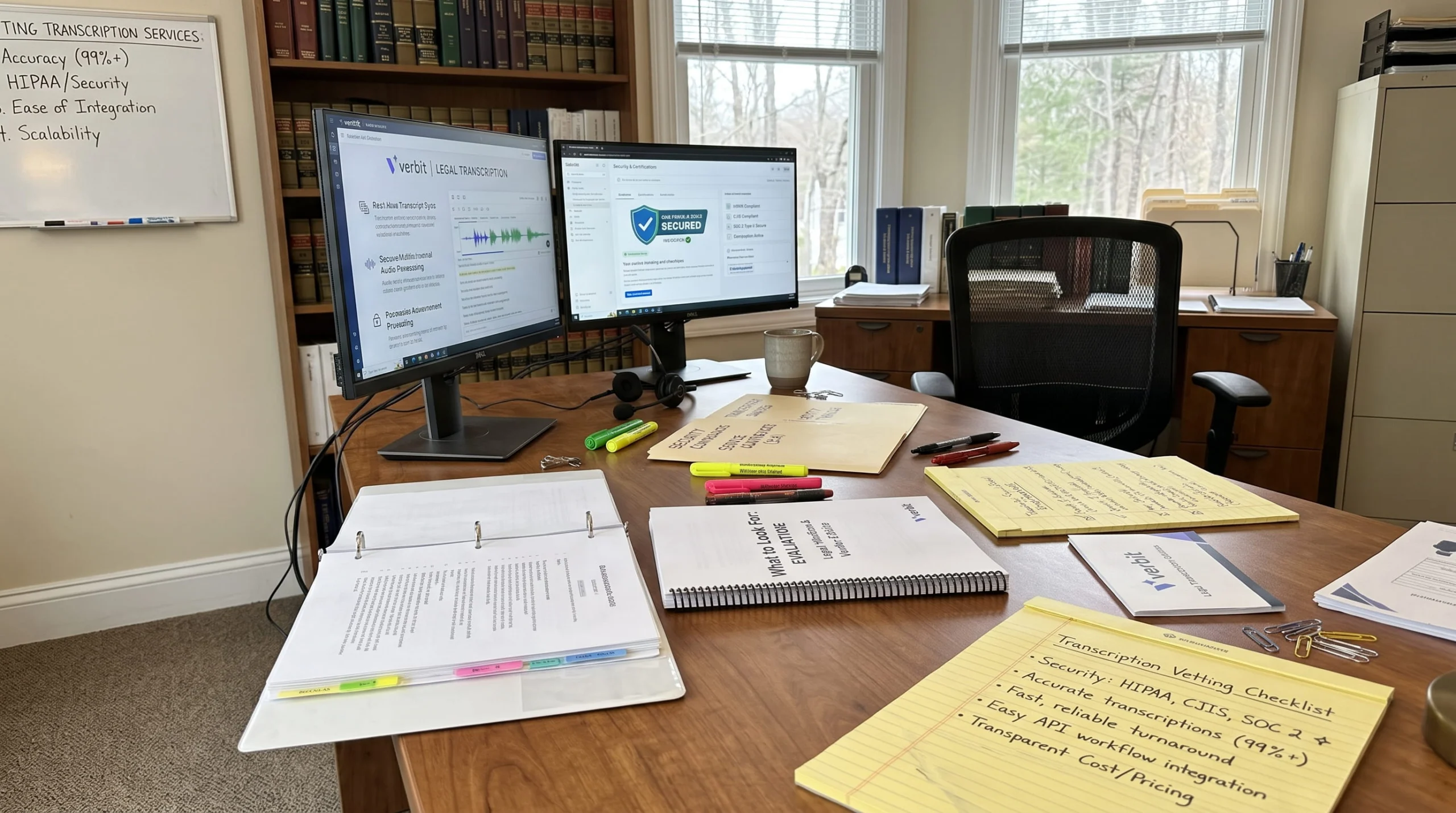
General transcription services aren’t built for legal work. Use this checklist when comparing providers.
Accuracy and Legal Expertise
- AI trained on legal terminology, not just general speech
- Human review by trained legal transcriptionists
- Case-specific glossaries for names, places, and Latin terms
- Speaker identification and verbatim or intelligent verbatim options
Turnaround Options
- Rough drafts within 24 hours for case prep
- Same-day or expedited delivery for urgent matters
- Predictable delivery dates for final transcripts
Transparent Pricing
- Clear per-page or per-minute pricing
- No appearance fees for recordings you upload
- Upfront estimates and no surprise charges
Security and Confidentiality
- SOC 2 Type II and ISO 27001 certification
- HIPAA compliance for personal injury and medical malpractice files
- Encrypted upload, storage, and access
Ease of Use
- Simple upload for audio and video files
- Integrations with Zoom, Teams, and case management tools
- Responsive support when deadlines are tight
Understanding the Role of a Legal Transcriptionist
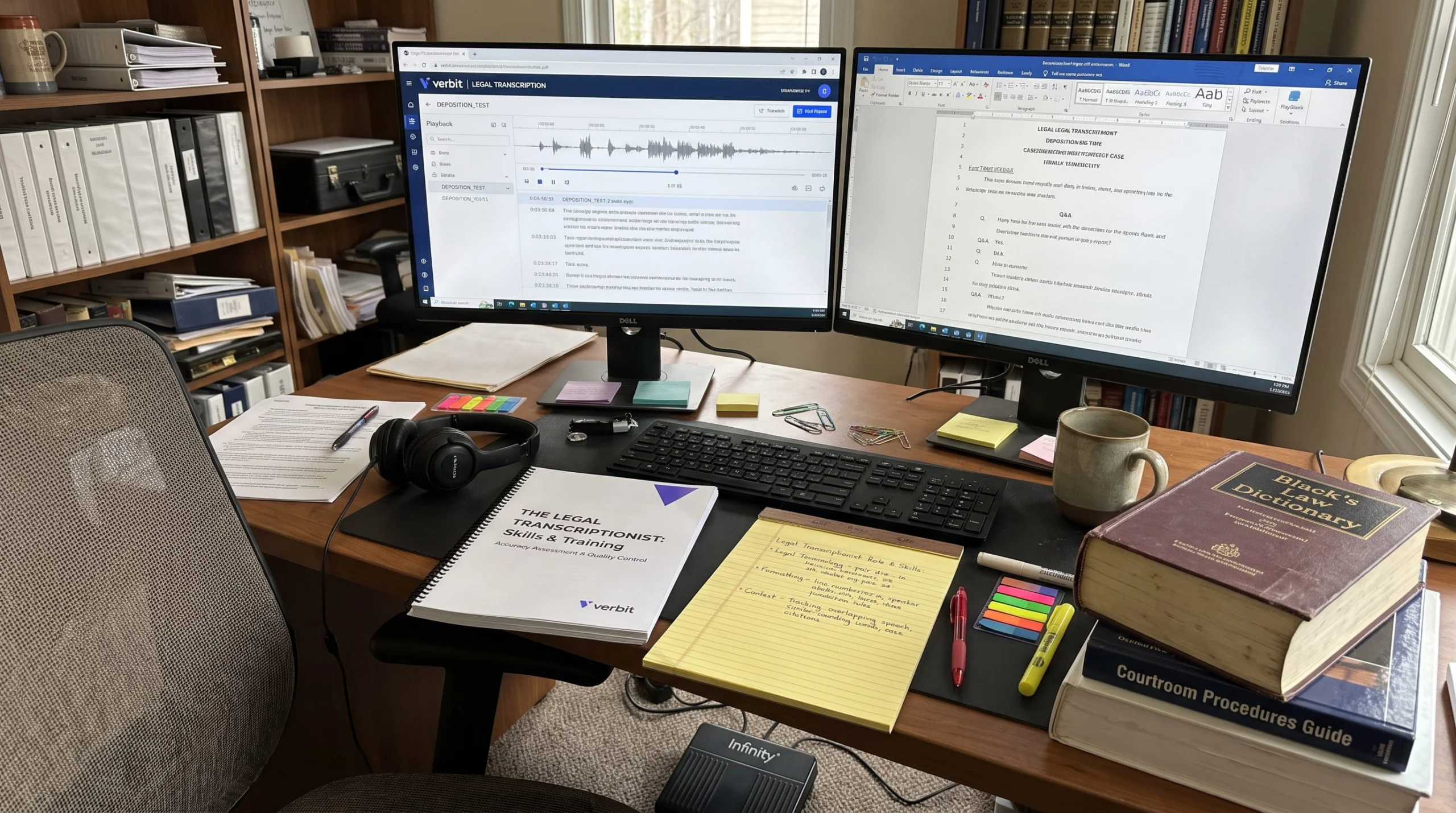
A legal transcriptionist does more than type what they hear. Three skills set them apart from general transcriptionists.
- Legal terminology: Terms like voir dire, in limine, sua sponte, and pro se need to be recognized and spelled correctly.
- Formatting: Legal transcripts follow conventions for line numbering, speaker labels, exhibits, and cover pages that vary by jurisdiction and matter type.
- Context: An experienced legal transcriptionist can tell similar-sounding terms apart, recognize case citations, and keep speakers straight when attorneys talk over each other.
At Verbit, human transcribers complete in-house legal training and an accuracy assessment, and certified court reporters handle quality control.
Legal Transcription Jobs vs. Full-Service Legal Transcription Services
Some firms try to save money by hiring freelancers through sites that post legal transcription jobs. That can work for occasional needs, but it shifts the work onto your team:
- Finding and vetting qualified transcriptionists
- Managing deadlines and communication
- Checking accuracy and handling corrections
- Making sure confidential files are handled securely
Full-service legal transcription services take on all of that. They recruit and train transcriptionists, run quality control, secure your files, and stand behind the final product. For small firms without dedicated admin staff, that difference matters.
How Verbit's Legal Transcription Services Support Small Law Firms
Verbit offers transcription for small law firms that’s designed around the three things small practices care about most: accuracy, speed, and predictable cost.
AI Built for Legal, Reviewed by People
Verbit’s legal AI is trained on legal vocabulary and a wide range of accents and audio conditions, and you can add case-specific names and terms to a glossary before transcription starts. Rough drafts combine AI with editing for fast reference. Final transcripts are also available with human-review, with opportunities to request cover pages, end pages, and custom formatting. Certification is available on request.
Fast Turnaround When You Need It
Rough drafts arrive within 24 hours, so you can start preparing while the final transcript is completed. Same-day and expedited options are available for urgent matters.
No Appearance Fees for Uploaded Recordings
For client interviews, witness statements, recorded hearings, and other recordings you’re permitted to make, you simply upload the file – no appearance fees, travel time, or scheduling. For depositions, Verbit works alongside your court reporter or reporting agency to speed up rough drafts and finals. Rules on who must administer the oath and certify a deposition vary, so check your jurisdiction (in federal cases, see FRCP Rule 30).
Security You Can Show Clients
Verbit is SOC 2 Type II and ISO 27001 certified and supports HIPAA compliance, so firms can handle privileged communications and medical records with confidence. Read more about HIPAA-compliant legal transcription.
More Than Transcripts
Verbit’s generative AI can produce summaries, chapters, and keywords from transcripts to speed up case review. Firms with multilingual clients can add legal translation. Litigation teams that want more during depositions can use Legal Visor for real-time insights during and after the deposition.
How to Choose Transcription for Your Small Law Firm
Before you pick a provider, answer five questions:
- Volume: How many depositions, hearings, and interviews do you handle each month?
- Budget: Can you absorb appearance fees, or do you need predictable per-page costs?
- Turnaround: How often do you need a rough draft within 24 hours?
- Quality: Do you need legal formatting and certified finals, or will a clean draft do?
- Capacity: Do you have staff to manage freelancers or edit automated transcripts?
For most small firms, the answers point to a full-service provider that pairs AI efficiency with human review, offers fast rough drafts, and keeps pricing predictable. For a deeper look at depositions specifically, see our deposition transcription guide, and learn why verbatim accuracy matters.
How to Demo Verbit’s Legal Transcription for Small Firms
Small firms need legal transcription services that are accurate enough to rely on, fast enough for tight deadlines, and priced for a small-firm budget. Verbit’s transcription for small law firms combines legal-trained AI, human review, and enterprise-grade security, without appearance fees for the recordings you upload.
Interested in seeing the technology firsthand? Book a Verbit demo and we’ll walk you through how Verbit’s transcription can fit into your workflow.
FAQs on Transcription for Small Law Firms
What is the best transcription option for small law firms?
For most small law firms, a full-service legal transcription provider that combines legal-trained AI with human review offers the best balance of accuracy, speed, and cost. It avoids appearance fees for uploaded recordings and the cleanup time that free automated tools require. Verbit’s legal transcription, which can be customized down to a firm’s specific needs, offers a strong option.
How much do legal transcription services cost?
Pricing varies by turnaround and transcript type, usually per page or per audio minute. Traditional court reporting adds appearance fees on top of per-page rates, while uploading recordings to a transcription provider avoids those fees.
What does a legal transcriptionist do?
A legal transcriptionist converts recordings of depositions, hearings, interviews, and dictation into accurate text, using correct legal terminology, speaker labels, and the formatting legal documents require.
Can AI transcription be used for legal work?
Yes, more firms are using legal AI to produce transcripts with opportunities for human review. Smart firms are choosing to work with AI that’s trained on legal vocabulary to speed up rough drafts and see strong accuracy performance. They then enlist human legal transcriptionists or human quality control make sure final transcripts are accurate and properly formatted. Verbit can handle all of this to provide you with rough drafts, final transcripts with cover pages, and more all in one platform.
Does Verbit hire for legal transcription jobs?
Verbit works with trained transcribers who complete in-house legal training and an accuracy assessment. Current openings are listed on Verbit’s careers page.