
Leaders, administrators, IT, and tech volunteers at churches, synagogues, temples, mosques, and other houses of worship.
Key Takeaways
Congregants at churches, synagogues, temples, mosques, and other houses of worship often sit through services in a language they don’t fully understand. Live translation lets them follow messages, prayers, and readings as they happen, and more congregations are now exploring how to offer translation to create a more inclusive experience for everyone. This piece covers why translation matters for your community, how translated captions compare with spoken translation, and where to begin.
AT A GLANCE
- Offer translations on display screens or via congregants' phones with QR codes to let everyone take part with equity, from longtime members to first-time visitors.
- Reading translated captions vs. hearing the translated audio offer different experiences, so consider which is best for your members.
- AI translation opens a door for houses of worship who are often working with limited budgets - Verbit's is both cost-effective and designed to deliver accurate results.
- Consider starting small by translating one service and asking your bilingual members to check the results and provide feedback.
WHO SHOULD READ THIS
Estimated Reading Time
10 minutes
In a single week, Verbit’s team received calls from religious leaders and IT professionals at eight different churches and other houses of worship. Nearly all asked the same question: How can we offer worshippers the opportunity to hear the service in their own language, in real time? Not read it in captions or subtitles – hear it.
If your congregation members include people who speak different languages from the one used in your services, you are likely weighing the same decision. This article covers what we heard, your options, and how to choose.
Short answer: Houses of worship can offer real time translations of live services in two main ways:
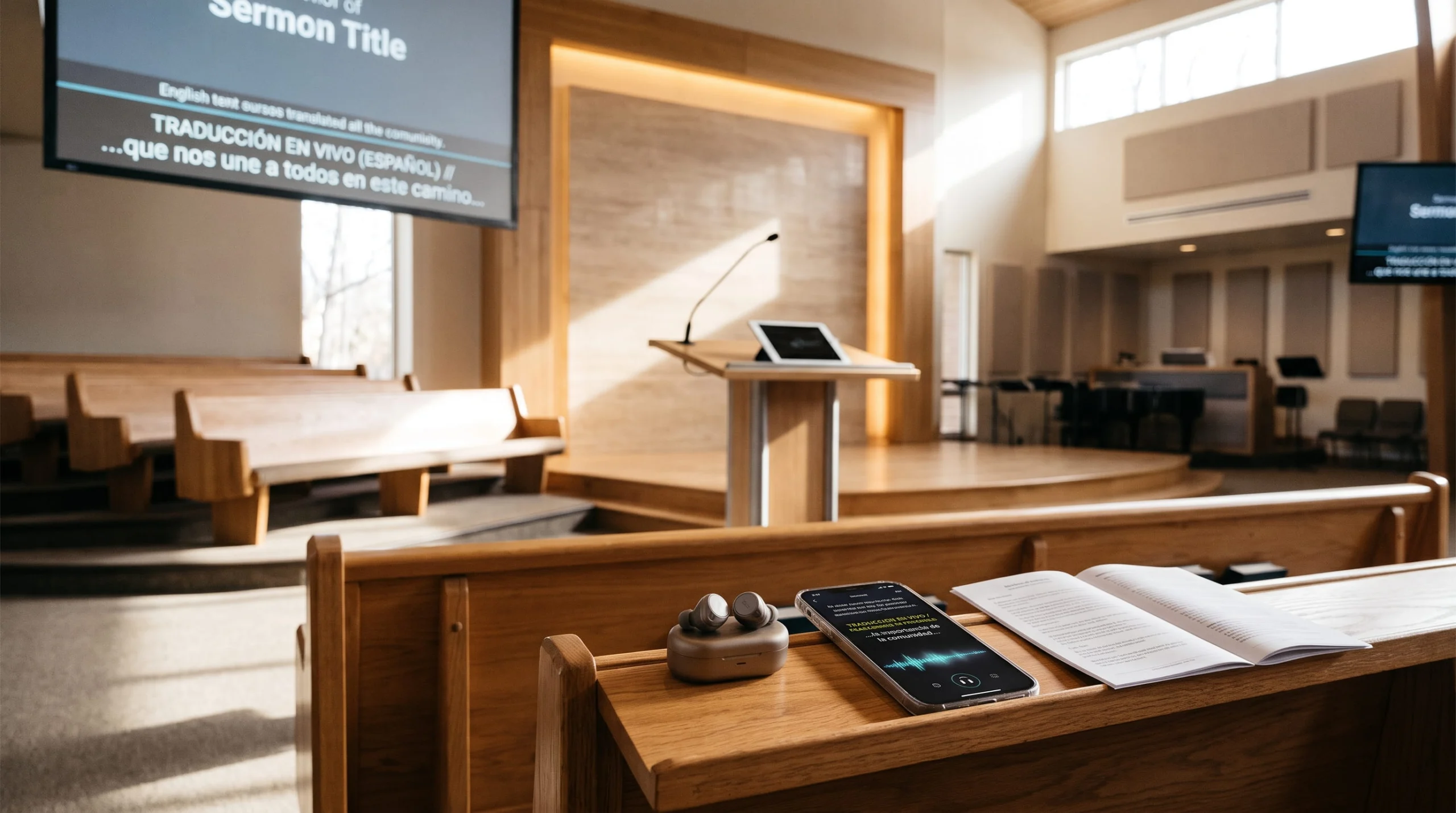
- Translated captions (sometimes called live subtitles) show the translation as text on a screen or on worshippers’ phones. These are usually quicker to set up and easier to test.
- Spoken translation delivers audio in another language through headphones or an app, using AI or a human interpreter. Spoken translation can feel more natural in worship, but it adds questions about delay, accuracy, and cost.
The three types of live language support, defined. People often use these terms interchangeably, but they are different solutions:
- Live captions: text of what the speaker says, in the same language as the speaker.
- Translated captions (live subtitles): text of what the speaker says, in a different language.
- Spoken translation: audio of what the speaker says, in a different language.
Most of the houses of worship we spoke with wanted the third option, not text on a screen in either language.
What leaders at houses of worship are asking about live translation
Across those eight calls, the leaders and staff looking to offer translation kept coming back to the same five questions:
- Can worshippers hear the translation in their own language? Most were not asking for captions or subtitles. They wanted parishioners and other worshippers to listen along in real time.
- Is the translation done by AI or by a human interpreter? Teams wanted to know who, or what, is translating, and how that affects accuracy and trust.
- How far behind the speaker is the translation? With spoken translation, even a few seconds of lag can make a sermon hard to follow. It was a deal-breaker on at least one call.
- Which languages are supported, including less common ones? Requests ranged from Spanish to Russian, Ukrainian, and Malayalam.
- Is there an option that fits one service a week on a modest budget? Several teams hold a single weekly service and were wary of options built for large events and big budgets.
For many congregations, reading along, in either same-language captions or translated subtitles, did not meet the need. Delay mattered more than we expected, and the pricing question was less “what does it cost?” than “does this fit how a small team buys?”
Live translation options for churches & other religious institutions: Translated captions vs. spoken translation
| Option | How it works | Best for | Watch for |
|---|---|---|---|
| Translated captions on screens | Translated text appears on a screen in the room | Congregations that can read comfortably and share a space | Reading while following the service, screen placement and visibility |
| Translated captions on phones | Worshippers scan a QR code and read on their own smartphones | Members who prefer their own language and screen size | Phone use during worship, signal strength, font size |
| Spoken translation with AI | Audio in another language plays through headphones, earbuds, or a translation app | Larger languages, informal settings, smaller budgets | Delay, accuracy with religious terms, language coverage |
| Human interpreter, in person or remote | A person interprets aloud as the speaker talks | Sensitive or high-stakes services, nuanced language | Availability, scheduling, cost, interpreter fatigue |
One church in Colorado, featured in Religion News Service reporting, lets Spanish-speaking worshippers listen along in real time: they enter a code on their phones and hear the translation through headphones. The same story notes that experts have raised concerns about accuracy, so the church asked bilingual members to test the translation quality themselves. Whichever option you choose, borrow that step: your own bilingual members are the best judges of whether the translation sounds right.
AI translation vs. human interpreters for church services
There is no single right answer, and many religious organizations end up using a mix.
AI translation software is fast, scales to many languages, and is often a cost effective option for routine services and events. Its limits show up with proper names, scripture, and liturgical language, so check how it handles your terms before you rely on it.
Human interpreters bring judgment and nuance, which matters for sensitive sermons, funerals, or services where tone carries meaning. They also take scheduling and budget.
A hybrid approach combines both. For example, you might use AI translation for your regular weekly services and bring in a human interpreter for major holidays or other special services.
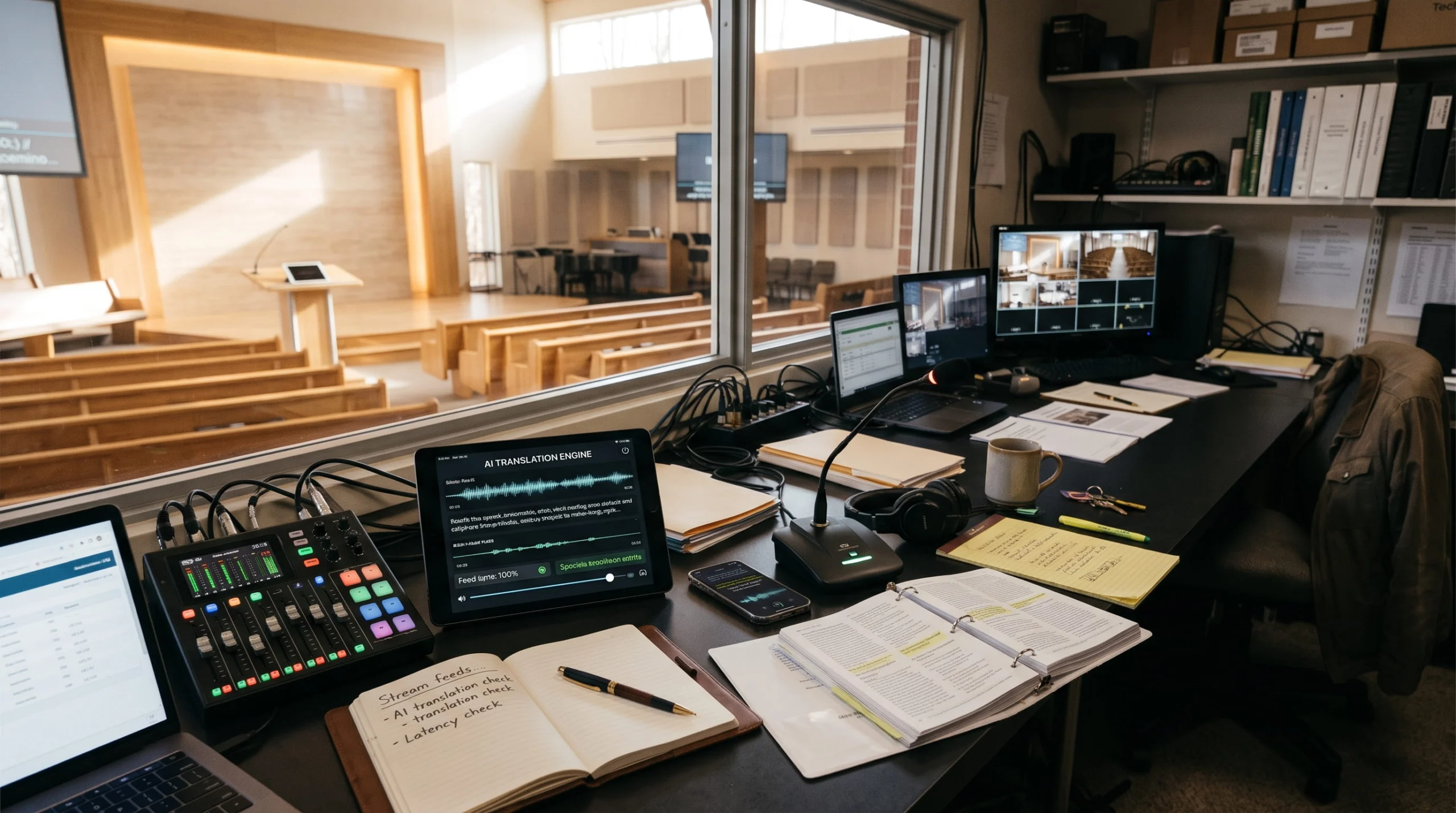
How to choose a church translation system: A checklist for all houses of worship
Run through this list with your leadership team and your tech volunteers.
- Languages and dialects. List the different languages your congregation actually needs, including regional variants, and ask any provider to confirm each one.
- Delay. Ask for a live demo, not a description. Try it with a real speaker.
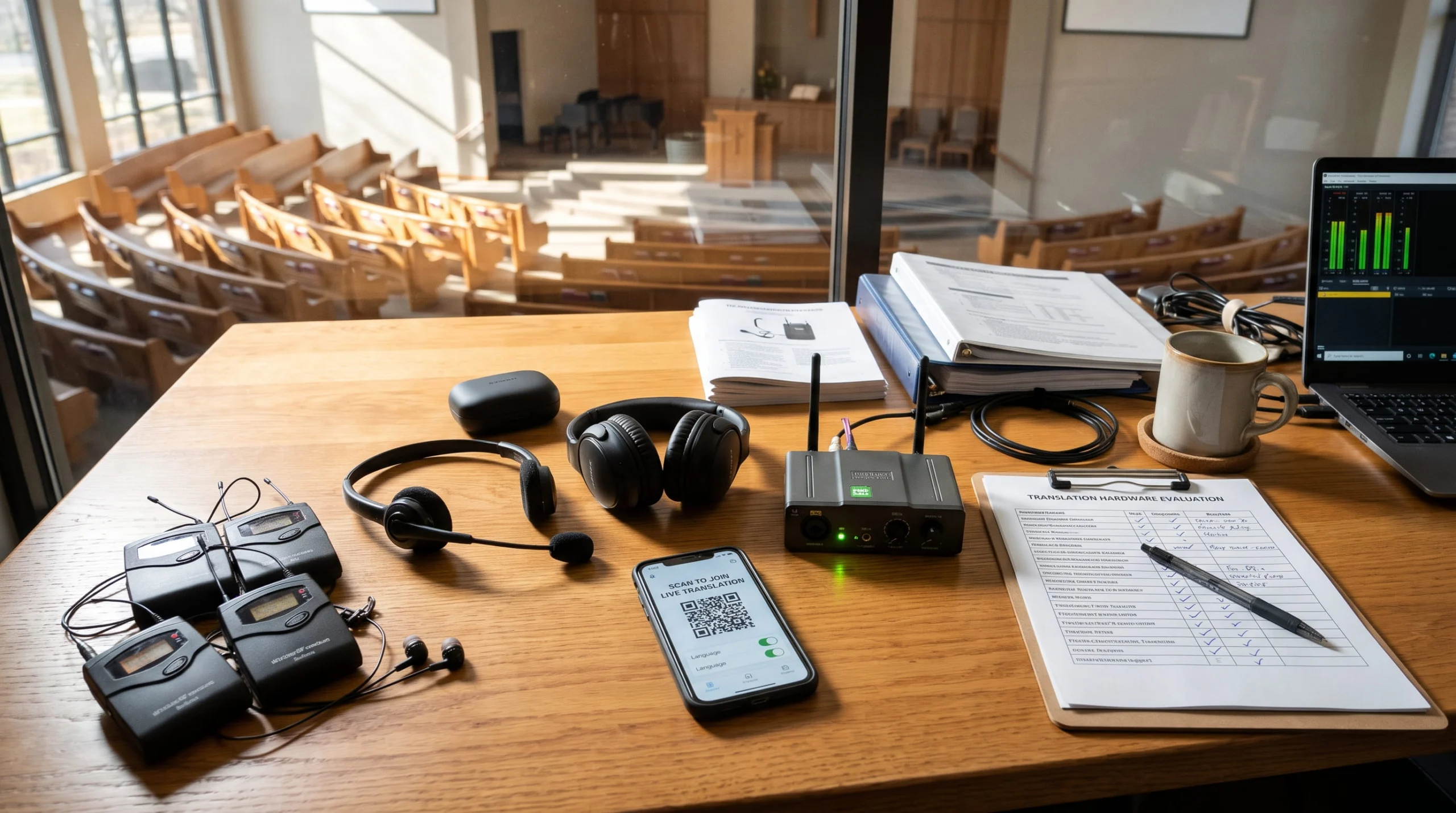
- Equipment. Do you need translation devices for churches, such as headset receivers, or will worshippers use their own smartphones? Phones need no extra equipment but depend on signal, while dedicated devices give you more control but add setup and upkeep.
- Your online congregation. If you stream services, confirm that captions or translation can reach your stream as well as the room.
- Terms and names. Scripture, liturgy, and names of people and places are where AI stumbles, and a guest minister may bring new ones each week. Ask whether you can share a glossary ahead of time.
- Budget and buying model. One weekly service looks different from a conference. Compare pay-as-you-go with a plan built around a set budget, and see our breakdown of committed hours versus usage-based contracts.
- Who runs it during Sunday worship services, or on Friday night or Saturday. The best setup is one a volunteer can start without calling for help.
Live translation for synagogues, temples, mosques, and other houses of worship
Most of what we hear comes from church services and church communities, but the same needs show up across faiths. Synagogues, temples, mosques, and other religious institutions often serve multilingual communities, and each brings its own vocabulary: Hebrew and Aramaic, Arabic, Sanskrit, Greek, and many others. Services may include chanting, recitation, or singing, which can be harder for AI to follow than the spoken word.
A few things to keep in mind:
- Different formats need different plans. A weekly service, a holiday gathering, a class, and a funeral each have different needs.
- Sacred and liturgical language needs testing. Run a sample of your actual liturgy, and ask members who speak the target languages to review it.
Verbit’s accessibility solutions for houses of worship are built for churches, synagogues, temples, and other faith communities.
Do houses of worship have to provide captions or translation?
For most religious organizations, this is about welcome, not legal obligation. Religious entities are generally exempt from ADA Title III, as the ADA National Network explains, though other rules can apply depending on what an organization runs and whether it receives federal funding. If you run a school, daycare, or other program, check what applies with counsel.
Whatever the legal picture, people who are deaf or hard of hearing, newcomers, visitors, and members who speak another language all want to take part in worship, and accessibility often decides whether they stay and feel a continuing sense of belonging.
How Verbit's live captioning and translation help houses of worship
When a house of worship reaches out, we start with what your community needs: which languages, and whether people want to read or listen. Then we recommend the best fit and tell you plainly where our current options fall short.
Live captioning in the room and on phones. Verbit’s live captioning shows on in-venue screens or on attendees’ phones, so worshippers can follow along wherever they sit. Parkland Chapel, a church in Farmington, Missouri, started using Verbit’s captioning for members with hearing loss. Captions now run on a screen beside the stage, with a transcript available on personal devices, and others in the congregation found them helpful too, including when a visiting missionary with a strong accent spoke. Learn more about how Parkland Chapel is working with Verbit.
Translating captions for live services. Verbit offers live translation through AI and human translation options, with captions shown as text on screens or phones. It suits congregations that are comfortable reading along, and it covers dozens of languages. Availability varies by language, so ask us about yours.
Identifying names, terms, and religious language accurately. You can share prep materials such as names and terms ahead of time. One church we work with saw its captions handle Greek and Hebrew terms well.
Supporting live streaming and existing setups. Verbit supports streaming protocols including RTMP, HLS, and SRT, and one church integrated captions into its existing live streaming software.
Making sermon transcripts and recordings actionable. After the service, searchable transcripts help members who missed it. Read more about how sermon transcription benefits churchgoers. Audio description is available for recordings too.
Delivering human customer support, so you don’t have to chase. For a small team, follow-through matters. At Parkland Chapel, staff flag an issue with a quick message in the Verbit platform, and it is resolved or passed to their Verbit account team member seamlessly.
Offering flexible pricing. Verbit builds a custom plan for each religious institution around its budget.
If you’re interesting in exploring spoken translation, subtitles, captions or any other service we provide, book a demo with our team today.
How to start live translation at your house of worship: A simple pilot plan
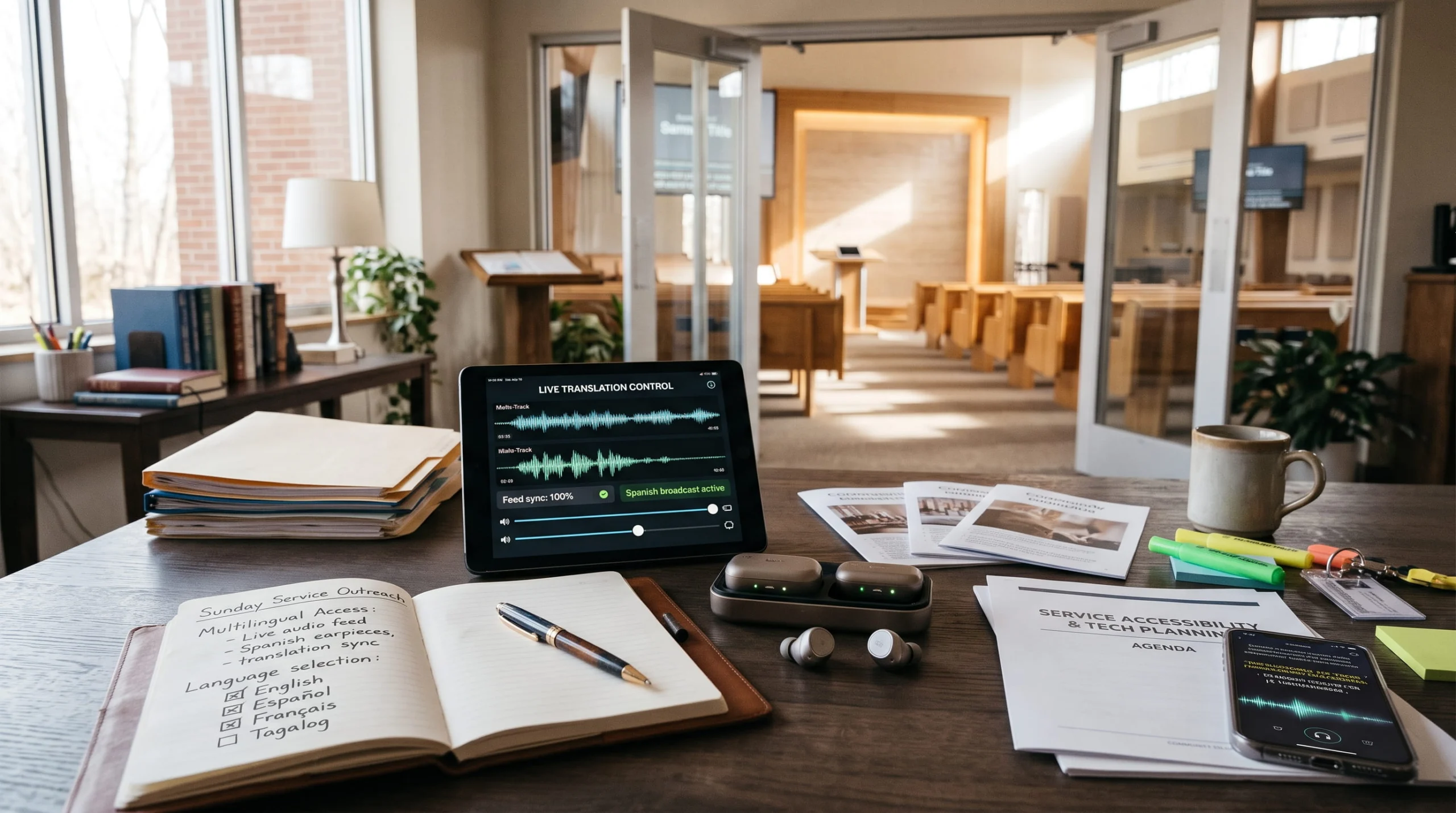
- Pick one service to translate live. Start small, such as one weekly service or one event.
- Select your languages. List the two or three languages your congregation needs most.
- Recruit bilingual speakers from your congregation to confirm the results are accurate. Ask them to follow along and flag anything that sounds wrong.
- Choose how worshippers will receive the translation. Decide between translated captions on screens or phones and spoken translation through headphones.
- Review the feedback, then add more services or languages. Fix what your testers flagged, then expand once the first service works well.
For a broader plan covering your facility, technology, and culture, see our accessibility checklist for houses of worship.
Want to talk through your services and your community’s languages? Connect with Verbit’s team to find the right fit.
FAQs on live translation for houses of worship
How do you translate a church service in real time?
There are two main ways: translated captions (live subtitles) shown as text on a screen or on worshippers’ phones, and spoken translation delivered as audio through headphones or an app, using AI or a human interpreter.
What should you know before adding live translation for synagogues, temples, and mosques?
The same two options apply. Plan for the vocabulary your community uses, such as Hebrew, Arabic, or Sanskrit terms, and expect chanting or recitation to be harder for AI than regular speech. Test with your actual liturgy before you commit.
Are translated captions or subtitles enough for non-English speakers in a congregation?
It depends on the congregation. Many people are comfortable reading translated captions, especially on their own phones, while others strongly prefer to listen. Ask members what they would use, and pilot with a small group.
Is there a delay between the speaker and the live translation during a worship service?
Yes, usually a short one. It depends on the method and the language, and spoken translation generally lags more than translated captions. Ask any provider for a live demo with a real speaker before you decide.
Do religious organizations have to provide captions or translation under the ADA?
Religious organizations are generally exempt from ADA Title III, but other rules can apply depending on what an organization runs and whether it receives federal funding. Check with counsel about your situation.