The US Department of Justice last year finalized new regulations under Title II of the Americans with Disabilities Act (ADA), setting clear and enforceable standards for how public schools and educational institutions must make their digital content accessible to individuals with disabilities.
The mandate now explicitly requires that website, mobile app, learning platform, video and other digital service content provided by state and local governments — including public schools, community colleges and universities — be fully accessible to individuals with disabilities.
While the thought of making every piece of digital content accessible might seem daunting (new Title II enforcement begins in 2026, with varying deadlines based on populations served), AI-powered tools and a helpful subscription launched by Verbit, are helping schools bridge the gap.
These smart technologies are making it faster, easier and more cost-effective to meet the ADA’s evolving digital standards while ensuring every student can engage meaningfully with online learning.
A new solution to meet ADA Title II
Explore Campus Complete, a new subscription model, designed to help universities meet upcoming Title II requirements.

What ADA Title II means for education
The new Title II rules clarify that digital services, from online course materials and administrative portals to streamed lectures and virtual classrooms, must be “readily accessible to and usable by individuals with disabilities.” This includes:
- Captions and transcripts for audio and video, offering accurate captions for all live and pre-recorded audio and video content, including lectures, webinars and virtual classes, for students with hearing loss.
- Audio description, providing narration for visual content in videos, supporting students who are blind or with low vision.
- Accessible text and documents, ensuring that pictures, PDFs and other electronic documents can be read by assistive technologies used by individuals with vision loss.
With machine learning, natural language processing and speech recognition improving rapidly, AI-driven tools can now produce high-quality accessibility features at scale. When combined with expert human review, these tools become an even more reliable engine for day-to-day compliance.
Preparing for Title II
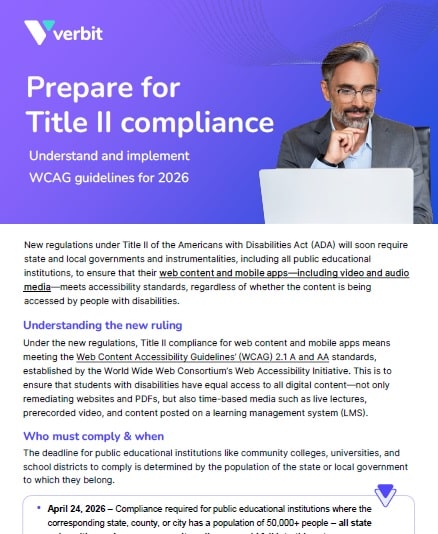
Read our latest whitepaper that offers a roadmap to ADA Title II compliance.

Key ADA Title II requirements and how Verbit can help
Captioning and transcription of video and audio content
One of the cornerstone requirements of Title II for education is providing captions for all audio and video content. All public-facing and instructional videos must include accurate captions while audio content must have transcripts.
Verbit provides highly accurate captions for both live and pre-recorded video. Our AI-powered Captivate™ ASR platform generates captions and transcripts with speed and accuracy, enabling schools to confidently caption lectures, seminars, guest talks and on-demand learning content across platforms.
Audio description for visual media
When videos rely heavily on visuals to convey information, schools must offer audio descriptions for students with visual low-vision users.
Verbit’s professional audio description solution uses AI-generated scripts and human and synthetic voiceovers to ensure that important visual information is clearly conveyed. These descriptions can be synced with existing content and integrated with media platforms to provide full access for students.
Accessible digital materials
PDFs, Word documents, presentations and online forms must be perceivable and usable by individuals with disabilities, including screen reader users.
While Verbit focuses primarily on audio and video content, our accessibility services complement broader efforts to ensure that all digital learning materials are compliant. Captions and transcripts generated by Verbit can be embedded into Learning Management System (LMS) platforms, classroom resources and take-home materials, providing accessible alternatives for students.


Supporting schools beyond technology
Whether you’re captioning a single event or catching up on years of archived media, Verbit helps public institutions build sustainable, scalable accessibility strategies.
Our Campus Complete subscription plan for schools and universities offers greater access to unlimited, accurate captions at a fixed annual rate, helping campuses manage costs and scale services. Academic Complete features AI-powered and human-edited captions, integrations with popular LMS platforms and the ability to modify text, speaker labels and non-speech elements.
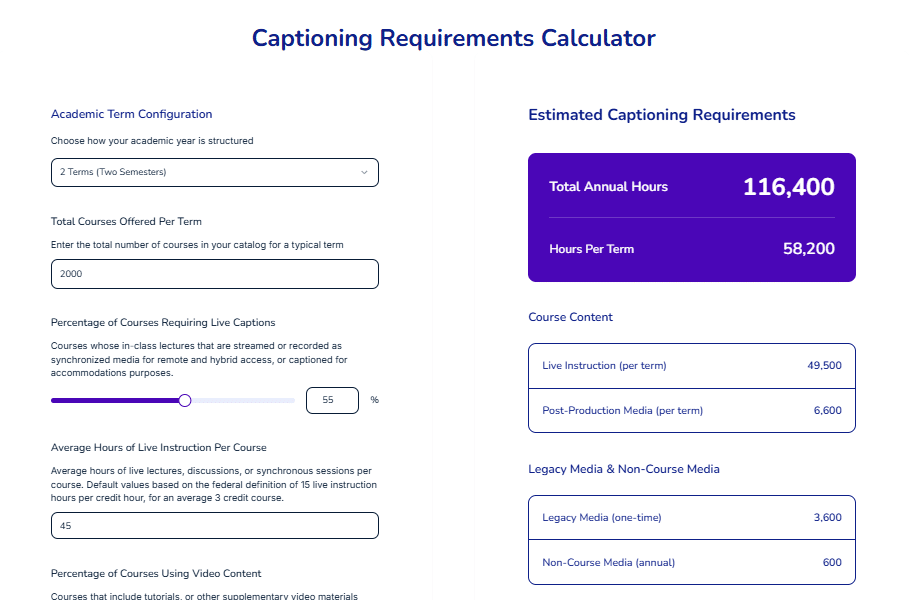
ADA Title II calculator to help higher-ed institutions prepare
As of April 24, 2026, most public higher-ed institutions must make their digital media content accessible. Use this calculator to estimate your scope of work for compliance.

We also offer a wide range of easy-to-use integrations with the most popular LMS and video platforms (Canvas, Zoom, Kaltura and Blackboard, just to name a few), streamlining the process of adding captions, transcripts and audio descriptions without disrupting existing educational workflows.
Making compliance achievable
ADA Title II compliance is about more than checking boxes — it’s about giving every student an equal opportunity to succeed. By leveraging AI-powered tools like Verbit, schools can move beyond the fear of falling behind and begin building a digital ecosystem where accessibility is the default, not an afterthought.
Turning compliance into action
Watch our on-demand webinar for practical strategies to meet ADA Title II requirements and plan accessible video workflows.